Ask most scuba divers about coral conservation and they will probably express genuine concern for the ocean. Yet a gap can exist between what divers believe they are doing underwater and what their fins, hands or equipment are actually doing.
A 2026 study published in Conservation Letters found that frequent reef contact was not limited to obviously careless tourists. Much of the observed damage was accidental, unnoticed and caused by people who considered themselves environmentally responsible.
The lesson is not that people should stop diving. Reef tourism can support coastal livelihoods, conservation funding and public appreciation of marine life. The more useful lesson is that good intentions are not enough unless they are matched by buoyancy control, spatial awareness and active guidance.
What Researchers Saw Underwater
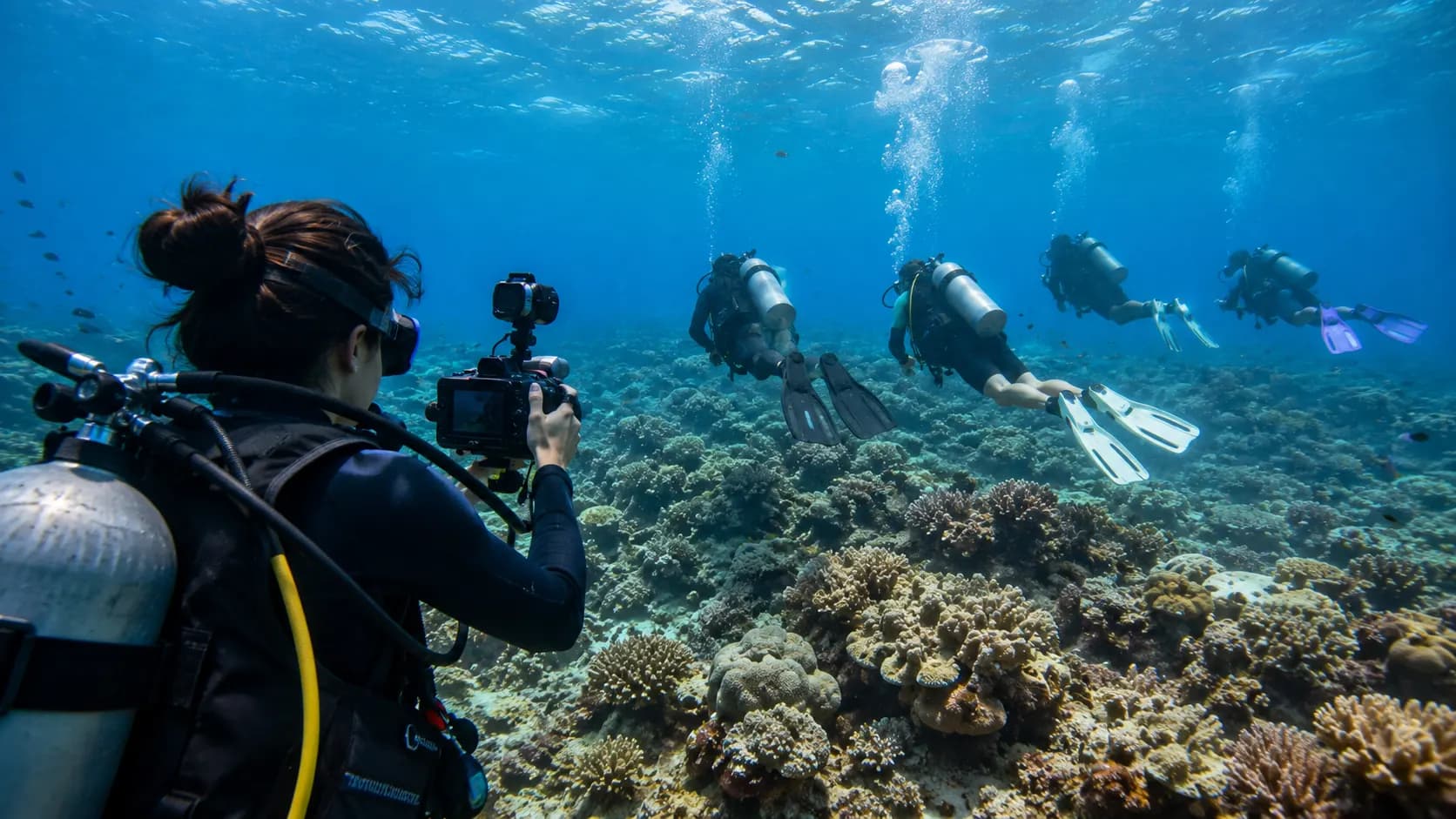
Researchers used video-assisted observations and post-dive questionnaires to study 732 recreational divers across tourism destinations in Indonesia and the Philippines. Detailed observations of 411 divers produced records of 4,981 physical contacts with the reef during more than 300 hours underwater.
Divers averaged 0.26 reef contacts per minute, or approximately one contact every four minutes. They also spent nearly two seconds of every minute in direct contact with the reef.
Around 41% of contacts caused visible damage. This included direct breakage and disturbed sediment settling onto living reef organisms. The results do not mean every touch permanently kills an entire coral colony, but repeated breakage, abrasion and sediment exposure create an avoidable local pressure.
Divers Underestimated How Often They Touched the Reef
The most revealing finding was not only the number of contacts. It was the difference between confidence and observed behaviour.
Roughly three-quarters of participants rated their own ability as above average. Yet divers underestimated their reef contacts by about 4.9 times. More than 80% of damaging contacts were accidental, unnoticed or both.
This creates a difficult conservation problem. A person cannot correct an action they do not realise is happening. Someone may finish a dive believing they maintained perfect clearance while their fin tips, pressure gauge or camera repeatedly passed through the reef behind them.
How Divers Accidentally Damage Coral
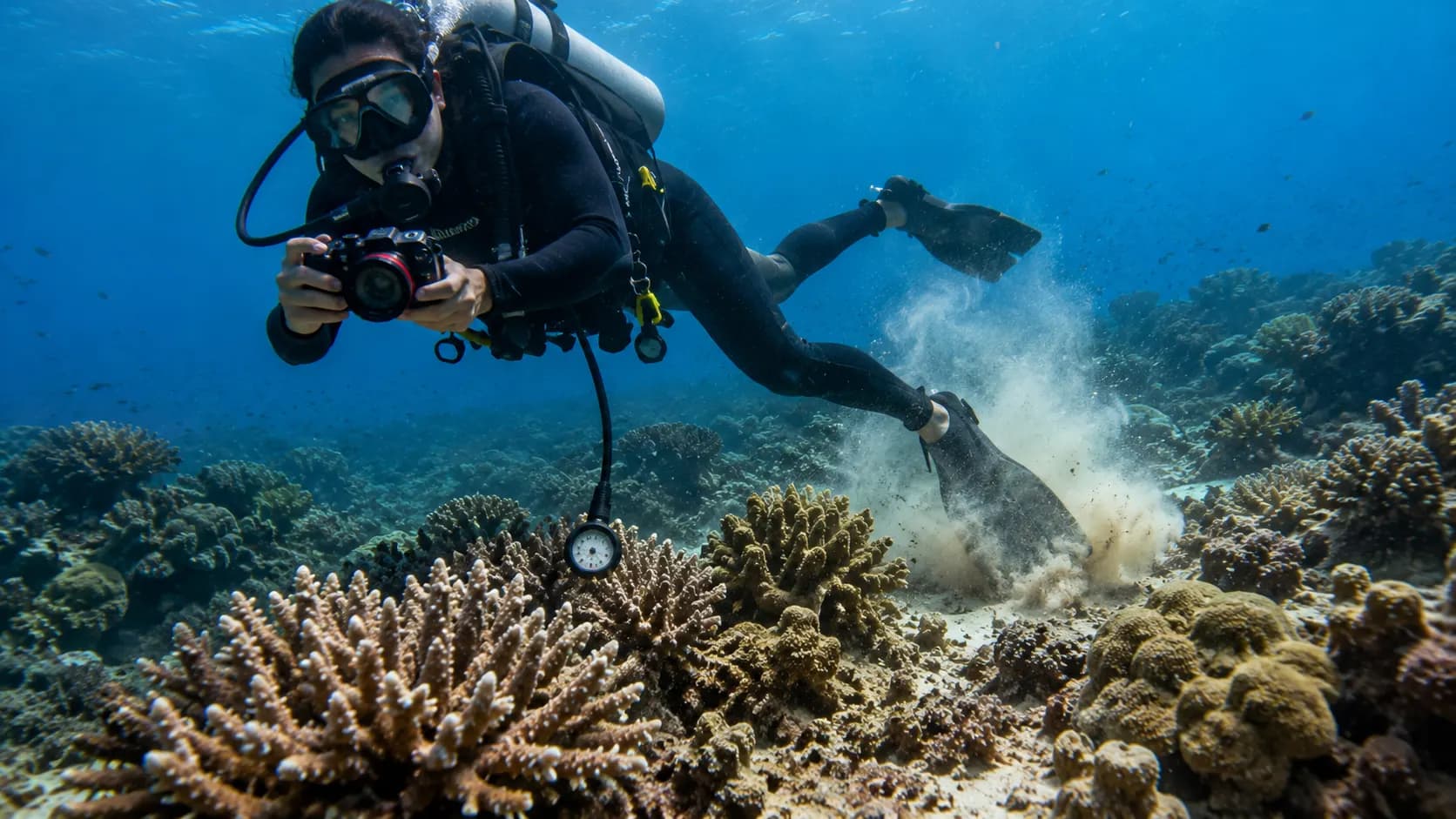
Fins and Poor Trim
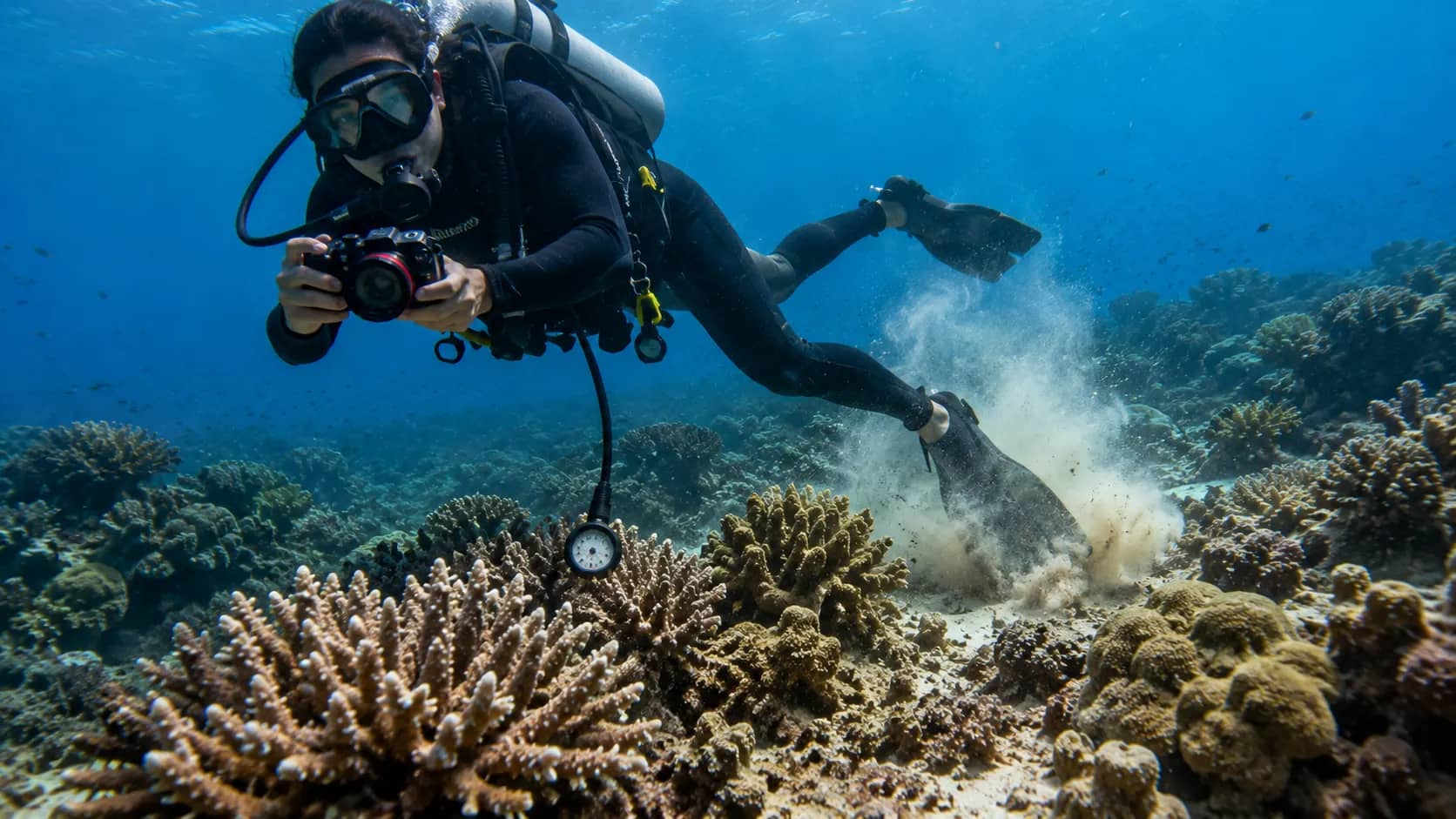
A diver may watch their hands and torso while forgetting how far their fins extend behind them. Flutter kicks used close to the seabed can strike branching coral or push water downward, disturbing loose sediment.
Hands, Knees and Unsecured Equipment

Keep reading
How Trees Cool Cities and Protect Daily Life
A hand used for balance, a knee lowered during photography or a dangling gauge can abrade living tissue and break fragile structures. Hoses, alternate regulators, torches and other accessories should be clipped or tucked close to the body.
Sediment Settling on Living Coral
Fin kicks and poor buoyancy can lift sand and fine sediment from the seabed. When that material settles onto coral, it can cover living polyps, interfere with feeding and light exposure, reduce growth and add physiological stress.
Cameras and Wildlife Distraction
The study identified accessory use, particularly cameras, as an important correlate of reef contact. A diver concentrating on a screen may lose awareness of fin position, depth or nearby coral.
Wildlife sightings amplified the problem. During encounters with marine animals, intentional contacts increased by 220%, unintentional contacts by 85% and damaging contacts by 106%. The excitement of approaching or repositioning for a better view can pull attention away from the reef.
Why Experience Does Not Remove Every Risk
A high certification level or a long logbook does not guarantee precise control on every dive. Skills can fade after a break, unfamiliar equipment can change a diver's balance, and currents or task loading can reduce awareness.
The study found that confidence was not a reliable measure of competence, with the greatest overconfidence appearing among the least capable divers. This does not mean experienced divers are always worse. It means that self-assessment alone should not replace a buoyancy check, observation by a guide or corrective feedback.
How Divers Can Reduce Their Impact: Complete a weight and buoyancy check away from sensitive coral, especially after a long break or when using unfamiliar equipment.
Maintain neutral buoyancy and a horizontal trim with fins raised away from the seabed.
Use controlled finning techniques, such as a horizontal frog kick, when appropriate for the conditions and your training.
Keep enough clearance for your entire body, fins and equipment, including when turning or responding to a current.
Clip or tuck in gauges, hoses, torches and cameras before entering the water.
Pause and stabilise at a safe distance before taking photographs or watching wildlife.
Do not touch, stand on, hold or use coral as a handhold.
If control deteriorates, move into open water, signal the guide and end the dive if necessary rather than risking repeated contact.
Green Fins guidance also encourages no-touch policies, careful management of underwater photographers and no-glove policies where gloves are not required for safety. Gloves can create a false sense of protection and make touching wildlife or reef surfaces feel less consequential.
What Dive Operators Can Do
Operators have an important role because divers often copy the behaviour they see around them. The 2026 study found that reef contact more than doubled when other divers nearby were also touching the reef.
Include specific no-touch, fin-position and equipment reminders in every pre-dive briefing.
Check weighting, trim and loose equipment before entering a sensitive site.
Give photographers separate guidance about safe positioning and retreating from the reef.
Correct damaging behaviour underwater rather than waiting until the dive ends.
Explain corrections calmly during the post-dive debrief so the diver can improve.
Use recognised environmental standards such as Green Fins to strengthen operating practices.
Diving Is Not the Greatest Threat to Coral Reefs
This issue needs perspective. NOAA identifies climate change as the greatest global threat to coral reefs. Marine heatwaves drive mass bleaching, while ocean acidification, pollution, sediment runoff, disease and unsustainable fishing create additional pressure.
Recreational diving is a local stressor, not the main cause of global reef decline. That does not make it unimportant. Reducing preventable physical contact can improve conditions at heavily visited sites and help reefs cope with pressures divers cannot solve during a single trip.
Reference notes
Sources and further reading
- Conbio Onlinelibrary Wiley (opens in a new tab)https://conbio.onlinelibrary.wiley.com/doi/10.1111/con4.70055
- Cpree Princeton (opens in a new tab)https://cpree.princeton.edu/news/2026/princeton-and-university-sydney-study-reveals-hidden-impacts-scuba-diving-tourism-coral
- Sydney (opens in a new tab)https://www.sydney.edu.au/news-opinion/news/2026/05/27/hidden-impacts-scuba-diving-tourism-on-coral-reefs-bing-lin.html
- Collaborate Princeton (opens in a new tab)https://collaborate.princeton.edu/en/publications/causes-and-correlates-of-unsustainable-scuba-diving-tourism-on-co/
- Greenfins (opens in a new tab)https://greenfins.net/blog/environmental-dive-briefing/
- Greenfins (opens in a new tab)https://greenfins.net/blog/guiding-guests-towards-the-environmental-best-practice/
- Greenfins (opens in a new tab)https://greenfins.net/topic/managing-photographers/
- NOAA (opens in a new tab)https://oceanservice.noaa.gov/facts/coralreef-climate.html
- NOAA (opens in a new tab)https://www.fisheries.noaa.gov/corals
Our editorial promise
Prepared with clarity and care.
This guide completed our editorial review before publishing. If something needs attention, report a correction or contact the publisher.
About this article
- Published:
- Last updated:
- Author:
- Ceyora Editorial Team
- Review status:
- Editorially reviewed
- Sources:
- 9
- Corrections:
- Report an issue