
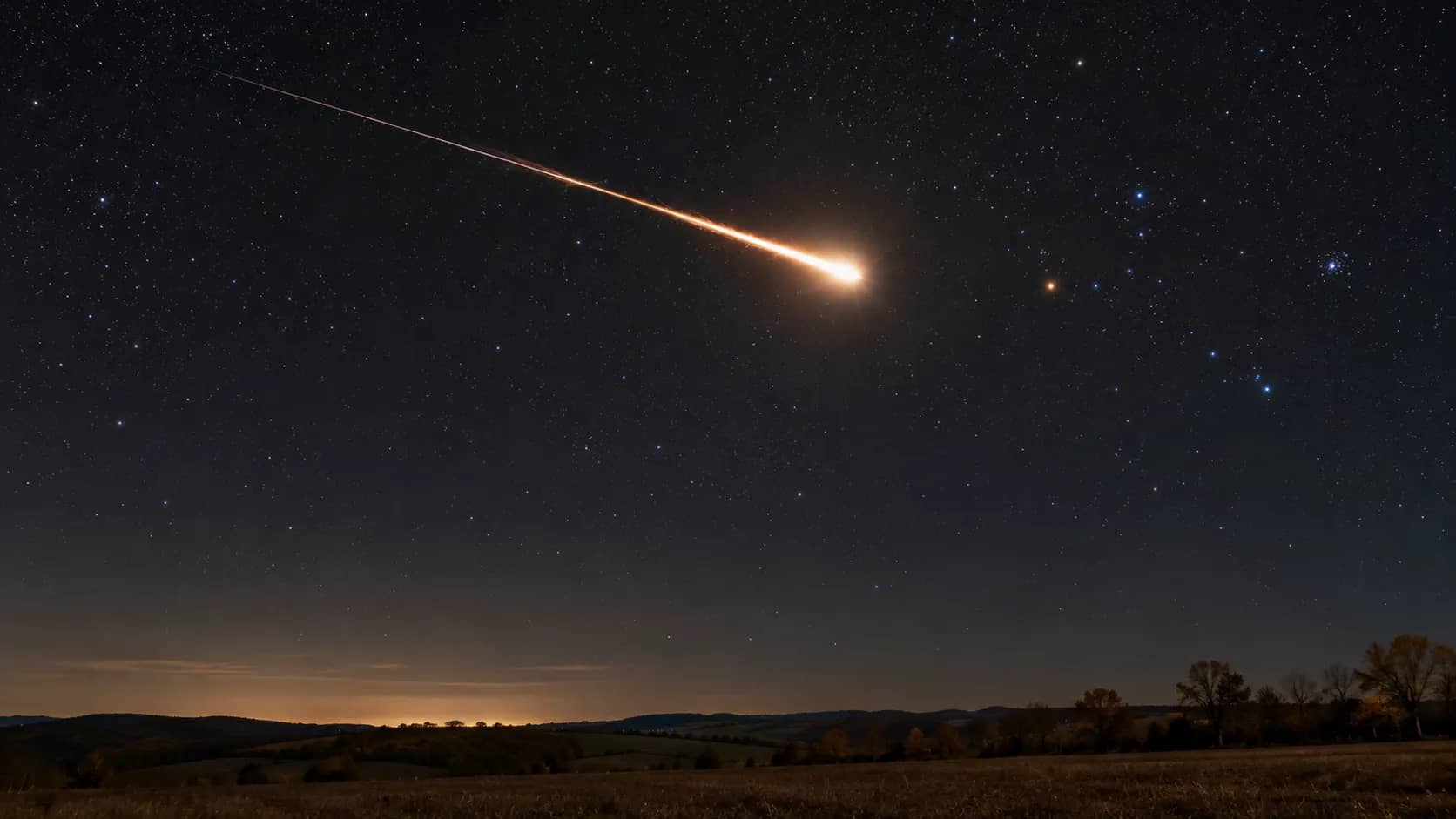
The Taurids are easy to underestimate. On a good night, you may see only a handful of Taurid meteors in an hour. Then one unusually bright meteor can cross a large part of the sky and become the thing you remember from the entire night.
That is what makes the Taurids different from famous high-rate showers such as the Perseids or Geminids. Their reputation comes less from quantity and more from occasional bright fireballs, a long viewing season and two overlapping meteor streams that appear to radiate from the constellation Taurus.
The Taurids Are Really Two Meteor Showers
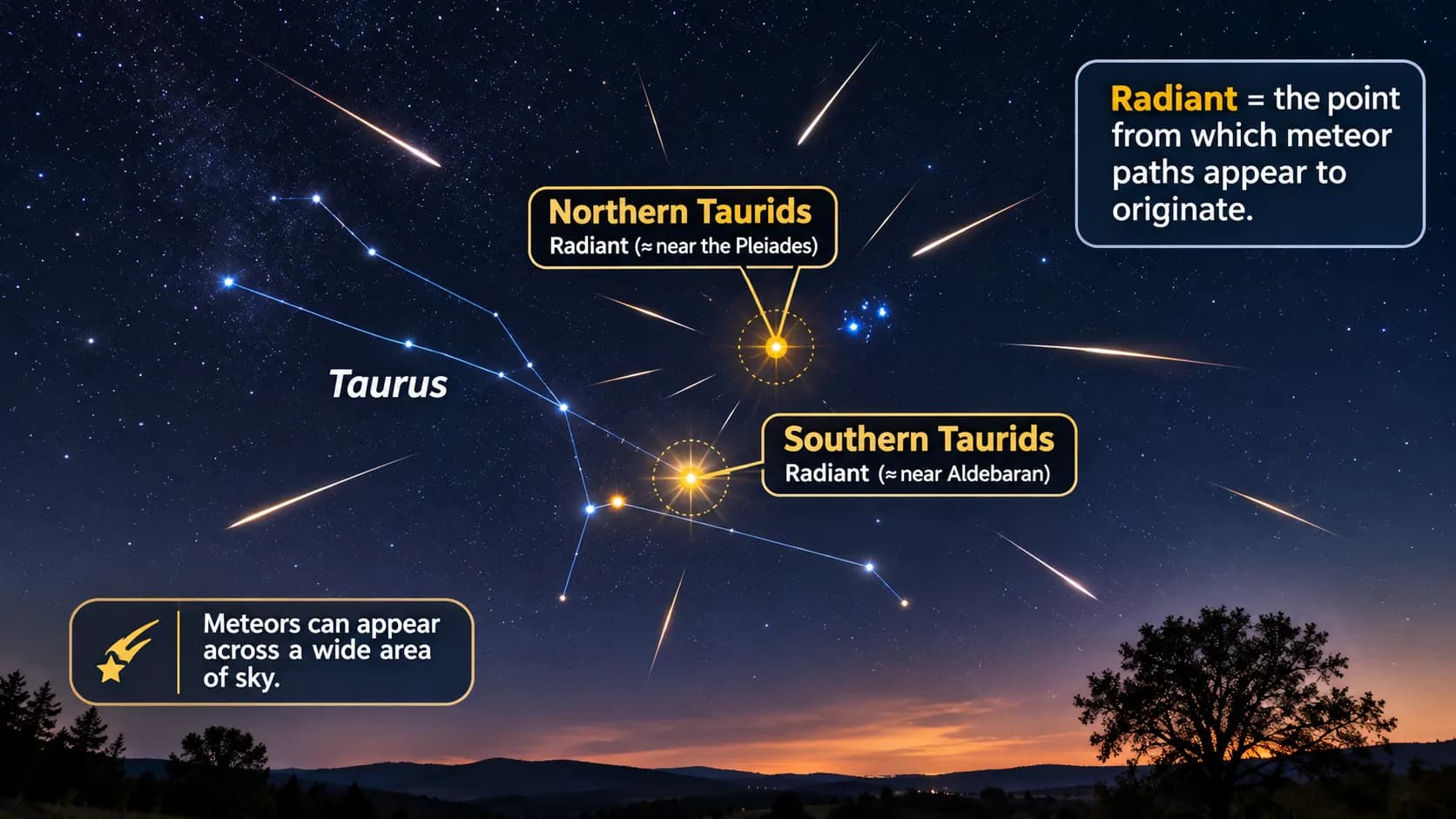
The name Taurids refers to two closely related streams: the Southern Taurids and the Northern Taurids. Their active periods overlap for part of the year, which can make them feel like one long meteor shower.
Both appear to radiate from areas in the constellation Taurus. The radiant is not where the meteors physically begin. It is a perspective effect: if you trace the paths of shower meteors backward across the sky, they appear to converge near the same region.
You do not need to stare at Taurus to see them. Taurid meteors can appear across a wide area of sky, and trails seen farther from the radiant can look longer.
Where Do Taurid Meteors Come From?
Meteor showers happen when Earth travels through streams of small particles distributed along the orbit of a comet or, in some cases, an asteroid. When those particles enter Earth's atmosphere at high speed, they produce the brief streaks of light we call meteors.
NASA associates the Taurid meteor stream with Comet 2P/Encke, a small comet that orbits the Sun roughly once every 3.3 years. NASA's Jet Propulsion Laboratory lists 2P/Encke as the parent body associated with the Southern Taurids and asteroid 2004 TG10 with the Northern Taurids.
These connections are part of a broader structure astronomers call the Taurid complex. Instead of imagining one neat trail directly behind one comet, it is more accurate to picture a widespread family of related debris streams occupying similar paths through the Solar System.
What Happens When a Taurid Particle Reaches Earth?
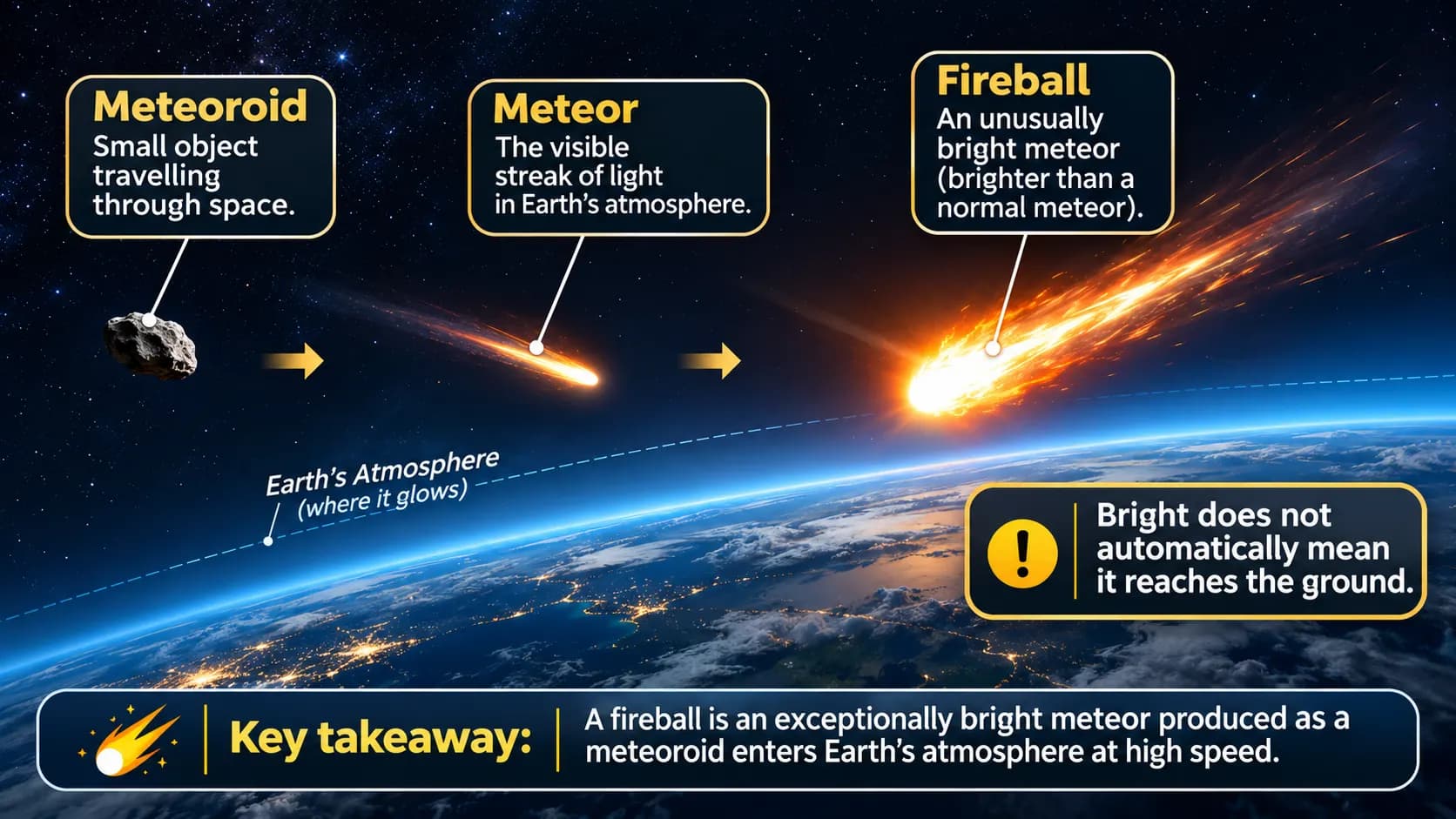
The glowing streak is not a star falling from space. A small solid object in space is called a meteoroid. When it enters the atmosphere and produces visible light, we see a meteor.
The object is travelling at enormous speed. Taurid meteors enter Earth's atmosphere at roughly 29 kilometres per second, or about 65,000 miles per hour. That is relatively slow for a meteor shower, even though it is extremely fast by everyday standards.
As the meteoroid races into denser atmosphere, the air ahead of it is rapidly compressed and heated, while material is stripped from the object. The resulting hot gas and vaporised material create the luminous path visible from the ground.
Why Are the Taurids Known for Fireballs?
NASA defines a fireball as an exceptionally bright meteor, bright enough to stand out far more dramatically than an ordinary shooting star.
Keep reading
Solar Eclipse and Perseid Meteor Shower 2026: August 12 Guide
The Taurid stream contains particles of different sizes, and some larger pieces can produce much brighter atmospheric events. That is why the shower can generate striking fireballs even when its total meteor rate is modest.
A bright fireball does not automatically mean that a dangerous object is reaching the ground. Most meteor-shower particles are small and are destroyed in the atmosphere. NASA notes that no meteorites have been definitively traced to the Taurid shower.
Why the Taurids Can Feel Slower Than Other Meteors
Meteor showers do not all hit Earth's atmosphere at the same speed. The Taurids enter at about 29 kilometres per second, while some other major showers arrive considerably faster.
That difference can make Taurid meteors look more deliberate as they move across the sky. A bright Taurid fireball may remain visible long enough for an observer to notice its path rather than seeing only a very fast flash.
Slow-moving does not mean slow in the ordinary sense. At tens of kilometres per second, a Taurid meteoroid still travels many times faster than any aircraft.
When Can You See the Taurids?
The Taurids are primarily an autumn meteor display. The Southern branch begins earlier, while the Northern branch extends later into the season. Their overlapping activity is particularly noticeable around late October and November.
Unlike showers with a sharp burst lasting only a night or two, Taurid activity is spread across a long period. Their peak is broad, which means observers do not have to treat one exact hour as their only opportunity.
Rates are low. The American Meteor Society typically gives each branch a zenithal hourly rate of around five meteors under ideal conditions near maximum. Real-world observers may see fewer because of light pollution, clouds, obstructions and the position of the radiant.
How to Watch Without Any Special Equipment
You do not need a telescope or binoculars. In fact, magnification limits your field of view and makes it easier to miss meteors elsewhere in the sky.
Choose a dark, safe place with as much open sky as possible. Move away from direct lights and give your eyes time to adjust to the darkness. Then watch a broad area of sky rather than concentrating on one star or the exact radiant.
Around midnight is often a useful viewing period because Taurus is higher in the sky. Local weather and moonlight can matter more than being outside at an exact predicted peak minute, especially because the Taurids have such a broad activity period.
The Taurids Reward Patience More Than High Expectations
Someone expecting a meteor every few seconds will probably be disappointed. That is not what the Taurids usually offer.
Their appeal is different: a dark autumn sky, long gaps between meteors and the possibility that one slow, brilliant fireball suddenly travels across a large part of your view.
That combination is why the Taurids continue to attract skywatchers despite their low numbers. Sometimes a meteor shower does not need hundreds of meteors to be memorable. One particularly bright one can be enough.
Reference notes
Sources and further reading
- NASA (opens in a new tab)https://science.nasa.gov/solar-system/meteors-meteorites/meteor-showers/
- NASA (opens in a new tab)https://science.nasa.gov/solar-system/meteors-meteorites/facts/
- NASA (opens in a new tab)https://science.nasa.gov/solar-system/comets/2p-encke/
Show all 7 sources
- NASA (opens in a new tab)https://ssd.jpl.nasa.gov/sb/meteor_streams.html
- Amsmeteors (opens in a new tab)https://www.amsmeteors.org/meteor-showers/major-meteor-showers/
- Amsmeteors (opens in a new tab)https://www.amsmeteors.org/meteor-showers/meteor-shower-calendar/
- Earthsky (opens in a new tab)https://earthsky.org/astronomy-essentials/taurid-meteors-all-you-need-to-know/
Our editorial promise
Prepared with clarity and care.
This guide completed our editorial review before publishing. If something needs attention, report a correction or contact the publisher.
About this article
- Published:
- Last updated:
- Author:
- Ceyora Insights
- Review status:
- Editorially reviewed
- Sources:
- 7
- Corrections:
- Report an issue