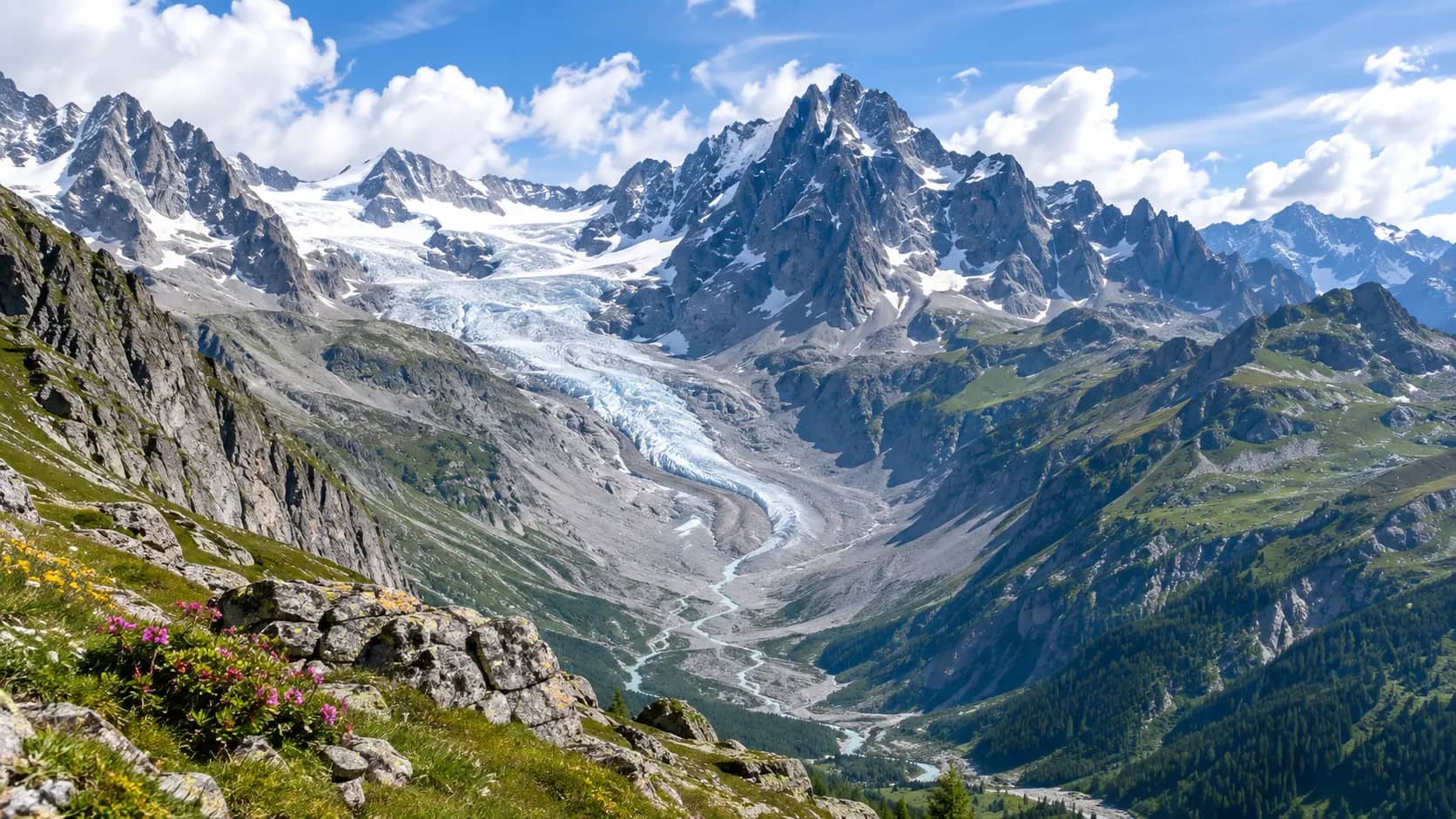
Stand beneath an Alpine peak and the landscape can seem almost impossibly permanent. Rock towers thousands of metres above deep valleys. Ridges disappear into the distance. Some of the same mountains have shaped human routes, borders and settlements for centuries.
Geologically, though, the Alps are not a finished monument. Their rocks were folded, buried, stacked and lifted during a mountain-building story that unfolded over tens of millions of years. Ice later carved many of the valleys people recognise today. Parts of the range are still moving upward, while erosion works in the opposite direction and glaciers are shrinking on a far faster timescale.
The Alps Are Much Bigger Than Switzerland
Switzerland may provide some of the world's most familiar Alpine imagery, but the mountain system crosses eight countries: Austria, France, Germany, Italy, Liechtenstein, Monaco, Slovenia and Switzerland.
The Alpine Convention defines a region covering about 190,700 square kilometres and stretching roughly 1,200 kilometres across Europe. Around 14.8 million people live within that Alpine Convention area, so this is not simply a wilderness of remote summits. It is also a lived-in landscape of towns, farms, roads, railways, valleys and long-established communities.
How Were the Alps Created?
There was no single moment when two continents hit each other and the Alps suddenly appeared. Their geological history involved changing seas, moving continental fragments, subduction, compression and the stacking of enormous sheets of rock over a very long period.
It Began With Ancient Seas
More than 100 million years ago, the geography of Europe looked nothing like today's map. Oceanic areas associated with the Tethys system and a later Penninic Ocean separated continental regions. Sediments accumulated on seafloors and along continental margins, creating some of the material that would eventually become part of the Alps.
Then the Gap Began to Close
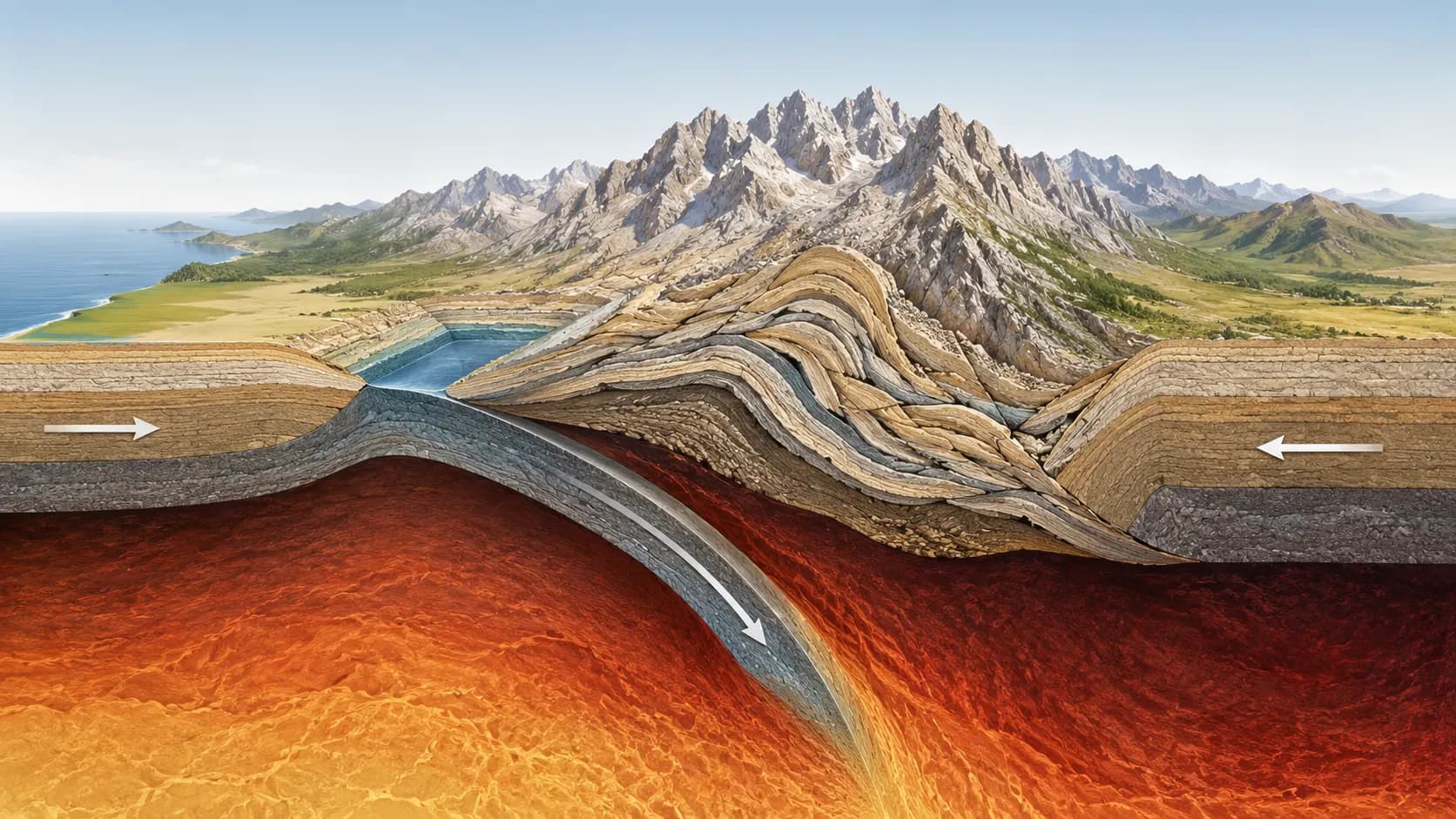
As plate motions changed, oceanic crust was consumed and continental regions were driven together. Rocks were squeezed, faulted, folded and pushed over one another in large sheets known to geologists as nappes.
GeoSphere Austria's reconstruction shows continental collision becoming a dominant part of Alpine mountain building after the Penninic Ocean closed, with major deformation and uplift continuing through the later stages of the process. This is why describing the Alps simply as 'Africa crashing into Europe' captures the broad idea but misses much of the real geology.
Why Are the Alps So High?
Compressing continental crust does not simply crumple its surface. It can also thicken the crust substantially. Thickened continental crust is relatively buoyant compared with the denser mantle beneath it, helping support high terrain.
Uplift exposed rocks that had once been buried much deeper, while erosion continually removed material from above. The impressive peaks we see are therefore not just products of upward movement. They are what remains after uplift and erosion have acted together for millions of years.
Glaciers Helped Create the Alps We Recognise Today
Tectonics built the mountain belt, but ice did much of the later sculpting.
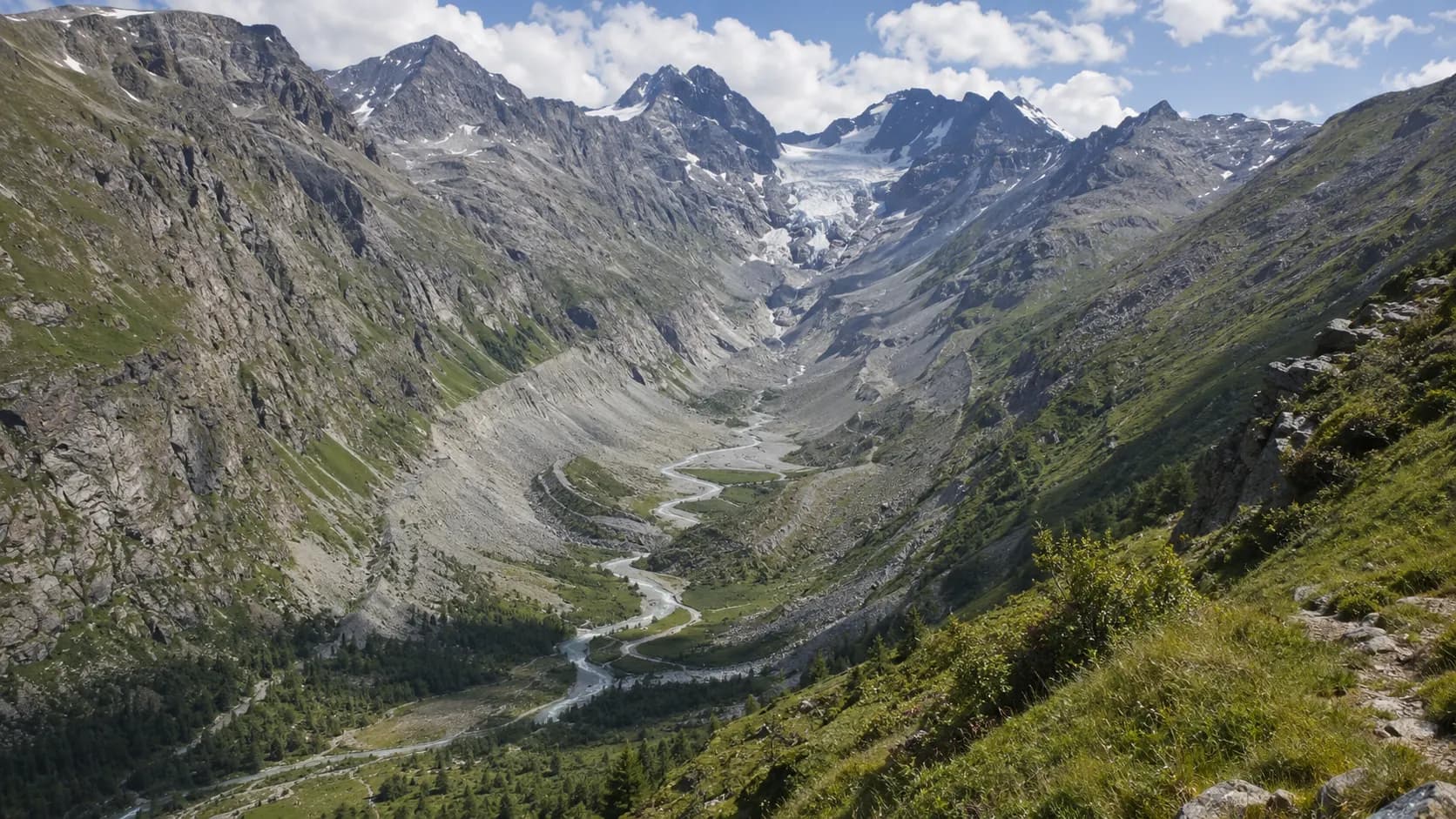
During repeated cold periods, enormous glaciers occupied Alpine valleys and, at times, extended far beyond the mountains. Flowing ice carried rock fragments across the landscape, eroding bedrock and deepening existing valleys.
That process helped create the broad U-shaped valleys associated with glacial landscapes. Lauterbrunnen in Switzerland is a particularly clear example: swisstopo describes its distinctive U-shaped form as the work of an ancient glacier.
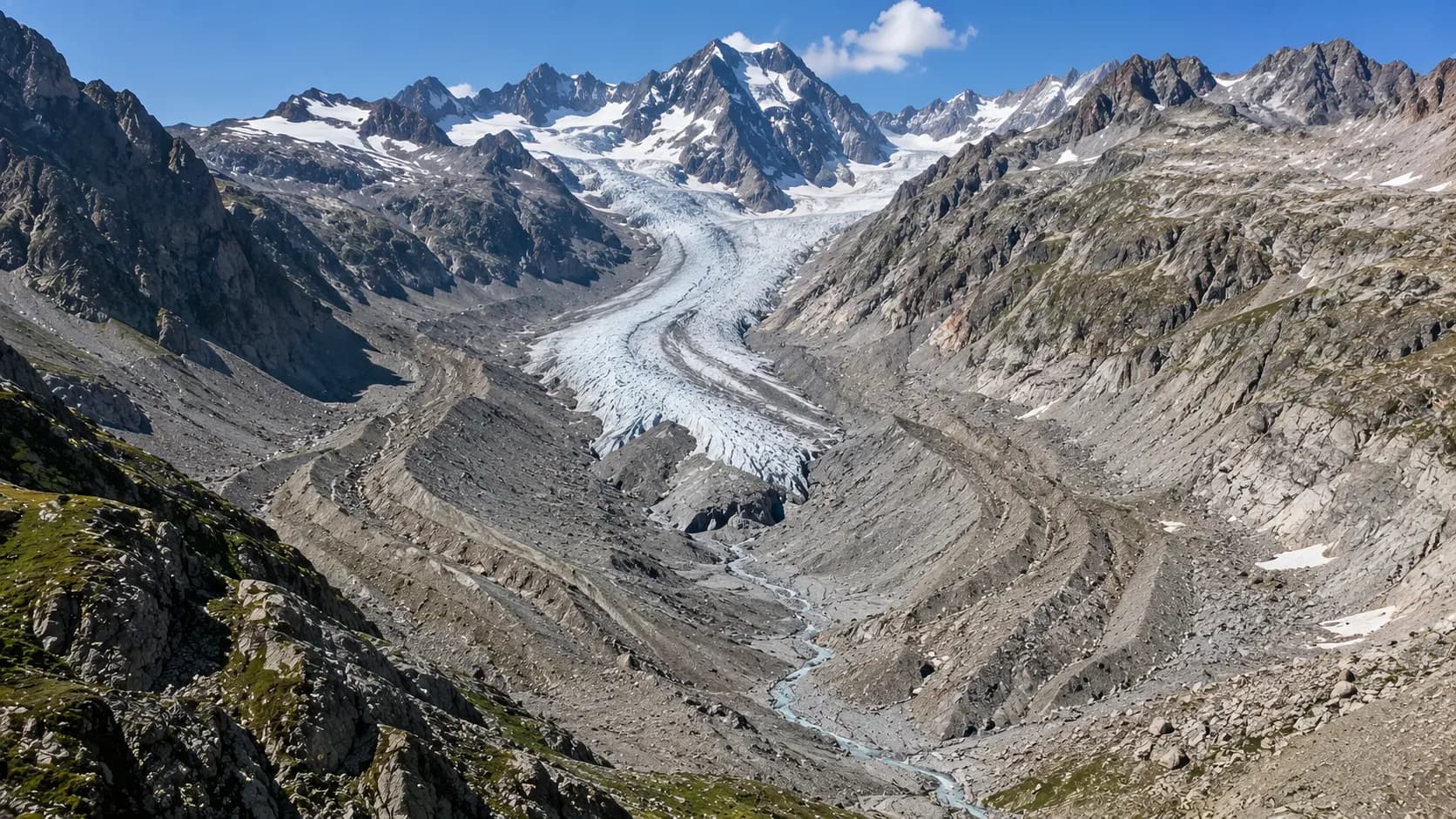
Glaciers also left moraines ridges and deposits of rock transported by ice. When you see one today, you may be looking at a physical marker of where a glacier once reached.
Are the Alps Still Growing?
Parts of the Alps are still experiencing measurable rock uplift, but saying simply that 'the Alps are still growing' hides an important scientific complication.
Keep reading
Why Are Orcas Called Killer Whales and Are They Dangerous?
GPS and levelling measurements have found uplift approaching 2 to 2.5 millimetres per year in parts of the northwestern and central Alps. Other areas rise more slowly.
Scientists do not attribute all of that modern movement to continued continental compression. Reviews of the evidence point to several interacting processes, including the Earth's response to the loss of ancient ice loads, erosion removing mass from the mountains and deeper mantle or tectonic processes.
The western Alps make the puzzle especially clear. Research has measured strong vertical uplift in areas where present-day horizontal convergence is very limited.
A Mountain Can Rise While Being Worn Away
Rock uplift and mountain height are not the same thing.
While sections of crust move upward, rain, rivers, frost, landslides, rockfalls and glaciers remove material. A summit can therefore exist within an uplifting region while erosion is simultaneously lowering the landscape.
That tug-of-war is one reason mountain ranges are better understood as active systems rather than piles of rock that were built once and then left unchanged.
The Fastest Change Is Happening to the Ice
The geological movements of the Alps are measured in millimetres per year. Glacier change can be measured in metres.
Copernicus reported that Alpine glaciers lost an average of about 1.2 metres of ice thickness during 2024. That followed even larger average losses of 3.6 metres in 2022 and 2.4 metres in 2023.
This does not mean the rocky Alps are disappearing. Glaciers and bedrock operate on very different timescales. What is changing rapidly is the ice cover, along with the landscapes, water systems, ecosystems and mountain routes influenced by it.
Why the Alps Matter Far Beyond the Mountains
Alpine snow, ice and rainfall feed river systems that continue far beyond the mountain valleys. Water originating in the region eventually moves toward major European drainage systems connected with the Rhine, Rhône, Danube and Po.
Changes in snow and glaciers therefore matter not only to mountaineers or ski resorts. They influence ecosystems, hydropower, water management, agriculture, transport and communities both within and downstream of the Alps.
What to Look for When You Visit the Alps
Once you know the landscape's history, an Alpine journey becomes easier to read.
Look at the shape of the valley. A broad U-shaped valley can reveal the work of former glaciers.
Notice moraine ridges and piles of transported rock around modern glaciers. They can mark earlier ice positions.
Look for folded or tilted rock layers. They are visible evidence that the mountain belt has been heavily deformed.
Compare today's glacier edge with marked historical positions where reliable signs or local information are available.
Do not focus only on the highest summit. Valleys, exposed rock, river gorges and sediments often tell the geological story more clearly.
The Alps Are Still a Work in Progress
The Alps feel permanent because human lives are short compared with geological time.
But the mountains record a much longer story: ancient oceans opened and closed, continental rocks collided, the crust thickened and rose, glaciers carved through valleys, and erosion began wearing the mountains down almost as soon as they formed.
That process has not stopped. Some Alpine rocks are still rising by millimetres each year. Erosion continues pulling material away. And the glaciers that helped create the scenery are changing fast enough for people to watch their retreat within a lifetime.
Reference notes
Sources and further reading
- Alpconv (opens in a new tab)https://www.alpconv.org/en/home/organisation/contracting-parties/
- Alpconv (opens in a new tab)https://www.alpconv.org/fileadmin/user_upload/Publications/TheAlps.pdf
- Rocky Austria Geosphere At (opens in a new tab)https://rocky-austria.geosphere.at/gebirgsbildung.html
Show all 10 sources
- Swisstopo Admin Ch (opens in a new tab)https://www.swisstopo.admin.ch/en/project-via-geoalpina
- Research Collection Ethz Ch (opens in a new tab)https://www.research-collection.ethz.ch/handle/20.500.11850/588746
- Ethz Ch (opens in a new tab)https://ethz.ch/en/news-and-events/eth-news/news/2018/11/an-ice-age-lasting-115000-years-in-two-minutes.html/
- Nature (opens in a new tab)https://www.nature.com/articles/srep28404
- Sciencedirect (opens in a new tab)https://www.sciencedirect.com/science/article/pii/S0012825218304136
- Climate Copernicus Eu (opens in a new tab)https://climate.copernicus.eu/esotc/2024/snow-and-glaciers
- Alpenverein De (opens in a new tab)https://www.alpenverein.de/verband/presse/pressemeldungen/klimawandel-in-den-alpen-tourenplanung-ist-wichtiger-denn-je
Our editorial promise
Prepared with clarity and care.
This guide completed our editorial review before publishing. If something needs attention, report a correction or contact the publisher.
About this article
- Published:
- Last updated:
- Author:
- Ceyora Editorial Team
- Review status:
- Editorially reviewed
- Sources:
- 10
- Corrections:
- Report an issue