
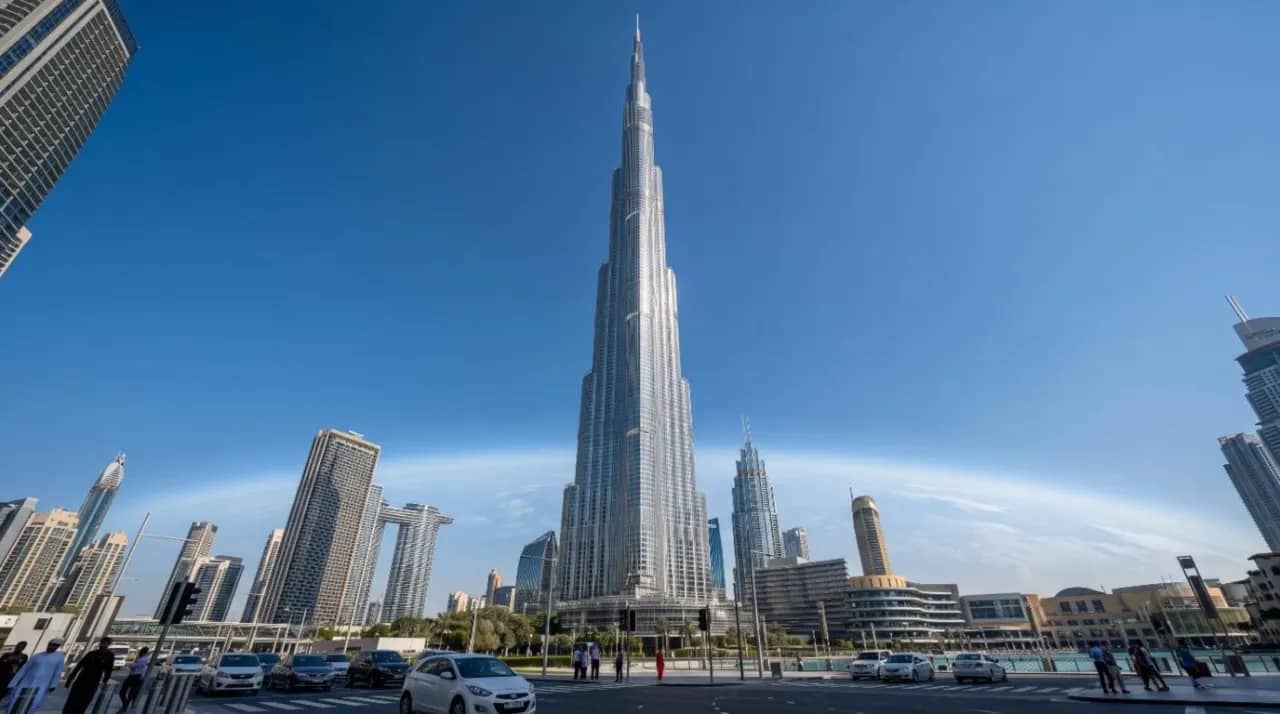
Stand beneath the Burj Khalifa and look upward, and the building seems to disappear into the sky. At 828 metres, it remains the world's tallest completed building in the Council on Tall Buildings and Urban Habitat's 2026 ranking.
That scale invites an unusual question. By lifting so much steel, concrete and glass above the ground, have humans slightly slowed the rotation of Earth?
The physics behind the idea is real. Moving mass farther from a rotating axis can change the speed of rotation. The practical effect of one skyscraper, however, is so tiny that it has no meaningful influence on the length of a day, clocks, weather or daily life.
Why Moving Mass Changes How Something Spins

The key concept is moment of inertia, which describes how mass is distributed around an axis of rotation. A figure skater demonstrates it clearly. With arms pulled inward, the skater spins faster. Extending the arms moves mass farther from the axis and slows the spin.
The skater is not creating or destroying rotation. Angular momentum is being conserved while the distribution of mass changes. Earth follows the same physical rule, although it is vastly larger and constantly exchanging angular momentum among its solid surface, atmosphere, oceans and interior.
If a fixed amount of material is raised vertically at the same location, it generally moves slightly farther from Earth's spin axis, except near the poles where the geometry differs. That raises the moment of inertia by a tiny amount and points toward a fractionally slower rotation.
A Skyscraper Does Not Add New Mass to Earth
A common misconception is that an enormous building makes Earth heavier. It does not. The iron, stone, sand, water and other materials were already part of the planet before construction began.
Construction rearranges mass rather than creating it. That distinction is important because the rotational effect depends on where every material began, where it ended and how far each location sits from Earth's axis.
Why the Materials' Starting Points Matter
Imagine steel transported from one latitude, stone from another and cement ingredients from several countries. Some material may have started closer to the rotation axis than its final position, while other material may have started farther away.
The upward movement within the finished tower is only one part of the calculation. Transport, excavation, foundations and the original locations of the materials can partly reinforce or cancel one another. It is therefore too simple to say that every tall building must produce a known net slowing effect.
Why There Is No Honest Exact Number for Burj Khalifa
It is tempting to claim that Burj Khalifa lengthened the day by a precise number of trillionths or quadrillionths of a second. Without enough reliable input data, that would be false precision.
A defensible calculation would require the building's complete mass, the vertical distribution of that mass, its distance from Earth's axis, the original position of every major material and the movement of soil and rock during construction. Most of the building's mass is also concentrated in its lower levels rather than at the spire.
The direction predicted by the simplified thought experiment is reasonable: lift the same mass at the same latitude and the day becomes slightly longer. The complete real-world number for the finished project is not available from the authoritative sources consulted.
How Small Would the Effect Be?
The most useful answer comes from comparison. A skyscraper relocates a large amount of material by human standards, but almost nothing compared with the mass of Earth.

Keep reading
Why Bees Are Important for the Planet
The magnitude 9.0 earthquake that struck Japan in March 2011 redistributed enough planetary mass for NASA Jet Propulsion Laboratory researchers to estimate that it shortened the day by about 1.8 microseconds. A microsecond is one millionth of a second.
That earthquake moved vast regions of rock along a major fault. Even its calculated effect was much smaller than normal seasonal changes in Earth's rotation. JPL notes that the length of a day naturally rises and falls by roughly one millisecond over a year, driven largely by exchanges involving the atmosphere and oceans.
A single tower moves far less mass through a far smaller distance. Any signal would be buried beneath much larger natural variations and would have no practical consequence.
What Changes Earth's Rotation Far More?
Earthquakes, Air and Oceans
Major earthquakes can shift large blocks of Earth's crust and produce calculable changes in day length. Winds, atmospheric pressure and ocean currents continually exchange angular momentum with the solid planet, creating much larger short-term and seasonal variations.
Melting Land Ice
When glaciers and ice sheets lose mass and the water spreads into the oceans, material moves away from the polar regions and toward lower latitudes. NASA-funded research found that this climate-driven redistribution is increasingly slowing Earth's rotation and lengthening the day.
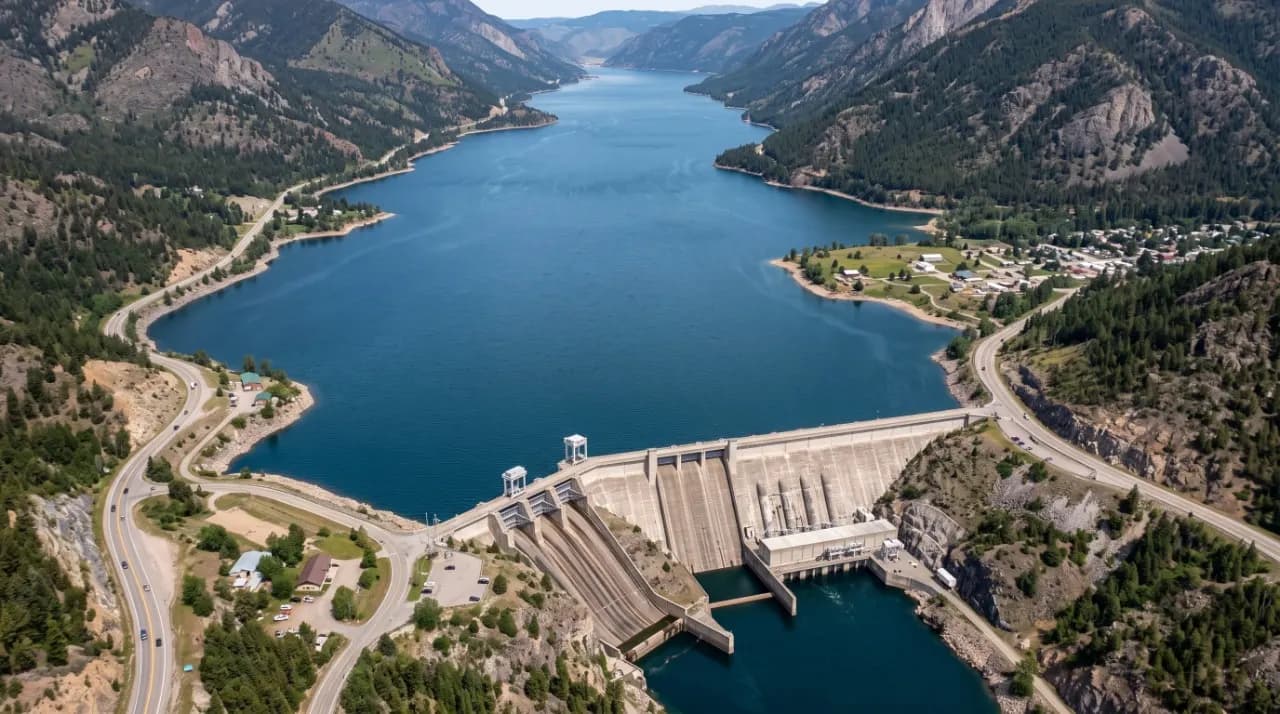
Large Reservoirs
Human projects can also redistribute enough mass for scientists to calculate a theoretical effect. NASA estimated that filling China's Three Gorges reservoir with about 40 cubic kilometres of water would lengthen the day by approximately 0.06 microseconds.
That reservoir moves vastly more mass than one skyscraper, yet the effect remains almost unimaginably small. It gives useful perspective on claims that an individual building could noticeably slow the planet.
Could Millions of Skyscrapers Add Up?
In principle, tiny rotational effects can add together. In practice, buildings are constructed at different latitudes from materials gathered across different regions. Their individual mass shifts would not all point neatly in the same direction.
Even an enormous global building programme would remain small beside the movement of oceans, ice sheets, groundwater, air and tectonic plates. Earth naturally redistributes mass on a scale that cities cannot approach.
How to Judge Claims That Something Changed Earth's Spin
Ask whether the event added mass or merely moved material that was already on Earth.
Check how much mass moved and how far its distance from the rotation axis changed.
Look for the assumptions behind any precise number, especially the material's starting position.
Compare the claimed effect with natural day-length variations measured in microseconds or milliseconds.
Prefer estimates from geophysics institutions rather than unsourced viral calculations.
Physically Real Does Not Mean Practically Important
The interesting part of this question is not that skyscrapers secretly control time. They do not. It is that a tower and a spinning planet obey the same fundamental rule as a figure skater on ice.
Raising mass can influence rotation in principle. For one building, the influence is overwhelmed by the moving atmosphere, oceans, ice, groundwater and geology of the planet itself.
Reference notes
Sources and further reading
- Skyscrapercenter (opens in a new tab)https://www.skyscrapercenter.com/buildings?function=all&location=world&material=all&status=completed
- Skyscrapercenter (opens in a new tab)https://www.skyscrapercenter.com/building/building/3
- NASA (opens in a new tab)https://www.jpl.nasa.gov/news/japan-quake-may-have-shortened-earth-days-moved-axis/
Show all 7 sources
- NASA (opens in a new tab)https://www.jpl.nasa.gov/news/nasa-details-earthquake-effects-on-the-earth/
- NASA (opens in a new tab)https://www.jpl.nasa.gov/news/nasa-study-goes-to-earths-core-for-climate-insights/
- NASA (opens in a new tab)https://www.nasa.gov/missions/grace/nasa-funded-studies-explain-how-climate-is-changing-earths-rotation/
- NASA (opens in a new tab)https://science.nasa.gov/climate-change/faq/
Our editorial promise
Prepared with clarity and care.
This guide completed our editorial review before publishing. If something needs attention, report a correction or contact the publisher.
About this article
- Published:
- Last updated:
- Author:
- Ceyora Editorial Team
- Review status:
- Editorially reviewed
- Sources:
- 7
- Corrections:
- Report an issue