
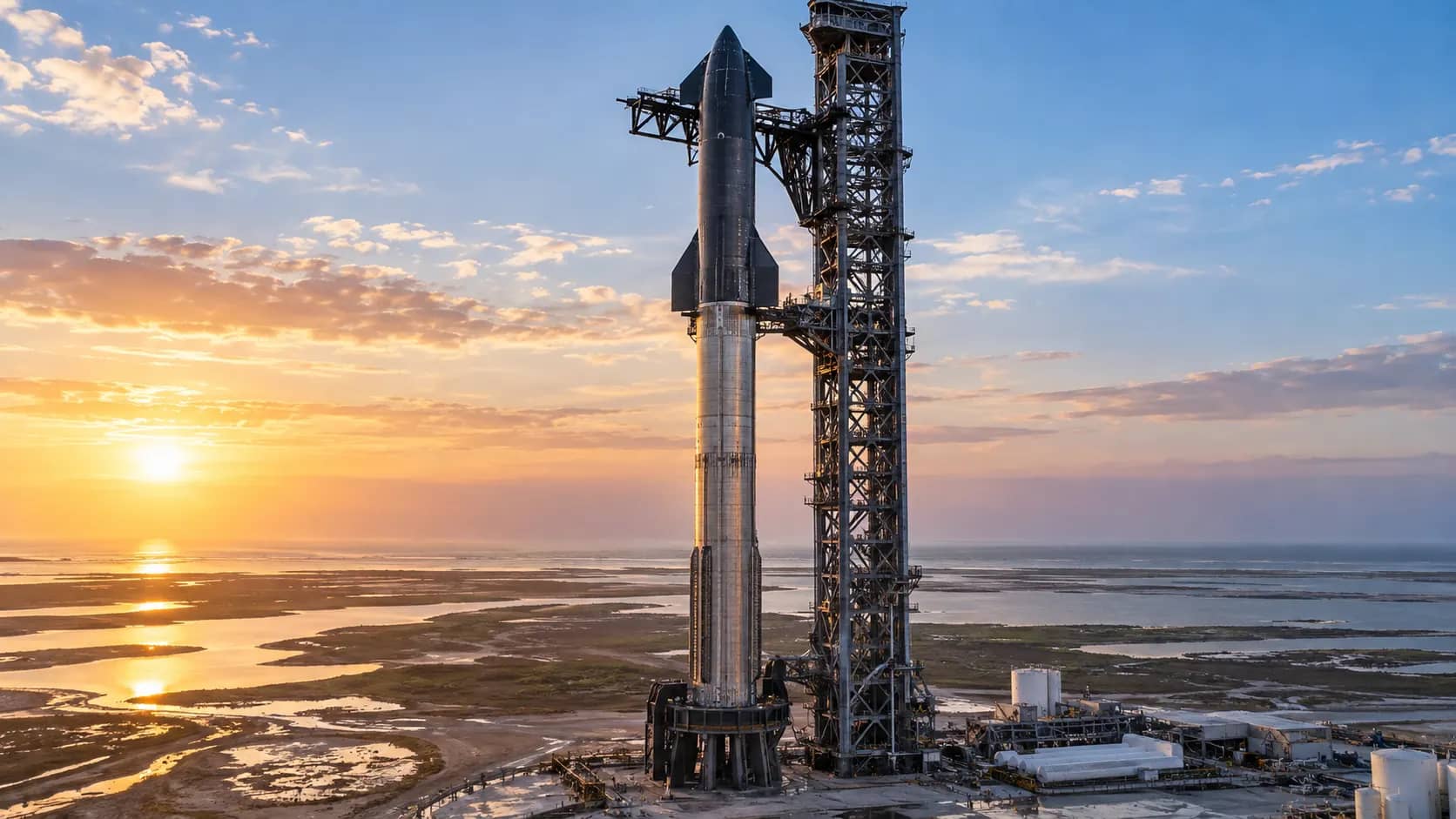
SpaceX has launched Starship many times, and earlier flights have already carried the spacecraft into space. Flight 14 is meant to cross a different threshold: becoming the first integrated Starship mission designed to enter a stable Earth orbit.
SpaceX lists Flight 14 for September 28, 2026 from Pad 2 at Starbase, Texas, with its launch window opening at 12:15 UTC. If the flight proceeds as intended, Starship will perform an orbital insertion burn, deploy 26 operational Starlink V3 satellites, circle Earth several times and later perform a controlled deorbit and Pacific splashdown.
Starship Has Reached Space Before, So What Is Different Now?
The first 13 integrated Starship and Super Heavy flights were intentionally flown on suborbital trajectories. Those missions could still test important systems such as ascent, stage separation, engine performance, payload deployment, heat shielding and atmospheric re-entry.
Flight 14 adds a critical step. SpaceX plans to reignite a Starship engine after the initial coast phase to raise and circularise the spacecraft’s trajectory. If that burn works as intended, Starship will remain in low Earth orbit instead of naturally falling back toward Earth after one partial trip around the planet.
Reaching Space Is Not the Same as Reaching Orbit
A spacecraft can travel high enough to reach space without entering orbit. The missing ingredient is sideways speed.
Imagine throwing a ball. Throw it gently and it lands nearby. Throw it faster and it travels farther before gravity brings it down. If something could move sideways fast enough, Earth’s surface would curve away beneath it at roughly the same rate that it falls.
It would keep falling around Earth instead of hitting the ground. That is orbit.
For Flight 14, that distinction matters more than simply reaching another impressive altitude. Orbital insertion would demonstrate that Starship can place itself on a controlled path around Earth and remain there long enough to perform useful operations.

What Will Flight 14 Actually Try to Do?
Flight 14 combines several objectives that earlier Starship missions could not demonstrate together.
Complete ascent and separation between Super Heavy and Starship.
Perform the planned orbital insertion burn.
Deploy 26 operational Starlink V3 satellites.
Operate spacecraft systems through roughly six Earth orbits.
Perform a planned deorbit burn.
Survive orbital-speed re-entry and complete a controlled Pacific splashdown.
Current mission reporting describes a flight lasting close to 10 hours, with Starship operating at roughly 275 kilometres altitude before its planned return.
Neither stage is planned for recovery for reuse on this mission. That is not necessarily a contradiction of Starship’s reusable goal. Development flights can focus on specific objectives rather than attempting every future capability at once.
Why Are Starlink V3 Satellites Riding on This Flight?
The satellites give Flight 14 a practical job beyond testing the rocket itself.
SpaceX is developing Starship partly because future Starlink satellites are larger and more capable than versions routinely launched on Falcon 9. Flight 14 is planned to deploy 26 Starlink V3 satellites into orbit.
Earlier Starship testing demonstrated deployment-related hardware and procedures on suborbital missions. Flight 14 is intended to take a more consequential step by placing operational satellites into orbit.
That difference matters. A rocket becomes much more useful when it can reliably deliver working payloads rather than simply demonstrate that the vehicle itself can fly.

Why Is Full Reusability So Difficult?

Keep reading
Why Does the Pentagon Have Five Sides?
Falcon 9 has already made first-stage rocket reuse an ordinary part of SpaceX operations. Starship’s ambition goes further because SpaceX intends both Super Heavy and the Starship upper stage to become reusable.
The upper stage is the particularly difficult part. It must return from orbital velocity through the atmosphere, survive intense heating and aerodynamic forces, remain controllable and eventually be recovered in a condition that makes another flight practical.
One successful orbital mission would therefore prove only part of the larger idea. Rapid full reusability requires repeated flights, dependable recovery and evidence that the same hardware can be prepared for another mission without excessive refurbishment.
A Test Can Be Useful Without Being Perfect
Development flights are often described in extremes. A missed objective gets labelled a complete failure, or every flight gets called a success because engineers collected data.
Neither approach tells the whole story.
The useful question is which objectives were achieved. Did the booster complete its planned portion of the flight? Did Starship enter orbit? Were the satellites deployed? Did the deorbit burn work? Did the heat shield and flight controls survive re-entry?
A problem in one part of the mission can still produce valuable engineering information, but it remains a problem that SpaceX needs to solve.
Why NASA Is Watching Starship Closely
Starship is also connected to NASA’s Moon plans. NASA is working with SpaceX on a specialised Starship Human Landing System designed to carry astronauts between lunar orbit and the Moon’s surface during Artemis missions.
NASA says ongoing integrated Starship flight tests provide important data for development of the Human Landing System version. The lunar lander will still require its own testing, demonstrations and mission-specific capabilities, so Flight 14 should not be treated as a direct test of a finished lunar lander.
Falcon 9 Already Works, So Why Build Something Bigger?
Falcon 9 is already an established operational rocket. Starship is being developed for a different scale.
SpaceX wants the newer system to carry much larger payloads, deploy next-generation satellites, support missions beyond low Earth orbit and eventually reuse both major stages.
That does not mean Starship automatically replaces Falcon 9. Before comparisons become straightforward, Starship still has to demonstrate reliability, useful payload operations, recovery and a repeatable launch cadence.
How to Judge Flight 14 After It Launches
If you follow the mission live, do not judge the whole flight from liftoff or one dramatic video clip. Follow the sequence of objectives instead.
Check whether ascent and stage separation occur as planned.
Look for confirmation that Starship performs its orbital insertion burn.
Check whether the 26 Starlink V3 satellites are deployed successfully.
Later, look for confirmation that the spacecraft performs its deorbit burn.
Finally, check whether Starship survives re-entry and reaches its planned Pacific splashdown.
What Would Reaching Orbit Actually Prove?
If Flight 14 reaches orbit and deploys its satellites, Starship will have demonstrated something fundamentally more useful than merely touching space.
It would show that the integrated system can launch, enter orbit and perform a real payload mission.
It would not prove that Starship is finished, routinely reusable or ready to carry people. Those achievements require repetition.
Starship is not important simply because it is enormous. The real experiment is whether SpaceX can turn a spacecraft of this scale into a useful, repeatable and eventually reusable orbital transportation system.
Reference notes
Sources and further reading
- Spacex (opens in a new tab)https://www.spacex.com/launches/
- Spacex (opens in a new tab)https://www.spacex.com/vehicles/starship/
- Spacex (opens in a new tab)https://www.spacex.com/vehicles/falcon-9/
Show all 7 sources
- Fly Faa (opens in a new tab)https://www.fly.faa.gov/adv/adv_spt?s=09
- Reuters (opens in a new tab)https://www.reuters.com/business/media-telecom/spacex-targets-first-starship-orbital-test-september-22-2026-09-15/
- Spaceflightnow (opens in a new tab)https://spaceflightnow.com/2026/09/28/live-coverage-spacex-to-launch-first-starlink-v3-satellites-to-orbit-on-starship/
- NASA (opens in a new tab)https://www.nasa.gov/humans-in-space/human-landing-system/
Our editorial promise
Prepared with clarity and care.
This guide completed our editorial review before publishing. If something needs attention, report a correction or contact the publisher.
About this article
- Published:
- Last updated:
- Author:
- Ceyora Editorial Team
- Review status:
- Editorially reviewed
- Sources:
- 7
- Corrections:
- Report an issue