
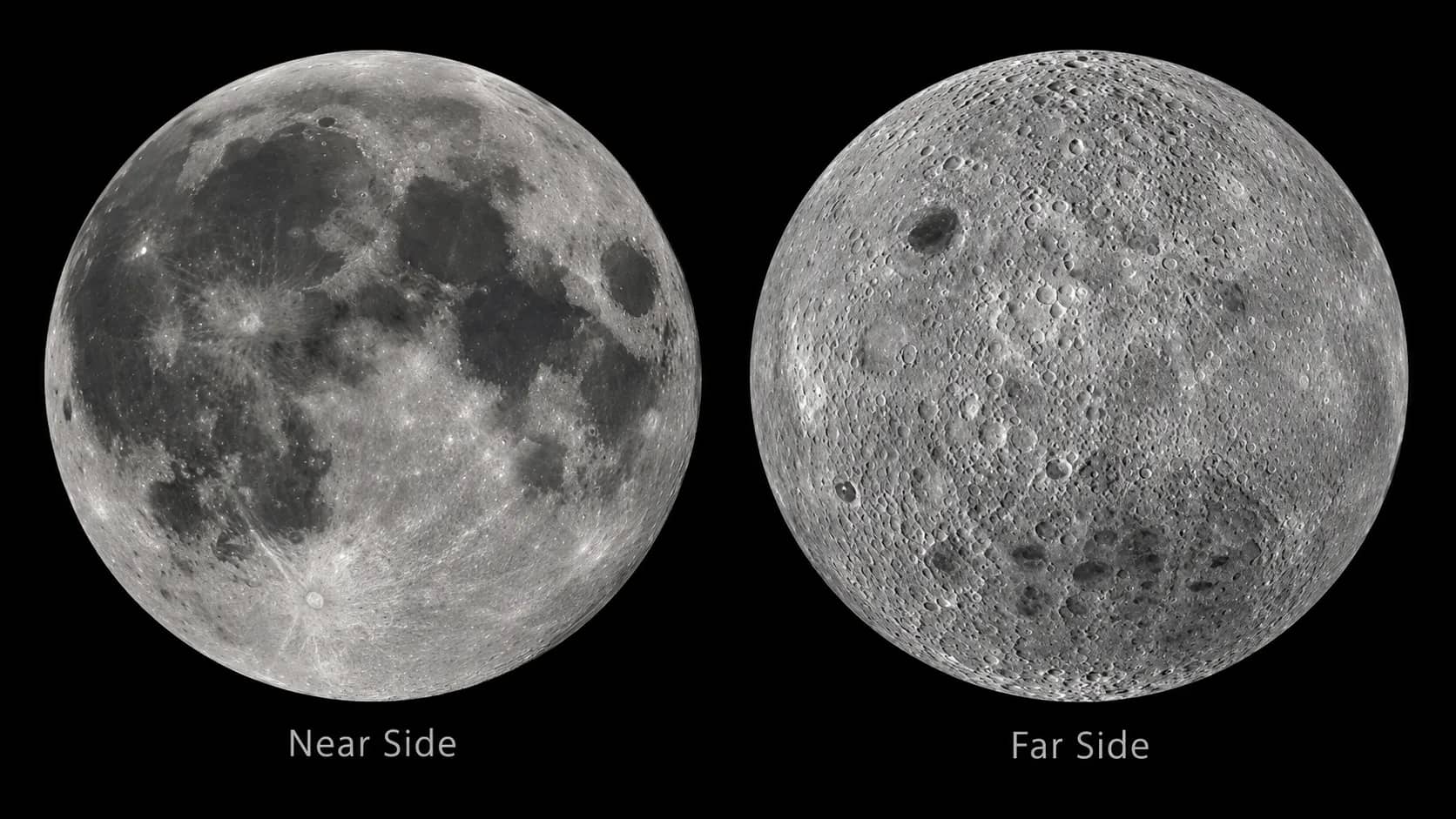
Watch the Moon for a month and something strange happens. It moves across the sky, changes phase and travels all the way around Earth, yet the familiar pattern of dark and bright regions keeps facing us.
It is tempting to conclude that the Moon does not rotate.
The opposite is true. The Moon rotates once in almost exactly the same amount of time that it takes to complete one orbit around Earth. That synchronization is why essentially the same hemisphere remains pointed toward us.
Does the Moon Actually Rotate?
Yes. A simple thought experiment makes it easier to see.
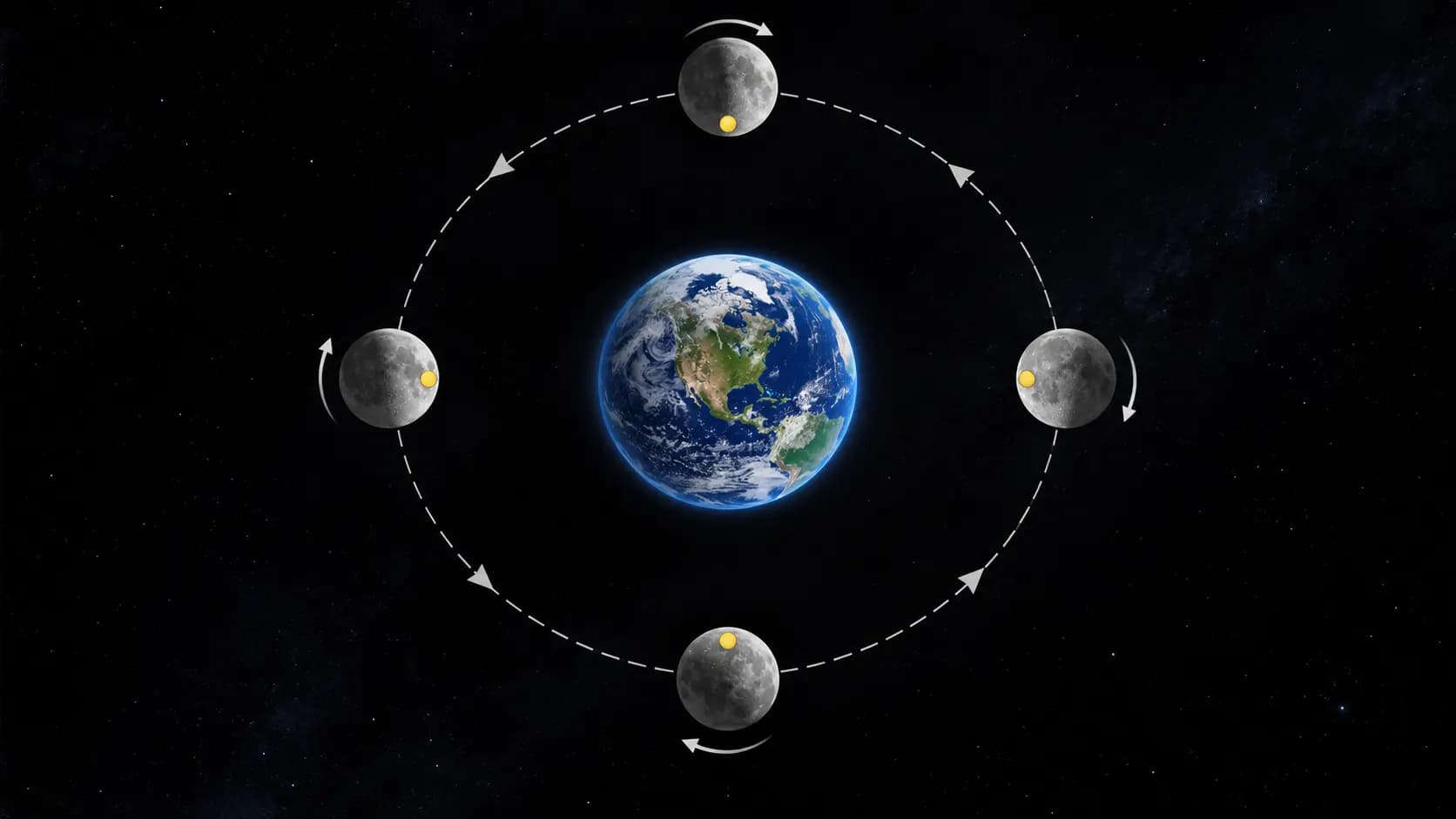
Imagine walking in a circle around another person while keeping your face pointed toward them the entire time. After completing the circle, you would have turned through one full rotation yourself. If you had not turned at all, the person in the centre would eventually see your side and then your back.
The Moon behaves in much the same way. It travels around Earth while continuously turning, completing one rotation during each orbit.
NASA gives the Moon's orbital period as about 27.3 days. Its rotation takes essentially the same amount of time.
Why Does It Rotate at Exactly the Right Speed?
The matching periods are not a lucky coincidence. They are the result of gravity acting over an enormous amount of time.
Early in its history, the Moon rotated much faster. Earth's gravity slightly distorted the young Moon, producing tidal bulges. Because those bulges did not stay perfectly aligned with Earth while the Moon was spinning, gravitational forces gradually removed rotational energy.
The Moon's spin slowed until one rotation matched one orbit. Once those motions became synchronized, essentially the same side remained directed toward Earth.
This state is called tidal locking. It is not unusual: NASA notes that all of the Solar System's large moons are tidally locked to the planets they orbit.
What Would Happen If the Moon Did Not Rotate?
We would eventually see every longitude of the Moon from Earth.
Imagine placing an arrow on the Moon that always points in the same direction in space while the Moon travels around Earth. At one part of the orbit the arrow might point toward us. Half an orbit later it would point away.
The fact that one face continues following Earth around the entire orbit is itself evidence that the Moon is rotating.
Is There Really a Dark Side of the Moon?
No. The phrase is memorable, but scientifically misleading.
The hemisphere facing Earth is called the near side. The hemisphere facing mostly away from us is the far side.
Both receive sunlight. At any ordinary moment, roughly half of the Moon is illuminated by the Sun and half is experiencing lunar night. As the Moon rotates and orbits Earth, daylight moves across both hemispheres.
Around new Moon, for example, much of the far side is sunlit while the near side faces mostly away from the Sun. Around full Moon, the situation is reversed.
Has Anyone Ever Seen the Far Side?
Humans could not see it directly from Earth before the Space Age.
That changed in October 1959 when the Soviet Luna 3 spacecraft passed the Moon and transmitted the first photographs of the far side. The early images were noisy and low resolution, but they revealed terrain no human had seen before.

Keep reading
Is Ramen Really Japanese? The Story Behind the Bowl
Modern spacecraft have transformed that first glimpse into detailed global mapping. NASA's Lunar Reconnaissance Orbiter, launched in 2009, has provided exceptionally detailed views of both hemispheres.
Why Does the Far Side Look So Different?
The familiar near side contains enormous dark volcanic plains called maria, formed when ancient lava flooded large impact basins.
The far side has far fewer of these broad dark plains. Instead, much of its surface appears densely covered with impact craters.
Luna 3 revealed this difference immediately, and later missions confirmed it in far greater detail. The reason for the asymmetry involves differences in the Moon's crust and geological history, and scientists continue studying exactly how the two hemispheres evolved so differently.
Do We Really See Only 50% of the Moon?
Not quite.
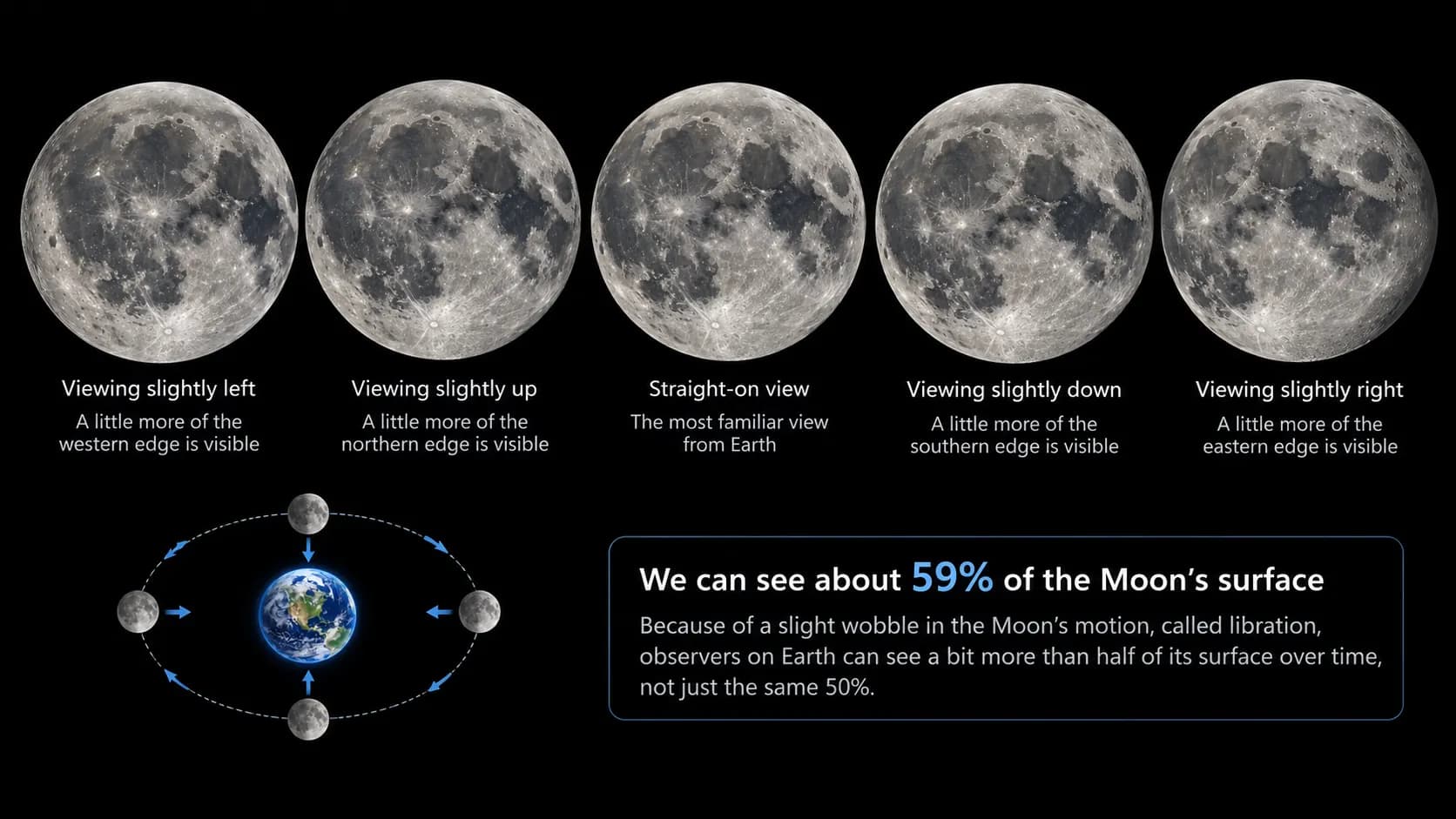
Although tidal locking keeps the same general hemisphere facing Earth, our viewing angle changes slightly during the month. The Moon's orbit is elliptical rather than perfectly circular, its rotational axis is tilted, and observers on a rotating Earth view it from slightly different positions.
Together these effects create an apparent gentle wobble called libration.
Areas close to the Moon's edge sometimes rotate slightly into view and later disappear again. NASA says favourable libration lets observers see about 59% of the lunar surface over time, although never all of that area at once.
Are Other Moons Locked Like This?
Yes. Tidal locking is common in the Solar System rather than something unique to Earth's Moon.
NASA notes that all of the Solar System's large moons are tidally locked to their planets. Jupiter's large Galilean moons and many other familiar satellites therefore also keep the same general hemisphere facing the world they orbit.
Pluto and its large moon Charon go even further: they are mutually tidally locked, meaning the same sides of Pluto and Charon continually face one another.
Moon Phases Are Not Earth's Shadow
There is one more misconception worth separating from tidal locking.
The ordinary phases of the Moon are not caused by Earth's shadow. The Sun always illuminates half of the Moon, except for the special circumstances of a lunar eclipse.
As the Moon moves around Earth, our viewing angle changes, allowing us to see different amounts of its sunlit half. That produces the crescent, quarter, gibbous and full phases.
The Moon Shows One Face Because It Turns
That is the counterintuitive part worth remembering.
The Moon does not keep the same face toward Earth because it has stopped spinning. It keeps the same face toward us because its spin became synchronized with its orbit.
Gravity created that relationship over immense spans of time. Spacecraft later revealed the hemisphere hidden from Earth, while libration gives anyone watching from the ground a small peek beyond the familiar edge.
The Moon looks almost unchanged from night to night. Behind that familiar face is a remarkably precise celestial dance.
Reference notes
Sources and further reading
- NASA (opens in a new tab)https://science.nasa.gov/moon/tidal-locking/
- NASA (opens in a new tab)https://science.nasa.gov/moon/top-moon-questions/
- NASA (opens in a new tab)https://science.nasa.gov/moon/viewing-tips/
Show all 7 sources
- NASA (opens in a new tab)https://science.nasa.gov/moon/moon-phases/
- NASA (opens in a new tab)https://science.nasa.gov/moon/facts/
- NASA (opens in a new tab)https://science.nasa.gov/resource/first-photo-of-the-lunar-far-side/
- NASA (opens in a new tab)https://science.nasa.gov/resource/the-moon-from-the-other-side/
Our editorial promise
Prepared with clarity and care.
This guide completed our editorial review before publishing. If something needs attention, report a correction or contact the publisher.
About this article
- Published:
- Last updated:
- Author:
- Ceyora Editorial Team
- Review status:
- Editorially reviewed
- Sources:
- 7
- Corrections:
- Report an issue