
When reports say a jet was descending at 20,000 or even 30,000 feet per minute, it can sound as if the aircraft simply dropped out of the sky. That is not usually what the number means. An aircraft in an extreme descent is still moving through the atmosphere, and its motion is being shaped by gravity, aerodynamic forces, its attitude, airspeed, weather and whatever level of control remains.
That distinction has become especially relevant after the November 1, 2026 crash of a Learjet 60 in South Florida. The NTSB says its investigation is ongoing. Flight information and radio communications reported by Reuters indicate that the crew encountered icing and turbulence before declaring an emergency during a rapidly accelerating descent. Investigators have also said there is evidence that parts of the aircraft may have separated before impact. None of that, by itself, establishes the cause.
A Descent Rate Is Not the Same as the Jet's Total Speed
Aircraft tracking data often reports vertical speed in feet per minute. That tells us how quickly altitude is changing, not how fast the aircraft is moving through the air overall.
A reported descent rate of 22,000 feet per minute is roughly 112 metres per second vertically. A momentary rate of 32,000 feet per minute is about 163 metres per second vertically. Those are enormous rates of altitude loss, but they should not be interpreted as the aircraft's complete velocity because the jet may also have substantial forward motion.
The descent rate can also change rapidly. A brief peak recorded by tracking data does not mean the aircraft maintained that rate for a full minute.
Why Gravity Does Not Normally Pull an Airplane Straight Down
An aircraft in normal flight is constantly affected by four broad forces: lift, weight, thrust and drag. Weight pulls the aircraft toward Earth, while the wings generate lift as air flows around them.
During level flight, these forces are arranged so that altitude remains approximately constant. During a descent, the aircraft's flight path tilts downward and the balance changes. A controlled descent can be completely normal. What makes an extreme descent different is the speed at which altitude is being lost and whether the aircraft remains within a controllable flight condition.
A Wing Can Still Produce Lift While the Aircraft Is Going Down
A common misconception is that descending means the wings have completely stopped working. An aircraft can descend rapidly while its wings continue producing significant lift.
What matters is the direction and magnitude of the aerodynamic forces compared with the aircraft's weight and flight path. A jet pointed steeply downward can accelerate while still generating aerodynamic forces. That is one reason an extreme descent should not automatically be described as free fall.
What Happens if the Wing Exceeds Its Critical Angle of Attack?
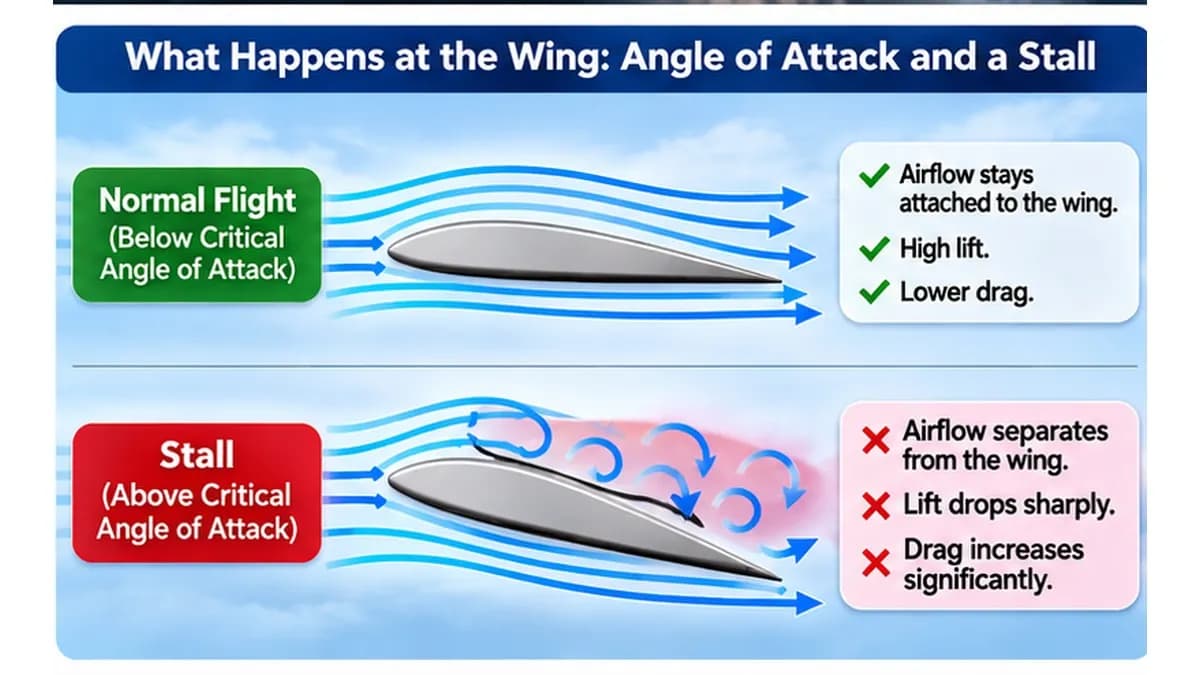
Lift depends strongly on angle of attack, the angle between the wing and the oncoming airflow. The FAA explains that when a wing exceeds its critical angle of attack, airflow begins separating from the upper surface. Lift decreases and drag rises sharply. This condition is an aerodynamic stall.
A stall is not simply an engine stopping, and it is not defined by one fixed airspeed. It can occur at different speeds depending on aircraft weight, configuration and load factor.
If a stall or another upset leads to a steep nose-down attitude, altitude can disappear very quickly while the aircraft accelerates.
Why Icing Can Change the Aerodynamics
Ice does more than make an aircraft heavier. Even relatively small changes to the shape and surface of a wing can disturb the carefully controlled airflow that produces lift.
The FAA describes aircraft icing as a significant safety hazard because it can disrupt airflow, increase drag, reduce lift and affect handling. Ice can also cause an aircraft to stall at a higher speed or behave differently from the clean-wing condition pilots normally expect.
Modern jets designed and approved for operation in icing conditions have anti-icing or de-icing systems, but aircraft certification does not mean every possible icing environment is harmless. Investigators therefore examine the type and severity of icing, aircraft systems, crew actions and weather conditions before deciding what role icing played in any accident.
Turbulence Can Apply Forces Far Beyond an Uncomfortable Bump
Ordinary turbulence may mean little more than an uncomfortable ride. Severe turbulence is different. FAA weather guidance describes it as capable of producing large and abrupt changes in altitude or attitude, large airspeed variations and moments when an aircraft may be temporarily out of control.

Keep reading
Why Singapore Airlines Was Named World’s Best Airline in 2026
A strong vertical gust effectively changes the airflow striking the aircraft. That can rapidly change the wing's angle of attack and the load acting on the structure.
Thunderstorms and strong convective weather can also contain severe turbulence, hail, rapid vertical air movement and other conditions that aircraft are normally routed around rather than deliberately flown through.
Why Speed Becomes a Serious Problem During a Steep Descent
Once an aircraft points steeply downward, gravity can contribute to acceleration along its flight path. As airspeed increases, aerodynamic forces can increase dramatically.
Aerodynamic pressure is strongly related to the square of airspeed. That means doubling the speed does not merely double the aerodynamic loading associated with the airflow. The relationship can make high-speed flight outside the aircraft's intended envelope particularly serious.
Aircraft therefore have operating-speed limits. An extreme upset can create a difficult situation in which recovering too aggressively may also impose large forces on the structure.
Pulling Out of the Dive Can Create Enormous Loads
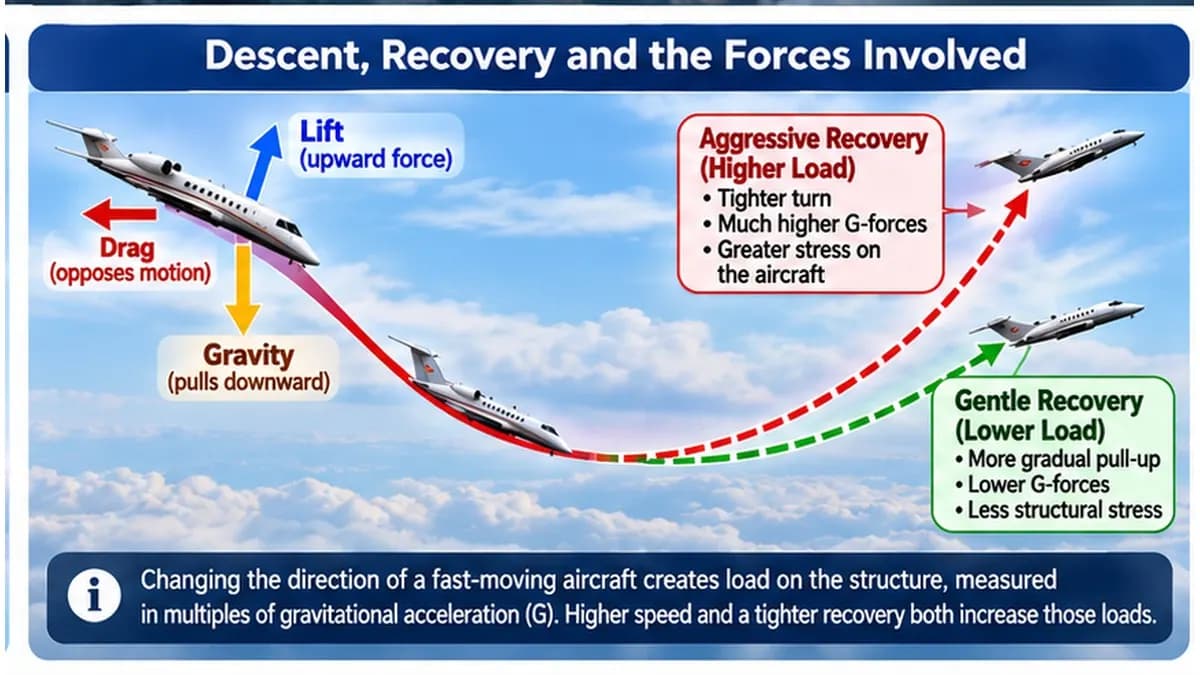
Imagine a jet travelling quickly downward and then changing direction back toward level flight. That change in direction requires acceleration, which creates load on the aircraft and everyone inside it.
The FAA measures these loads in multiples of gravitational acceleration, commonly called G. A load factor of 3 G means the aircraft structure is supporting forces equivalent to roughly three times its weight in that flight condition.
Aircraft are designed with structural limits and safety margins, but those limits are not unlimited. FAA guidance specifically notes that high speeds increase the potential for large load factors and that gusts or manoeuvres can place substantial stresses on an aircraft.
Can Turbulence or Icing Break an Aircraft Apart?
In extreme circumstances, aerodynamic loads can exceed what an aircraft structure is designed to tolerate. Severe turbulence can contribute to such loads, and excessive speed can increase them further.
But seeing debris away from the main crash site does not tell us by itself what caused a breakup or exactly when structural damage began. Investigators examine wreckage patterns, flight data, radar information, weather, maintenance records and aircraft systems to reconstruct the sequence.
In the Florida Learjet investigation, the NTSB has said evidence suggests parts of the aircraft may have separated before impact. That is an investigative finding about the sequence, not yet a conclusion explaining why it happened.
Why Investigators Cannot Simply Blame the Weather
The crew's reports of icing and turbulence make weather an obvious area of investigation, but aviation accident analysis works backward from evidence rather than from the most dramatic clue.
Investigators need to determine the aircraft's actual flight path, speed, attitude, systems status and structural condition. They also examine the weather the aircraft encountered, how its ice-protection systems were operating, what the pilots observed and what actions were taken.
More than one factor can interact. Weather can affect aerodynamics, a sudden upset can increase airspeed, higher speed can increase structural loading, and an attempted recovery can change those loads again. Determining which event came first is crucial.
What the Florida Learjet Crash Tells Us Right Now
As of November 3, 2026, the NTSB investigation into the Learjet 60 crash remains open. The agency's investigation page describes the information as preliminary and subject to change.
What can responsibly be said is that the aircraft experienced an extreme descent after the crew reported hazardous conditions, and investigators are examining weather, crew actions, aircraft systems and evidence of possible in-flight structural separation.
The physics explains how an aircraft can lose altitude extraordinarily quickly and why forces can escalate once a high-speed upset develops. It cannot, on its own, tell us what initiated this particular accident. That answer has to come from the investigation.
Reference notes
Sources and further reading
- Ntsb (opens in a new tab)https://www.ntsb.gov/investigations/Pages/ERA27MA026.aspx
- Reuters (opens in a new tab)https://www.reuters.com/business/aerospace-defense/nine-people-dead-learjet-crash-south-florida-officials-say-2026-11-01/
- Reuters (opens in a new tab)https://www.reuters.com/business/aerospace-defense/investigators-say-learjet-may-have-broken-up-before-crashing-florida-2026-11-02/
Show all 8 sources
- Faa (opens in a new tab)https://www.faa.gov/aircraft/air_cert/step/disciplines/flight_meteorological_effects
- Faa (opens in a new tab)https://www.faa.gov/nextgen/programs/weather/awrp/ifi
- Faa (opens in a new tab)https://www.faa.gov/regulations_policies/handbooks_manuals/aviation/phak
- Faa (opens in a new tab)https://www.faa.gov/sites/faa.gov/files/pilots/pilot_handbook.pdf
- Faa (opens in a new tab)https://www.faa.gov/sites/faa.gov/files/regulations_policies/handbooks_manuals/aviation/airplane_handbook/06_afh_ch5.pdf
Our editorial promise
Prepared with clarity and care.
This guide completed our editorial review before publishing. If something needs attention, report a correction or contact the publisher.
About this article
- Published:
- Last updated:
- Author:
- Ceyora Editorial Team
- Review status:
- Editorially reviewed
- Sources:
- 8
- Corrections:
- Report an issue