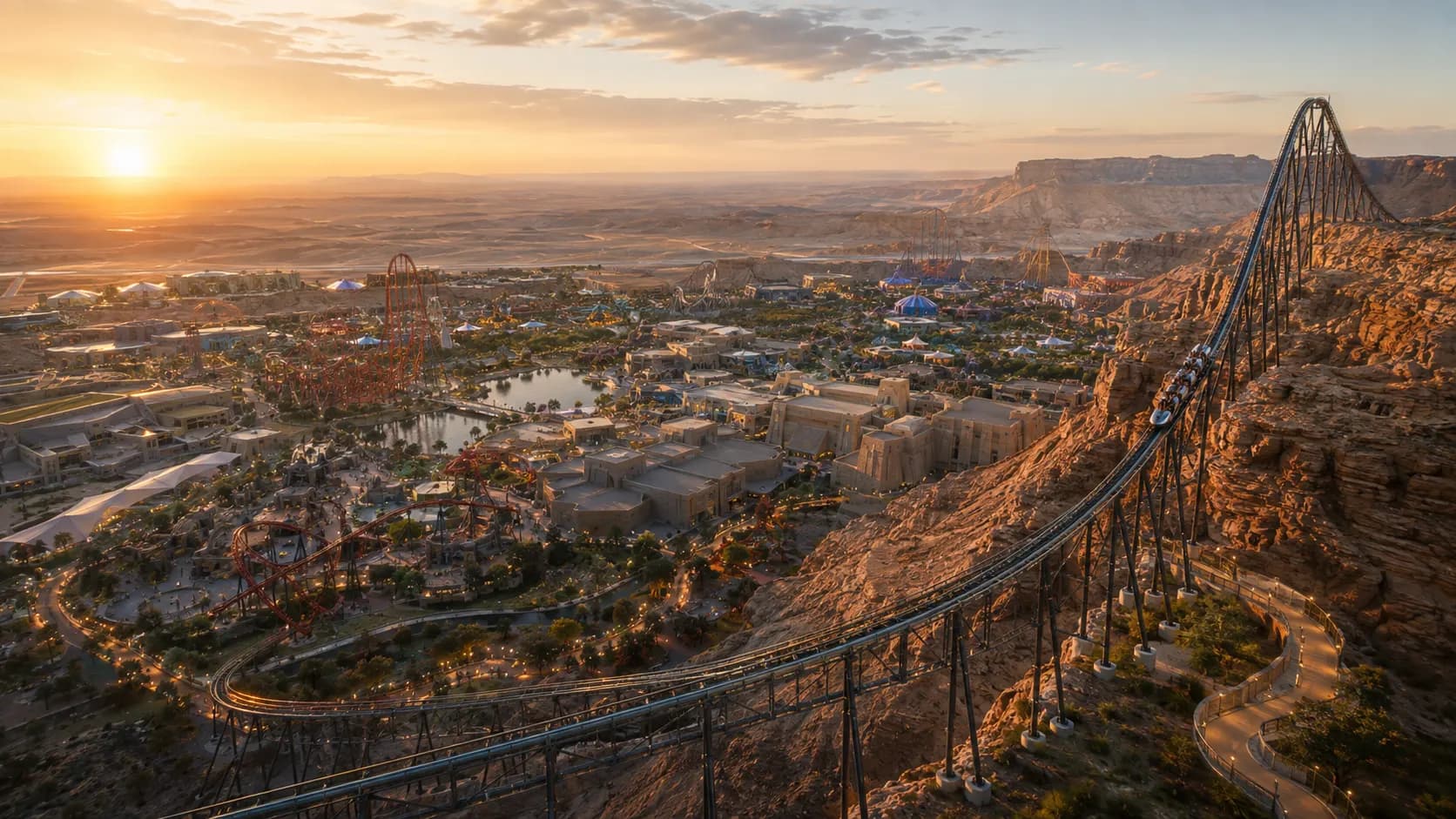
Most roller coasters feel enormous when you are standing underneath them. Falcons Flight operates on a different scale.
At Six Flags Qiddiya City near Riyadh, the coaster stretches for more than four kilometres, climbs into the Tuwaiq landscape and reaches a reported top speed of 250 km/h. Six Flags Qiddiya City, Qiddiya and ride manufacturer Intamin describe it as the world's tallest, fastest and longest roller coaster.
What makes it especially unusual is not simply that three large numbers were attached to one ride. Its designers used the natural elevation of Qiddiya to create a coaster that feels more like a high-speed journey across a landscape than a conventional ride squeezed into a compact amusement-park plot.
What Is Falcons Flight?
Falcons Flight is the signature extreme-thrill attraction inside the City of Thrills section of Six Flags Qiddiya City. The park opened to the public on December 31, 2025, becoming the first Six Flags park built outside North America.
The coaster was created by Swiss ride manufacturer Intamin, a company known for high-speed launch coasters. Rather than relying on a single lift hill and gravity alone, Falcons Flight uses linear synchronous motor, or LSM, technology to accelerate the train at several points around its enormous layout.
How Fast Is Falcons Flight?
The current official specification is 250 km/h, or about 155 mph. That is faster than the 240 km/h figure associated with Formula Rossa in Abu Dhabi, which held the speed benchmark for many years.
Falcons Flight does not reach its maximum speed immediately after leaving the station. According to Intamin, the ride contains three powered sections. The final and fastest launch comes after a major cliff descent and accelerates the train to 250 km/h before sending it over a huge 165-metre camelback hill.
That sequence matters because speed feels different after riders have already travelled high above the surrounding landscape and then descended toward the base of the cliffs. The attraction is designed around changes in terrain, elevation and speed rather than one short launch followed by a conventional circuit.
Why Is Falcons Flight So Tall?
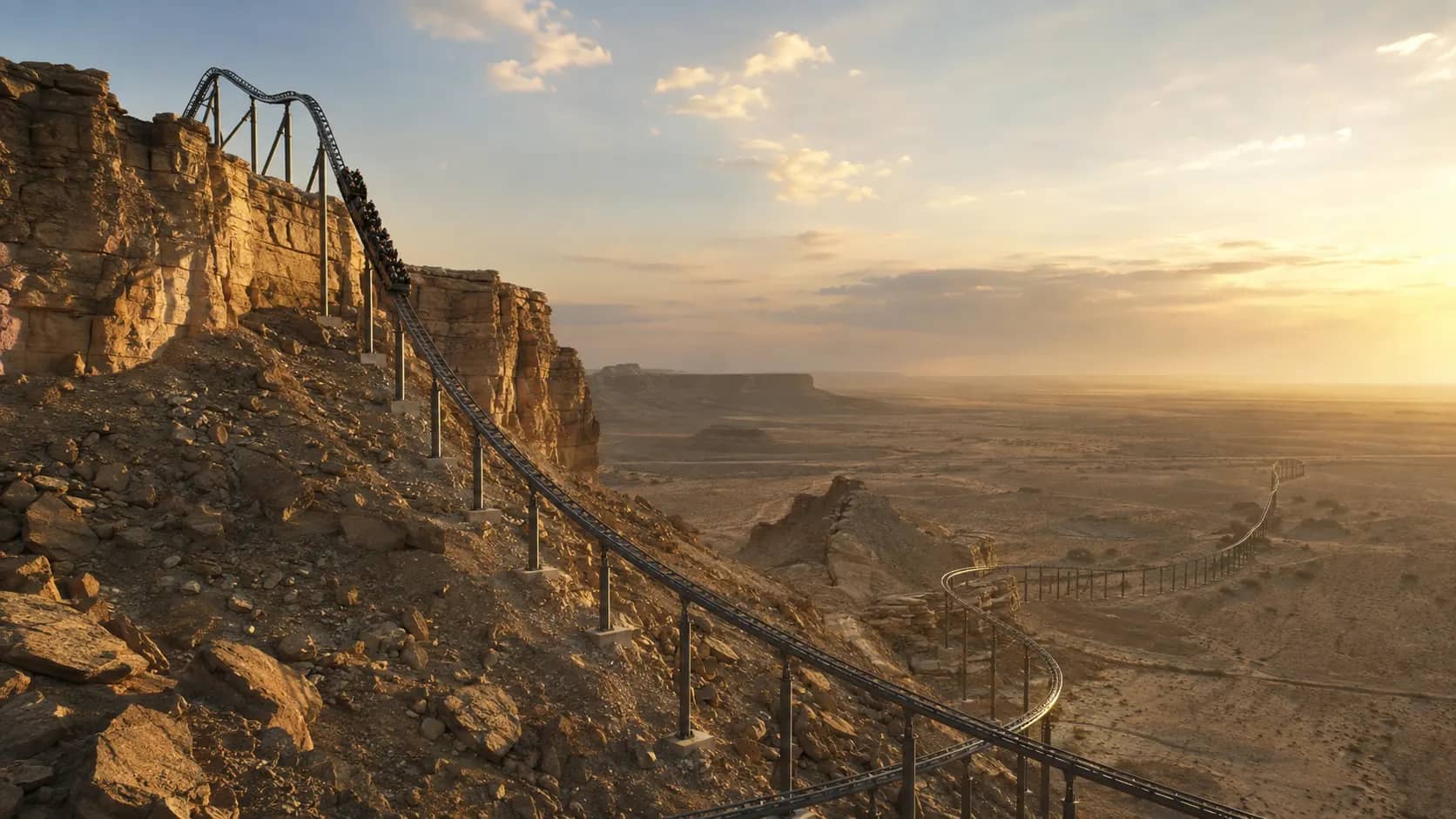
Falcons Flight reaches a maximum elevation of 195 metres. Part of the reason that figure is possible is Qiddiya's geography.
The layout carries riders toward the Tuwaiq cliffs and uses a long launch to reach the top. Intamin says this section accelerates the train to about 150 km/h while climbing toward the 195-metre elevation.
Near the summit, the track includes an outward-banked turn overlooking the cliff before riders approach the major descent. Instead of treating the landscape as empty ground on which to build a coaster, the designers incorporated the cliff itself into the experience.
What Makes It the World's Longest?
The published track length is 4,325 metres, or more than 4.3 kilometres. That scale allows the ride to contain several distinct sections instead of rushing through one compact sequence of elements.
The journey begins relatively gently with an LSM-powered climb followed by a twisted drop. It then travels toward the cliffs, climbs the terrain, descends again, enters its fastest launch, crosses the enormous camelback and continues through long high-speed turns and hills before returning to the station.
Intamin puts the ride time at approximately three minutes and 25 seconds. For a coaster capable of 250 km/h, sustaining an experience for that long requires an unusually large physical footprint.
What Does the Ride Actually Feel Like?
Without pretending to experience it first-hand, the engineering tells us something about the sensations riders can expect. Falcons Flight combines rapid acceleration, major elevation changes, airtime, long high-speed turns and strong forces.
Intamin says its designers deliberately balanced the most intense sections with longer transitions and moments when riders can take in the surrounding landscape. The trains also use aerodynamic bodywork and windscreens, an unusually important consideration at speeds approaching 250 km/h.
Multiple powered accelerations rather than one launch
A climb toward the top of the Tuwaiq cliffs
An outward-banked turn near the cliff edge
A dramatic descent followed by the fastest launch
A 165-metre camelback hill
Extended high-speed turns and airtime sections
Wide views across Qiddiya's desert landscape

Keep reading
Most Beautiful Islands in the World You Need to See
The Engineering Is Almost as Extreme as the Ride
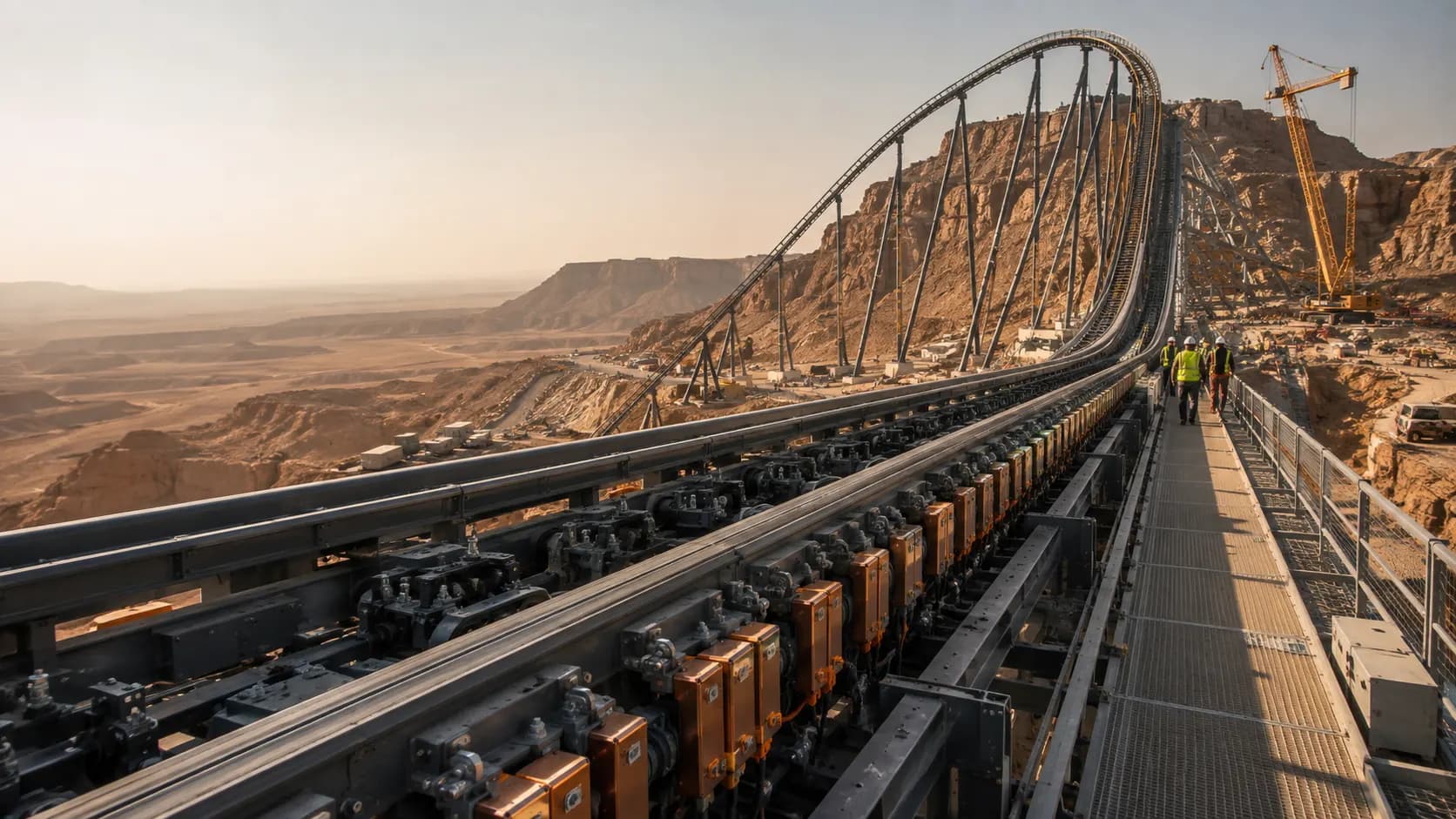
Building a coaster this large creates problems that do not appear on ordinary rides. Intamin says the 165-metre camelback superstructure alone weighs roughly 2,500 tonnes.
The company also reports more than 722 LSM stators distributed across the three powered sections. Long, high-speed launch tracks had to be kept extremely straight and accurately aligned so the propulsion system could work as intended while maintaining ride comfort.
The route even interacts with Qiddiya's wider design. Near the end of the ride, the coaster crosses the neighbouring Speed Park Track area and passes beneath the park's entrance bridge.
Why Build Something This Extreme in Saudi Arabia?
Falcons Flight makes more sense when viewed as part of Qiddiya City rather than as an isolated roller coaster.
Qiddiya is a major entertainment, sports and cultural development about 45 kilometres from central Riyadh. Six Flags Qiddiya City is one of its flagship attractions, and Qiddiya promotes the park as containing 28 rides and attractions, including five record-breaking rides.
A ride claiming three headline records gives the destination something instantly understandable to an international audience. People who know little about Qiddiya may still understand what 250 km/h and a 195-metre coaster mean. Falcons Flight therefore functions as both an attraction and a global calling card for the wider development.
Is Falcons Flight Safe for Everyone?
Extreme-looking does not automatically mean uncontrolled. Modern roller coasters are engineered around defined operating limits, restraint systems, control systems and rider restrictions. At the same time, that does not mean every person is suitable to ride.
Six Flags currently lists an allowed rider height range of 130 to 196 centimetres for Falcons Flight. Its official guidance also identifies several conditions for which the attraction is unsuitable, including heart conditions, back or neck problems, pregnancy, vertigo or fear of heights, high blood pressure and recent surgery.
Loose objects are also tightly controlled. The park says phones, cameras and other loose possessions cannot be taken onto the attraction, and riders pass through a metal-detector check before boarding.
Is Falcons Flight Open Right Now?
Six Flags Qiddiya City officially opened on December 31, 2025. As of August 2026, the current Six Flags website lists Falcons Flight as one of its attractions and publishes its rider requirements.
That should not be treated as a guarantee that the coaster will operate every minute of every day. Large attractions can close temporarily for weather, inspections, maintenance or operational reasons. Anyone travelling specifically to ride Falcons Flight should check the official Six Flags Qiddiya City website shortly before the visit.
One Number About Falcons Flight Is Easy to Get Wrong
You may still see references online to 240 km/h and acceleration to that speed in 4.9 seconds. Those figures are associated with Formula Rossa at Ferrari World Abu Dhabi, not the current Falcons Flight specification.
Six Flags Qiddiya City and Intamin currently give Falcons Flight a top speed of 250 km/h. Intamin describes the final launch as the point where the train reaches that maximum, but the official sources reviewed for this article do not give a 0-to-250 km/h acceleration time. It is better not to invent one.
Why Falcons Flight Is More Than a Record List
Records make Falcons Flight easy to describe, but they are not the most interesting part of the design. What separates it from a conventional coaster is the way speed, powered launches and enormous steel structures are combined with an existing cliff landscape.
A 250 km/h launch is impressive on paper. A 195-metre elevation is impressive on paper. A 4.3-kilometre track is impressive on paper. Putting all three into a ride that climbs across the Tuwaiq terrain is what makes Falcons Flight such an unusual engineering project.
Reference notes
Sources and further reading
- Sixflagsqiddiyacity (opens in a new tab)https://sixflagsqiddiyacity.com/en/explore/rides/falcons-flight
- Sixflagsqiddiyacity (opens in a new tab)https://sixflagsqiddiyacity.com/en/explore/rides/accessibility/Falcons-Flight-Accessibility
- Sixflagsqiddiyacity (opens in a new tab)https://sixflagsqiddiyacity.com/en/
Show all 9 sources
- Sixflagsqiddiyacity (opens in a new tab)https://sixflagsqiddiyacity.com/en/tickets-passes
- Qiddiya (opens in a new tab)https://qiddiya.com/qiddiya-city/assets/sixflags/
- Qiddiya (opens in a new tab)https://qiddiya.com/projects/qiddiya-city/
- Intamin (opens in a new tab)https://www.intamin.com/project/falcons-flight/
- Intamin (opens in a new tab)https://www.intamin.com/2026/01/15/six-flags-qiddiya-city-falcons-flight/
- Intamin (opens in a new tab)https://www.intamin.com/company/records-awards/world-records/
Our editorial promise
Prepared with clarity and care.
This guide completed our editorial review before publishing. If something needs attention, report a correction or contact the publisher.
About this article
- Published:
- Last updated:
- Author:
- Ceyora Editorial Team
- Review status:
- Editorially reviewed
- Sources:
- 9
- Corrections:
- Report an issue