
A fake online store does not always look fake. It can have professional product photography, a polished logo, hundreds of apparent reviews, a padlock beside the web address and a checkout page that looks almost identical to a legitimate retailer.
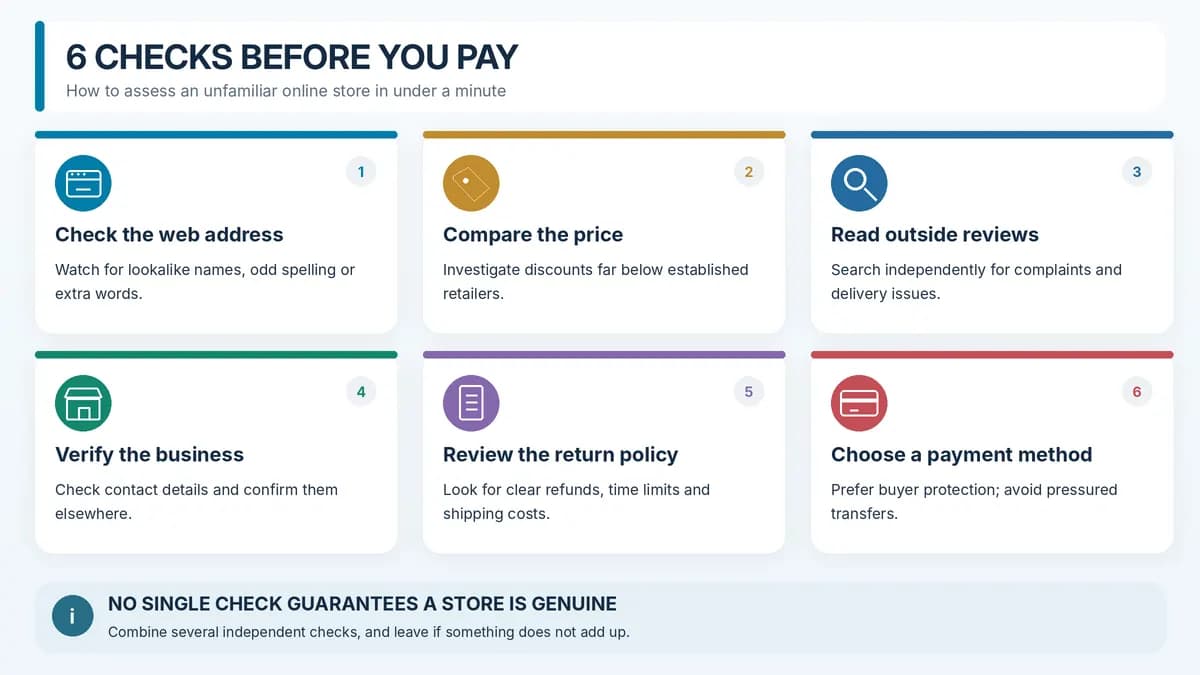
That means the safest approach is not to search for one perfect giveaway. Before paying an unfamiliar store, check whether several independent details make sense together: the web address, the price, the business behind the site, outside reviews, its policies and the way it wants you to pay.
Start With the Web Address, Not the Homepage
Scammers can copy the design, product photographs and branding of a real retailer. The web address is harder to overlook once you deliberately inspect it.
Look for misspellings, additional words, unexpected hyphens or domains designed to resemble a familiar company. A fake store might use a name that looks convincing at a glance while being completely unrelated to the retailer it appears to imitate.
The UK National Cyber Security Centre specifically warns that fraudulent shops can duplicate legitimate websites and use deceptive domains that resemble the real address. If you arrived through a social-media advertisement, email or text message, avoid assuming the link is genuine just because the page looks familiar.
If the store claims to be a well-known brand, open a fresh browser tab and find the company's official site independently rather than relying on the link that brought you there.
A Padlock Does Not Prove the Store Is Real
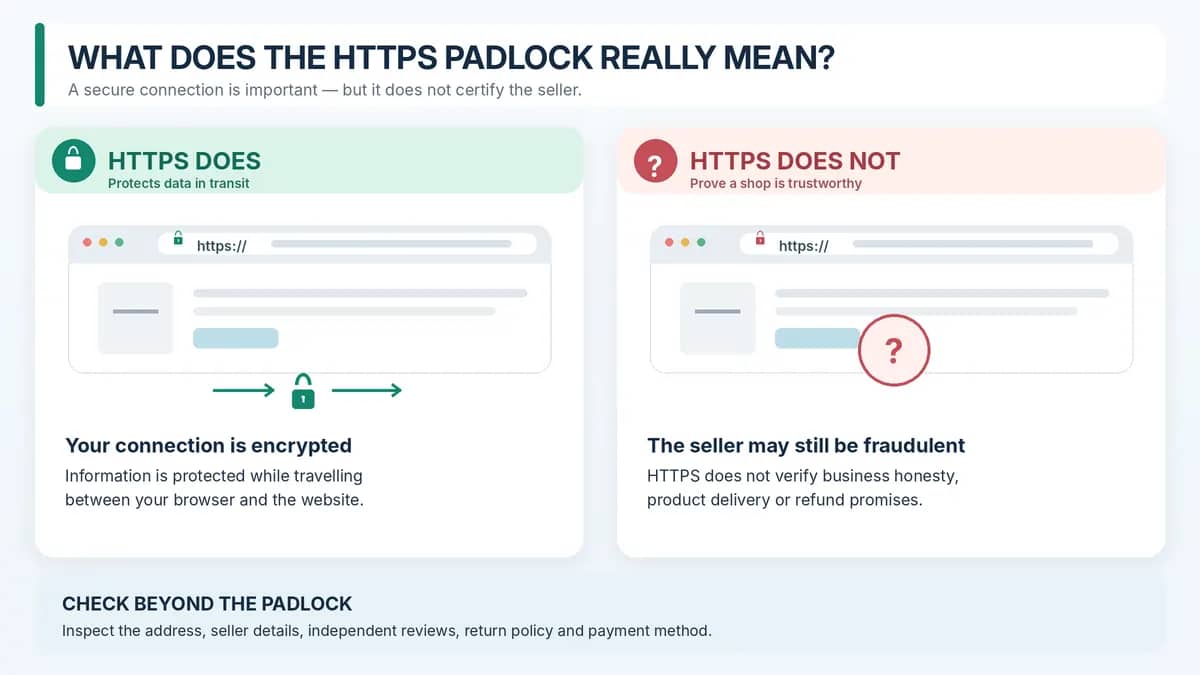
HTTPS is important, but its meaning is often misunderstood. It tells you that information travelling between your browser and the website is encrypted. It does not prove that the person operating the website is trustworthy.
The U.S. Federal Trade Commission explicitly warns that scammers can use encrypted HTTPS websites as well. A missing secure connection on a payment page is a reason not to proceed, but the presence of a padlock should never be treated as a seal of legitimacy.
Ask Whether the Price Makes Sense
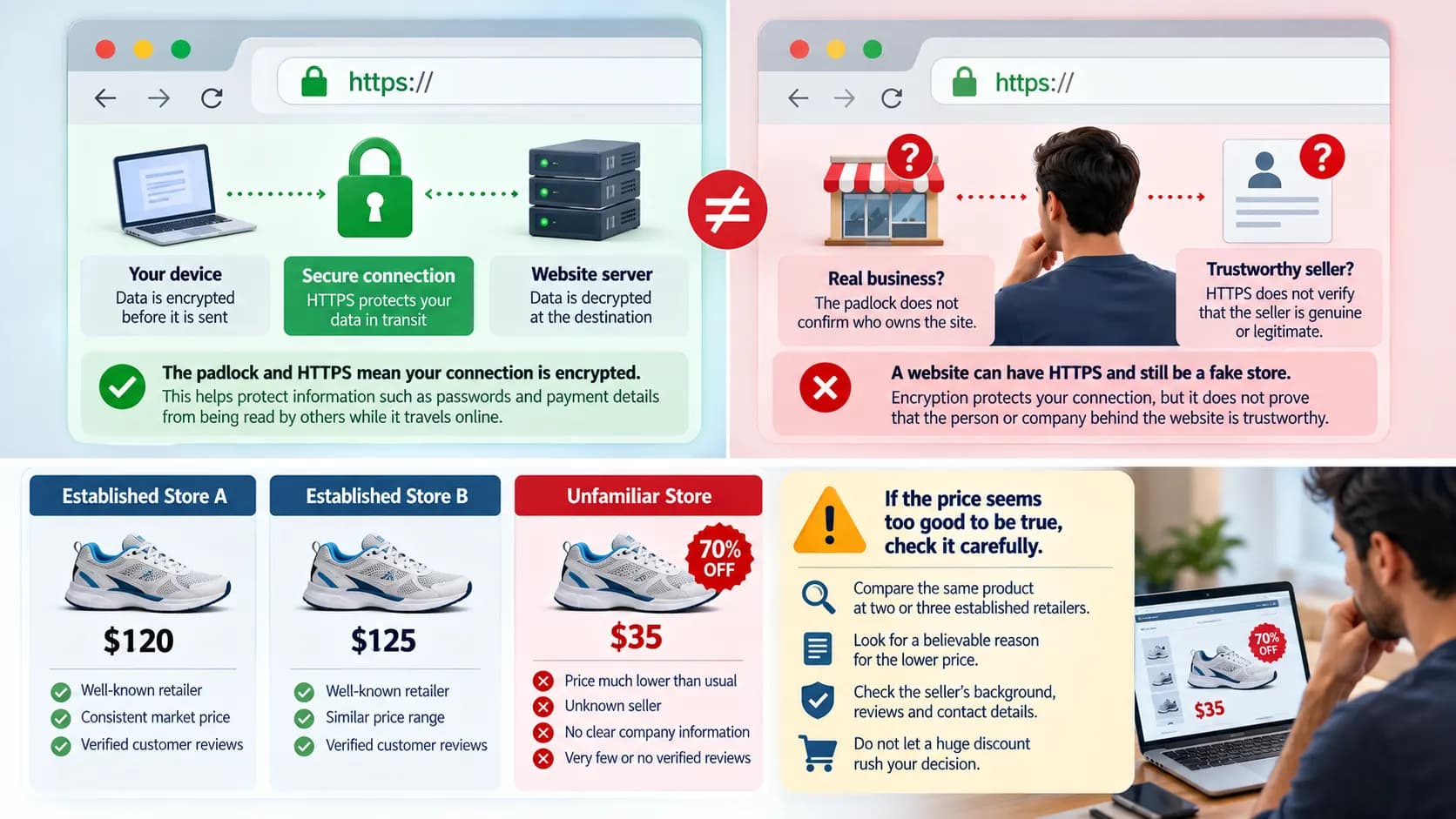
A discount is not evidence of fraud. Clearance sales, outlet pricing and genuine promotions exist. The warning sign is a price that becomes difficult to explain.
If several established retailers sell an expensive product for roughly the same amount and an unknown shop suddenly offers it for a fraction of that price, investigate before assuming you have discovered a bargain.
The FTC, FBI and other consumer-protection agencies repeatedly identify unusually low prices as a feature of fraudulent shopping sites. Scammers know that a dramatic bargain can make shoppers act before checking the seller.
Compare the same model or product at two or three established retailers. You are not trying to prove that every large discount is fake. You are asking whether the seller has a believable reason to be dramatically cheaper than everyone else.
Search for the Store Somewhere Other Than the Store
Reviews displayed on the retailer's own website are weak evidence because the retailer controls that page. Even external ratings need context because fake and manipulated reviews exist.
Search the store name independently with terms such as review, complaint or scam. The FTC recommends this approach before buying from unfamiliar sellers. Look across several sources rather than relying on one review platform or a perfect five-star score.
Pay attention to patterns. Recent reports describing orders that never arrived, counterfeit products, impossible refunds or unexplained card charges matter more than a handful of vague comments saying only that the store is great.
No search results at all do not automatically prove fraud. A genuinely new or small business may have little history. It simply means you have less independent evidence supporting the seller and should rely more heavily on the other checks.
Check Whether a Real Business Seems to Exist Behind the Website
Open the Contact, About, Shipping and Returns pages. Look for enough information to understand who is selling the product and what happens if something goes wrong.
A missing address, no meaningful contact method, a generic free email account, broken pages or vague policies are reasons to investigate further. The FBI has specifically advised shoppers to check retailer contact details such as the address, email and phone number.
Keep reading
How to Tell Whether a Supermarket Deal Is Actually Cheaper
Do not stop simply because an address is printed on the site. Search it independently. A fraudulent store can copy a real address, invent one or use details taken from another business.
Read the Return Policy Before You Need It
A genuine-looking returns page is not proof of legitimacy either, but its absence or poor quality can reveal problems.
Check how long you have to return an item, who pays return shipping, where returns must be sent and whether refunds go back to the original payment method. Watch for contradictions between different pages of the website.
Copied policies sometimes contain another company's name, irrelevant legal language or contact details that do not match the shop. Those inconsistencies deserve more weight than minor spelling mistakes by themselves.
Do Not Use Bad Grammar as Your Main Scam Detector
Older scam advice often told shoppers to look for poor spelling and amateur website design. Those clues can still matter, but they are much less reliable on their own.
Modern website templates and generative AI tools make it easier to produce convincing product descriptions, polished layouts and professional-looking customer service text. Canada's Cyber Centre now specifically warns that fraudulent shopping websites, including sites created with AI tools, can appear legitimate and convincing.
A beautifully written site can therefore be fraudulent, while a genuine small retailer may simply have an awkward website. Evidence from several independent checks is more useful than judging design quality alone.
The Payment Method Can Reveal More Than the Website
Be especially cautious when an unfamiliar retailer insists that you pay using a method that is difficult to reverse or dispute.
The FTC warns shoppers against sellers that demand payment through gift cards, wire transfers, cryptocurrency or certain payment apps. These methods can make recovering money much more difficult after a scam.
When available, a credit card or reputable payment service with buyer protection generally gives shoppers a better path to dispute a transaction if the product never arrives or is materially different from what was advertised. Exact protections vary by country, card issuer and payment service, so check the terms that apply to you.
On an established marketplace, keep the transaction inside the marketplace's official payment system. The FTC warns that paying a seller outside the platform can cause you to lose protections the marketplace would otherwise provide.
Be Careful When the Shop Came From a Social Media Ad
Seeing an advertisement on a major social network does not verify the retailer. Fraudulent stores can buy ads just as legitimate businesses can.
The FTC has warned about bogus shopping sites promoted through social media using stolen photographs and logos, often advertising expensive products at unusually low prices.
If an ad introduces you to a store you have never heard of, treat the advertisement as the beginning of your research, not proof that someone else has already checked the business.
A New Domain Can Be a Clue, Not a Verdict
Domain-registration information can sometimes help. If a website claims to have traded for 15 years but its domain appears to have been created very recently, that contradiction deserves investigation.
But domain age should never decide the case by itself. New legitimate businesses create new websites, registration details can be privacy-protected and older domains can change ownership or be compromised. Treat domain information as supporting evidence rather than a pass-or-fail test.
Use a 60-Second Check Before Entering Your Card
Read the exact domain name carefully and check whether it matches the business the site claims to represent.
Compare the product price with established retailers and question discounts that are difficult to explain.
Search the store name independently with words such as review, complaint and scam.
Check the contact details, shipping information and return policy, then verify important details outside the website.
Remember that HTTPS protects the connection but does not prove the seller is legitimate.
Look at the payment options and avoid sellers that insist on hard-to-reverse methods such as gift cards, wire transfers or cryptocurrency.
If several things still do not add up, leave the site rather than letting a limited-time offer force the decision.
The goal is not to prove with absolute certainty that every unfamiliar store is genuine. It is to decide whether there is enough independent evidence to justify trusting it with your money and payment information.
A fake shop can copy a logo, product photographs, reviews and even the appearance of a secure checkout. It is much harder for it to make its domain history, outside reputation, business identity, policies, prices and payment behaviour all withstand independent checking. That is why several small checks together are more useful than one impressive-looking sign.
Reference notes
Sources and further reading
- FTC Consumer Advice (opens in a new tab)https://consumer.ftc.gov/articles/online-shopping
- FTC Consumer Advice (opens in a new tab)https://consumer.ftc.gov/articles/buying-online-marketplace
- FTC Consumer Advice (opens in a new tab)https://consumer.ftc.gov/consumer-alerts/2024/11/dont-let-scammers-get-way-your-holiday-shopping
Show all 7 sources
- Ncsc (opens in a new tab)https://www.ncsc.gov.uk/guidance/shopping-online-securely
- Ic3 (opens in a new tab)https://www.ic3.gov/PSA/2020/PSA200803
- Cyber Gc Ca (opens in a new tab)https://www.cyber.gc.ca/en/guidance/shopping-online-safely-itsap00071
- Stopthinkfraud Campaign (opens in a new tab)https://stopthinkfraud.campaign.gov.uk/how-to-spot-fraud/how-to-spot-a-fake-website/
Our editorial promise
Prepared with clarity and care.
This guide completed our editorial review before publishing. If something needs attention, report a correction or contact the publisher.
About this article
- Published:
- Last updated:
- Author:
- Ceyora Insights
- Review status:
- Editorially reviewed
- Sources:
- 7
- Corrections:
- Report an issue