

A bright sale sign can make a product look like the obvious bargain. But imagine one pack costs $4.50, another says SALE $5.99, a larger version costs $8.50 and a fourth is offered at two for $10. The biggest discount is not necessarily the cheapest purchase.
The quickest way to judge most supermarket deals is to compare the price for the same amount of product. That usually means looking at the unit price, then checking whether the promotion makes you buy more than you actually need.
Start With the Unit Price
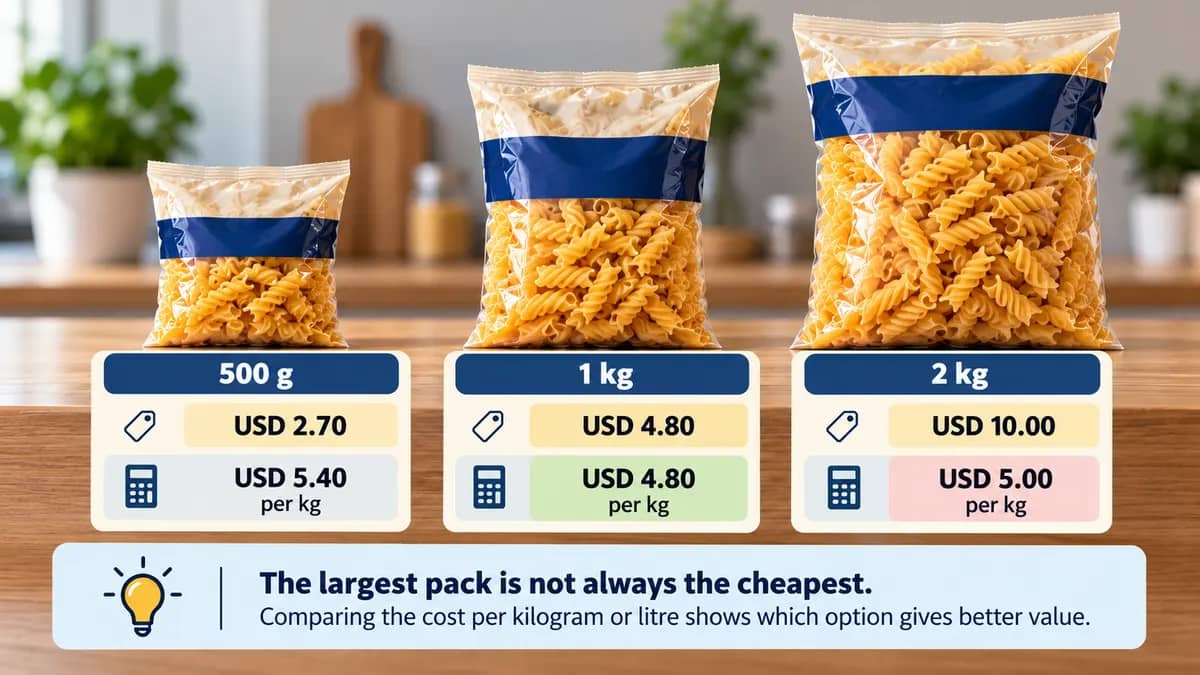
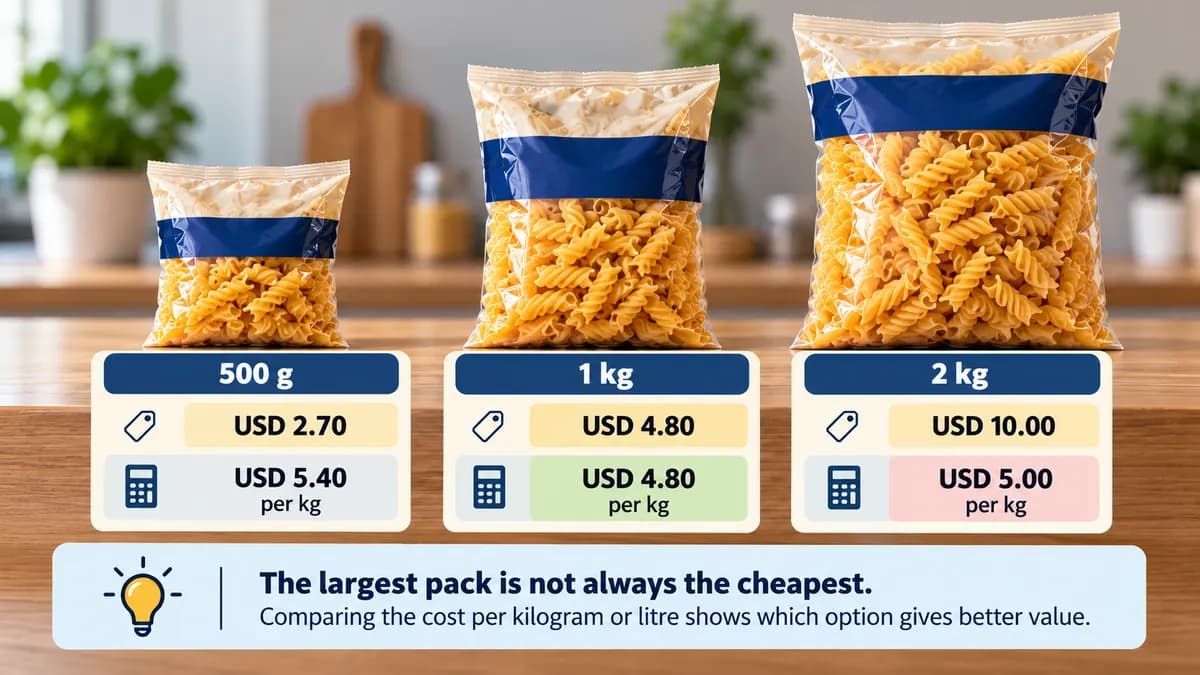
The main shelf price tells you what you will pay at the checkout. The unit price tells you what a standard amount costs, such as the price per kilogram, litre, 100 grams or individual item. That makes products of different sizes much easier to compare.
Suppose a 500 g pack costs $4.50 while a 750 g pack costs $6.30. The first works out to $9.00 per kilogram. The second costs $8.40 per kilogram. The larger pack costs more at the checkout, but you are paying less for each kilogram.
Consumer research from the UK Competition and Markets Authority has highlighted unit pricing as an important tool for grocery comparisons, while also finding that inconsistent or difficult-to-read displays can make those comparisons harder than they should be.
The Bigger Pack Is Not Always the Better Deal
Large packs often look economical, and sometimes they are. But there is no rule saying the biggest package must have the lowest unit price. A smaller pack may be discounted, a larger pack may carry a premium, or two sizes may simply be priced differently.
This is why words such as family size, value pack or extra large should not replace a price comparison. Treat them as descriptions of the package, not proof of savings.
Is a Multi-Buy Offer Really Saving You Money?
Multi-buy offers introduce a second question. A deal can reduce the price per item while increasing the total amount you spend.
Imagine one bottle costs $4. Buying three separately would cost $12, while a three-for-$10 offer saves $2 if you genuinely need three. But if you originally intended to buy only one, the promotion has moved your spending from $4 to $10.
That does not make the promotion fake. It means there is a difference between getting a lower price per item and spending less money overall.
A Loyalty Discount Can Be Real Without Being the Cheapest
Loyalty pricing often creates suspicion because shoppers see one price for members and another for everyone else. Evidence does not support assuming that every loyalty discount is manufactured.
The UK Competition and Markets Authority reviewed around 50,000 loyalty-priced grocery products and found that 92% offered a genuine saving against the product's usual price. At the five supermarkets examined, the average saving on loyalty-priced products was around 17% to 25%.
But there is an important catch. A genuine saving against one product's normal price does not prove that it is the cheapest comparable product on the shelf. Another brand, pack size or supermarket may still offer better value.
Do Not Compare a Sale Only With Its Old Price
A sign reading WAS $8, NOW $6 encourages you to compare $6 with $8. That tells you whether this particular product has become cheaper. It does not tell you whether $6 is the best available price.
An equivalent supermarket-own product might already cost $5 without any promotional sign. Instead of asking only, “How much am I saving compared with before?”, also ask, “What would a comparable product cost me right now?”
Shrinkflation Can Change the Value Without Changing the Shelf Price
Keep reading
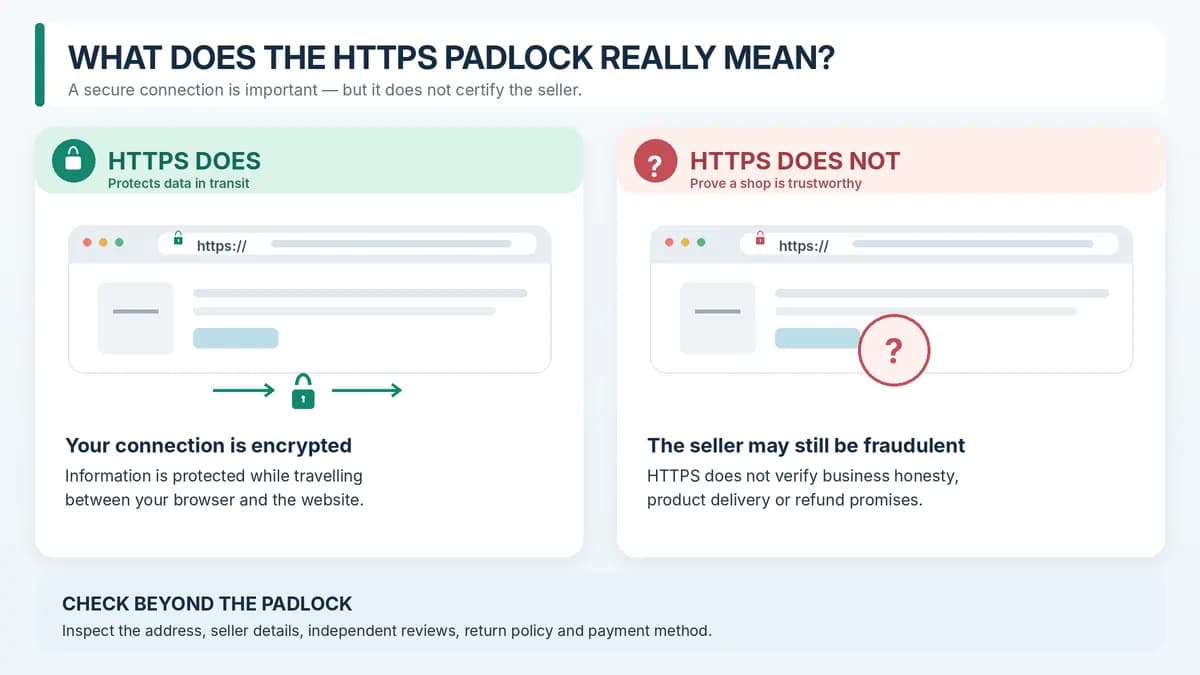
How to Tell if an Online Store Is Fake Before You Pay
Price comparisons become harder when the package changes. Suppose a product used to contain 500 g for $5 and now contains 450 g for the same $5. The visible shelf price has not moved, but the cost has risen from $10 per kilogram to about $11.11 per kilogram.
This is why it is worth checking the weight or volume occasionally on products you buy regularly. Shoppers often remember a familiar price more easily than the exact number of grams inside the package.
Bulk Buying Only Saves Money If You Use What You Buy
A lower unit price can still become poor value if some of the product is wasted. This matters especially with fruit, vegetables, dairy products, baked goods and other foods with limited shelf lives.
Bulk buying is easier to justify when the unit price is genuinely lower, the product stores well and you would have bought that quantity eventually anyway. Paying 15% less per kilogram is not much of a saving if a quarter of the food ends up in the bin.
Do Not Forget the Store Brand
Promotional signs naturally draw attention to the product being advertised. But a famous brand marked 30% off may still cost more than a supermarket's own comparable version.
This does not mean the products are identical in taste, ingredients or quality. It simply means a percentage discount answers one question: how much cheaper is this product than its reference price? It does not automatically answer: which suitable product costs me the least?
Why $4.99 Can Feel Different From $5.00
Supermarkets and other retailers frequently use prices ending in 9. Research on the left-digit effect has shown that, in some comparisons, people perceive a price such as $4.99 as noticeably lower than $5.00 because the first digit changes, even though the mathematical difference is only one cent.
The effect is not universal and does not mean every shopper is fooled by a 9-ending price. The practical lesson is simply to compare the complete price rather than letting the first digit or a familiar sale format make the decision for you.
Use This 10-Second Deal Check
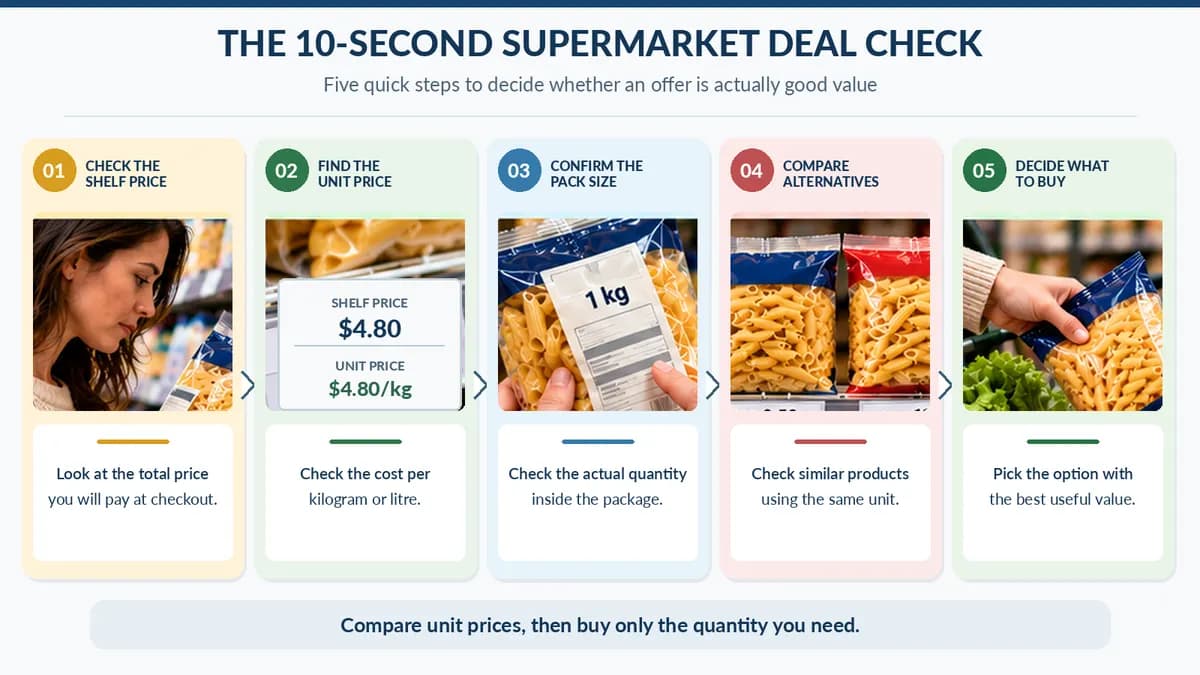
You do not need a calculator for every supermarket purchase. Most deals can be screened quickly with five checks.
Check the unit price and make sure both products use a comparable measurement.
Check the pack size, especially if it is a product you buy regularly.
Look at how many items the promotion requires you to buy.
Compare at least one similar alternative, including a store-brand option where appropriate.
Ask whether you will actually use the extra quantity.
The Cheapest Unit Price Is Not Always the Best Purchase
Suppose a 500 g box of cereal costs $4.50, a 750 g box costs $6.30 and a promotion offers two 500 g boxes for $8. Their unit prices are $9.00, $8.40 and $8.00 per kilogram respectively.
The multi-buy has the lowest unit price. But you must spend $8 and take home a full kilogram to get it. If you only need one small box and are trying to keep today's bill down, the $4.50 pack may still be the better purchase for you.
That distinction matters. Best unit value and best personal buying decision are not always the same thing.
A Deal Can Be Genuine and Still Not Be Right for You
Supermarket promotions are not automatically misleading. Loyalty discounts can be genuine, multi-buy offers can reduce unit costs and large packs can provide excellent value.
The mistake is assuming that words such as sale, member price, family size or save 30% have already answered the value question for you. They have not. They describe one part of the offer.
Reference notes
Sources and further reading
Our editorial promise
Prepared with clarity and care.
This guide completed our editorial review before publishing. If something needs attention, report a correction or contact the publisher.
About this article
- Published:
- Last updated:
- Author:
- Ceyora Insights
- Review status:
- Editorially reviewed
- Sources:
- 5
- Corrections:
- Report an issue