


A country can have world-class hospitals, advanced medicines and some of the most expensive medical care on Earth and still struggle with preventable deaths, unequal access or people delaying treatment because of cost. That sounds contradictory until you separate how much a country spends from what its health system actually achieves.
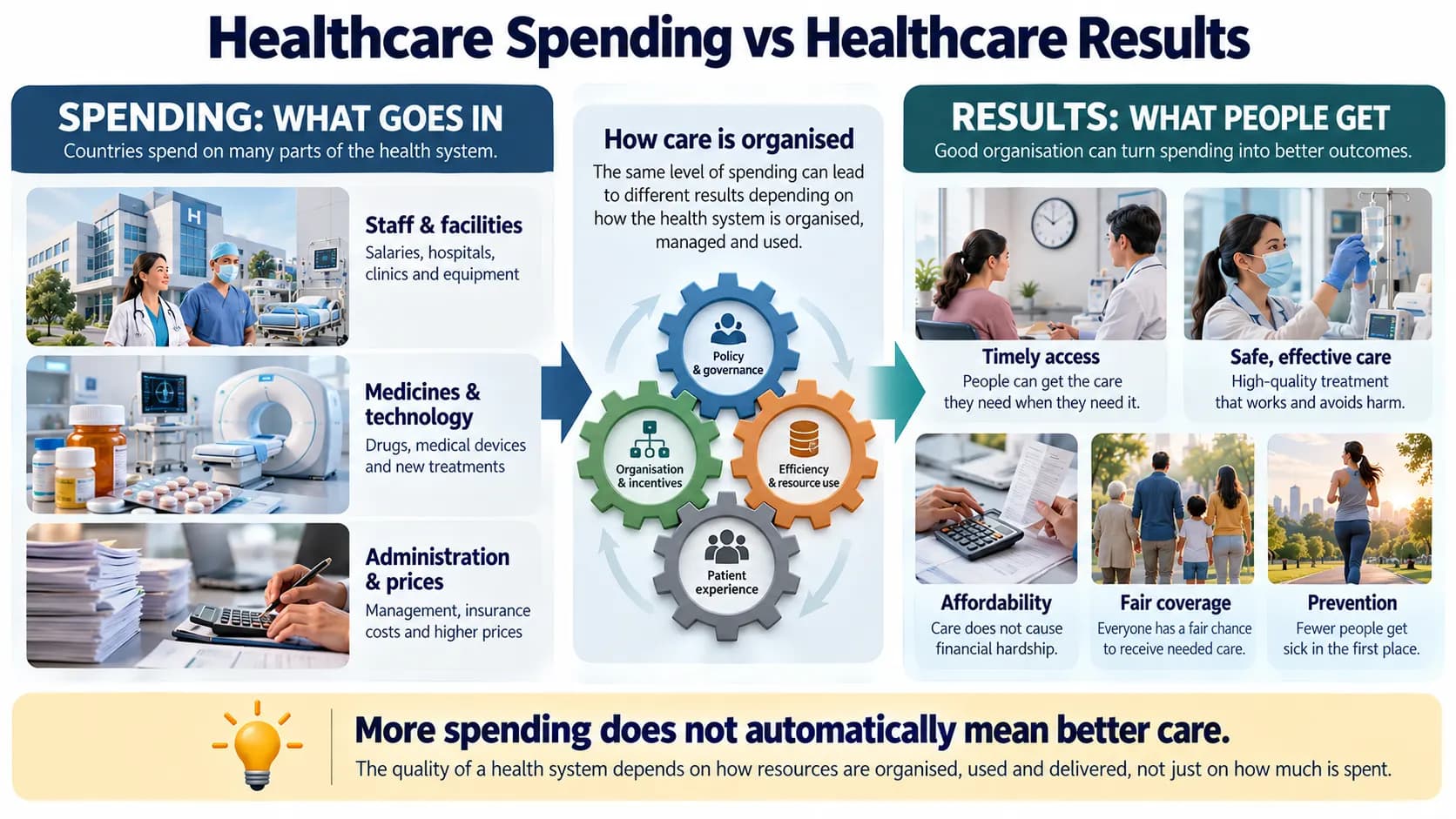
More money can improve healthcare, but spending alone is not a scorecard. A strong system has to turn its resources into timely access, effective treatment, prevention, fair coverage and protection from financial harm. It also operates inside a society where income, housing, diet, pollution, violence and other factors influence health.
More Money Does Not Automatically Mean Better Healthcare
The United States is a useful example of why spending and performance are different measures. OECD data estimate that the U.S. devoted 17.2% of GDP to health in 2024, compared with an OECD average of 9.3%. Yet the Commonwealth Fund's 2024 comparison of 10 high-income countries ranked the U.S. last overall, while Australia, the Netherlands and the United Kingdom ranked highest.
That does not mean high spending causes poor health. The comparison is better understood as a warning against assuming that a bigger budget automatically produces a better system. Prices, administration, coverage, workforce capacity, prevention and the way care is organised can all change what a country gets for its money.
What Is a Health System, Anyway?
It is much bigger than hospitals. A health system includes doctors and nurses, primary-care clinics, pharmacies, laboratories, emergency services, hospitals, insurers, government agencies, public-health programmes, rehabilitation, long-term care, digital records and the rules used to finance and coordinate all of them.
That is why judging a country's healthcare by its most impressive hospital can be misleading. A person may never need a transplant centre, but almost everyone benefits from vaccination, safe maternity care, medicines, mental-health support, screening and a clinician who can spot a problem before it becomes an emergency.
What Should a Good Health System Actually Do?
A useful way to compare systems is to stop asking which model has the best label and ask what it accomplishes.
Give people timely access to needed care.
Provide care that is safe and effective.
Protect households from severe financial hardship caused by medical costs.
Reduce unfair gaps in care linked to income, location or other circumstances.
Prevent illness and manage problems early rather than relying mainly on expensive hospital treatment.
Use staff, medicines, technology and public money efficiently.
WHO defines universal health coverage around a similar idea: people should be able to obtain the quality health services they need, when and where they need them, without financial hardship. That is broader than simply making a hospital visit free.
Why Can Healthcare Become So Expensive?
Healthcare costs rise for many reasons. Prices for medicines, procedures and hospital services can differ sharply between countries. Administrative systems can also consume resources through billing, insurance rules, authorisations and duplicated paperwork.
Ageing populations often need more chronic-disease management, medicines and long-term care. New treatments and technologies can save or extend lives but may also be costly. Workforce shortages create another problem: a country can have money available but not enough trained doctors, nurses or specialists to turn that spending into appointments and treatment.
Why Doesn't More Spending Automatically Produce Better Results?
Imagine two health systems each receive another billion dollars. One spends most of it treating advanced disease in expensive hospitals. The other strengthens primary care, vaccination, early diagnosis, diabetes management, maternity services and smoking prevention.
Both systems spent more. The long-term results could be very different because the timing and purpose of the spending differ. More resources help only when they reach the right problems in an effective way.
Why Primary Care Matters More Than It Looks
A family doctor or community clinic can look less impressive than a robotic operating theatre, but primary care can prevent people from needing that expensive hospital treatment in the first place.
Regular primary care can identify high blood pressure, diabetes, infections, mental-health problems and warning signs of serious disease earlier. WHO describes primary healthcare as the most inclusive, equitable and cost-effective approach to achieving universal health coverage.
What Does Universal Healthcare Really Mean?
Universal healthcare does not mean that every medical service is free, that the government owns every hospital or that every country follows the same model.

Keep reading
Why Is the 2026 Ebola Outbreak So Difficult to Contain?
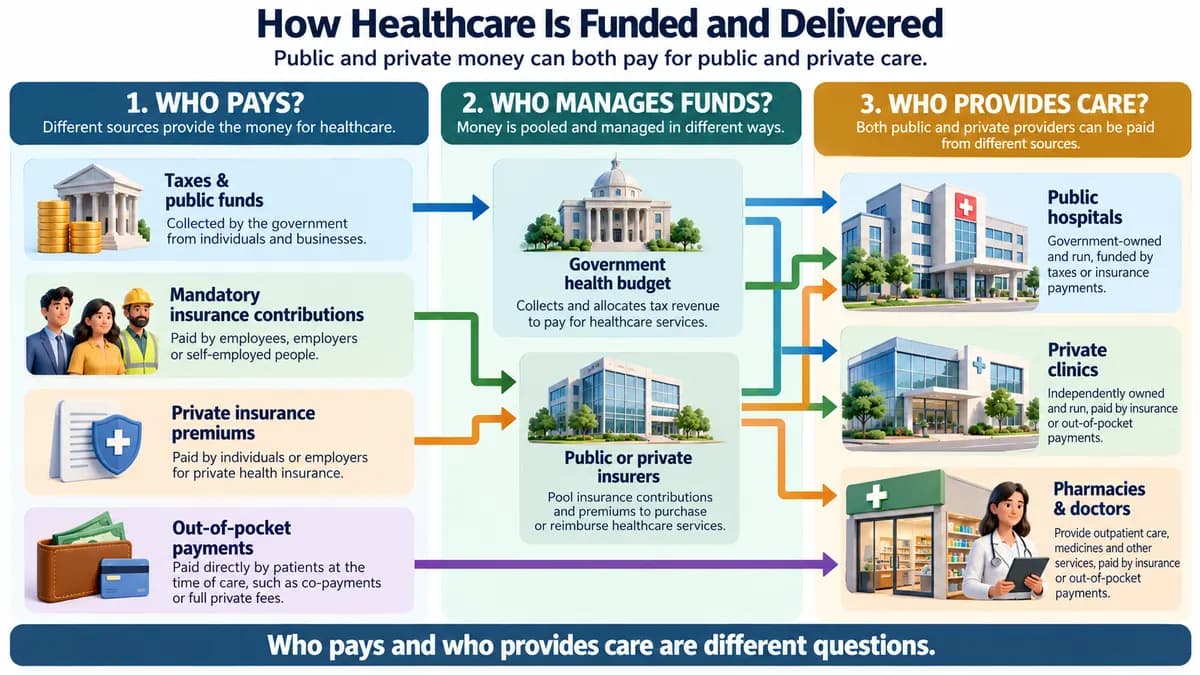
Countries can finance coverage through taxes, mandatory insurance or combinations of public and private funding. Care itself may be delivered by public hospitals, private clinics, independent doctors or a mixture. The central question is whether people can obtain needed quality care without being pushed into financial hardship.
Public vs Private Healthcare Is Usually the Wrong Question
Real health systems rarely fit neatly into a public-versus-private box. A government can pay for care delivered by private doctors. Private insurers can operate under strict public rules. Public hospitals can exist alongside private clinics.
More useful questions are: who is covered, who pays, who provides the care, how prices are set, how quickly patients are treated, and what happens to someone who cannot afford the normal cost.
Why Can Universal Systems Still Have Long Waiting Times?
Making care affordable does not create unlimited capacity. A country still has a finite number of doctors, nurses, operating rooms, scanners and hospital beds. If demand grows faster than that capacity, people may wait.
This is an important trade-off. Financial access and timely access are related, but they are not identical problems. A service can be affordable yet slow to obtain.
Why Can Faster Private Care Still Mean Worse Access?
A system can offer extremely fast treatment to people who can pay while others delay or avoid care because of cost or insurance gaps. From one patient's perspective, the system may feel wonderfully fast. From a population perspective, access may still be unequal.
That is why waiting time alone cannot tell you which healthcare system works best. Cost barriers, availability, quality and fairness matter as well.
Which Country Has the Best Healthcare System?
There is no universally accepted winner because rankings use different definitions and measures. In the Commonwealth Fund's 2024 comparison, Australia ranked first overall, followed by the Netherlands and the United Kingdom. Yet the report also stresses that every country has stronger and weaker areas.
Australia, for example, ranked highly overall but performed less strongly on some access and care-process measures. A league table can be useful, but it cannot answer every question about quality, choice, waiting, affordability or fairness.
Healthcare Cannot Fix Everything That Makes Us Unhealthy
Life expectancy and national health statistics are influenced by healthcare, but also by forces outside hospitals and clinics. Income, housing, nutrition, smoking, exercise, pollution, road safety, violence and social conditions can all affect how long and how well people live.
This matters when comparing countries. Poor population outcomes cannot automatically be blamed on doctors, just as a long life expectancy cannot automatically be credited entirely to the healthcare system.
Billions of People Still Lack Full Health Coverage
The global challenge is much larger than deciding which wealthy country has the best system. WHO's 2025 global monitoring report estimates that about 4.6 billion people lacked coverage for essential health services in 2023. In 2022, about 2.1 billion people experienced financial hardship from out-of-pocket health spending.
For billions of people, the central healthcare question is not whether one advanced system ranks above another. It is whether essential care is available and financially reachable at all.
How to Judge a Health System Without Falling for One Number
When you see a claim that one country has the world's best or worst healthcare, look beyond a single statistic.
Check access: can people actually obtain primary, emergency and specialist care when they need it?
Check quality: does treatment follow good standards and improve health?
Check affordability: do people delay care or face financial hardship because of cost?
Check equity: are outcomes and access very different across income groups or regions?
Check efficiency: how much health benefit is produced for the resources spent?
Check outcomes carefully: use preventable and treatable mortality alongside broader measures instead of relying on life expectancy alone.
Reference notes
Sources and further reading
- Commonwealthfund (opens in a new tab)https://www.commonwealthfund.org/publications/fund-reports/2024/sep/mirror-mirror-2024
- Oecd (opens in a new tab)https://www.oecd.org/en/publications/health-at-a-glance-2025_15a55280-en/united-states_3517f35e-en.html
- Oecd (opens in a new tab)https://www.oecd.org/en/publications/health-at-a-glance-2025_8f9e3f98-en/full-report/health-expenditure-in-relation-to-gdp_6e4c2773.html
Our editorial promise
Prepared with clarity and care.
This guide completed our editorial review before publishing. If something needs attention, report a correction or contact the publisher.
About this article
- Published:
- Last updated:
- Author:
- Ceyora Insights
- Review status:
- Editorially reviewed
- Sources:
- 6
- Corrections:
- Report an issue