

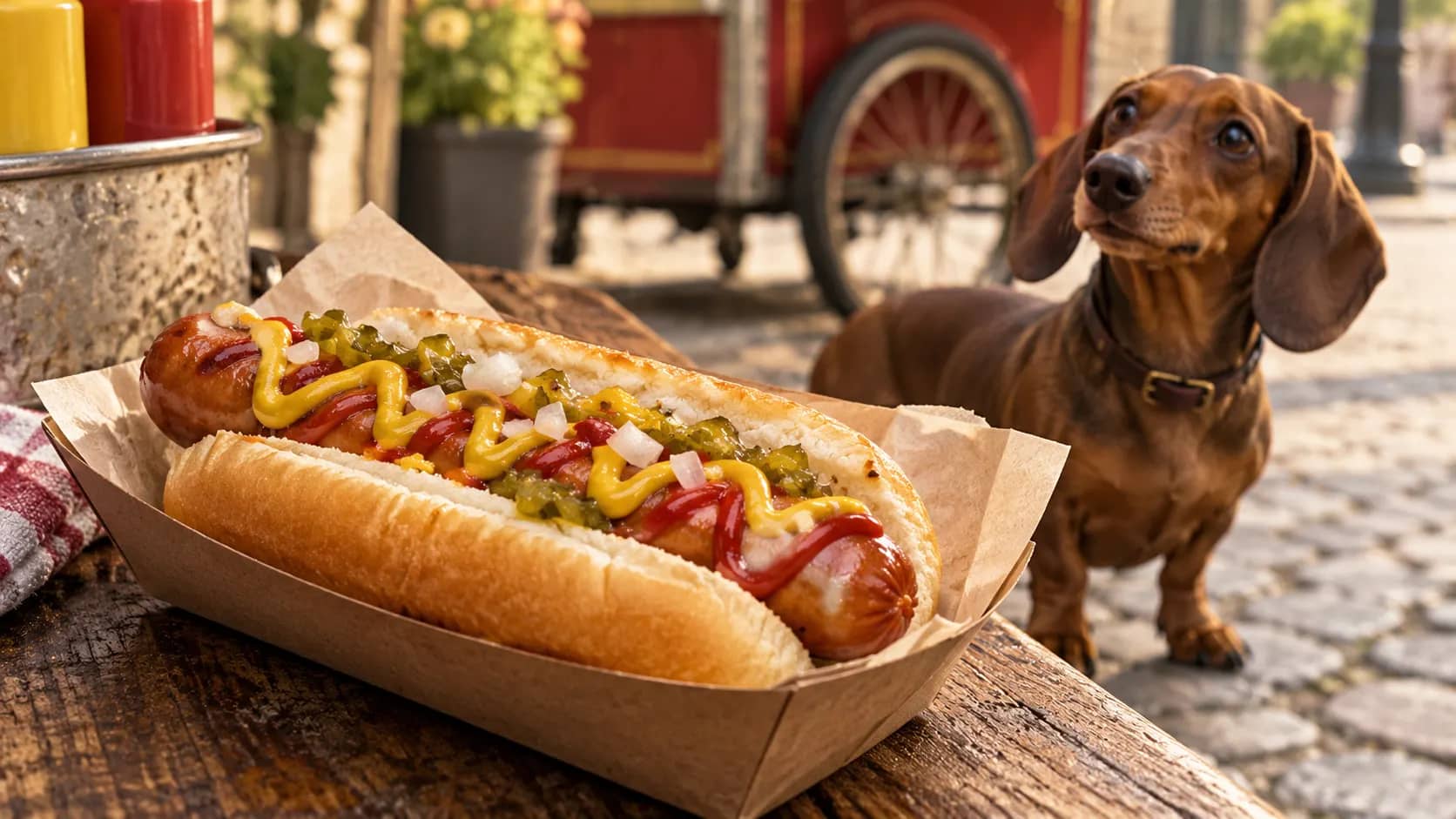
There is no dog in an ordinary hot dog, so why does one of the world’s most familiar foods have such a strange name? The most likely answer is not a single clever inventor. The name seems to have grown out of German sausage traditions, jokes about dachshunds and American slang in the late 1800s.
That makes the story more interesting, not less. Hot-dog history is full of confident legends, but the surviving evidence suggests the name developed gradually. By the mid-1890s, Americans were already using the expression for sausages, which means some of the later stories about who supposedly invented the term cannot be the whole explanation.
Before It Was a Hot Dog, It Was a Sausage
The food has European sausage roots. German-speaking immigrants brought frankfurters, wieners and related sausages to the United States during the 19th century, where they became practical street food in growing cities.
The names themselves point back to central Europe. Frankfurter is associated with Frankfurt, Germany, while wiener comes from Wien, the German name for Vienna. Historians disagree about which place should get credit for inventing the ancestor of the modern hot dog, so it is safer to think of the American version as developing from a broader European sausage tradition rather than one uncontested birthplace.
Why Did Dogs Get Involved?
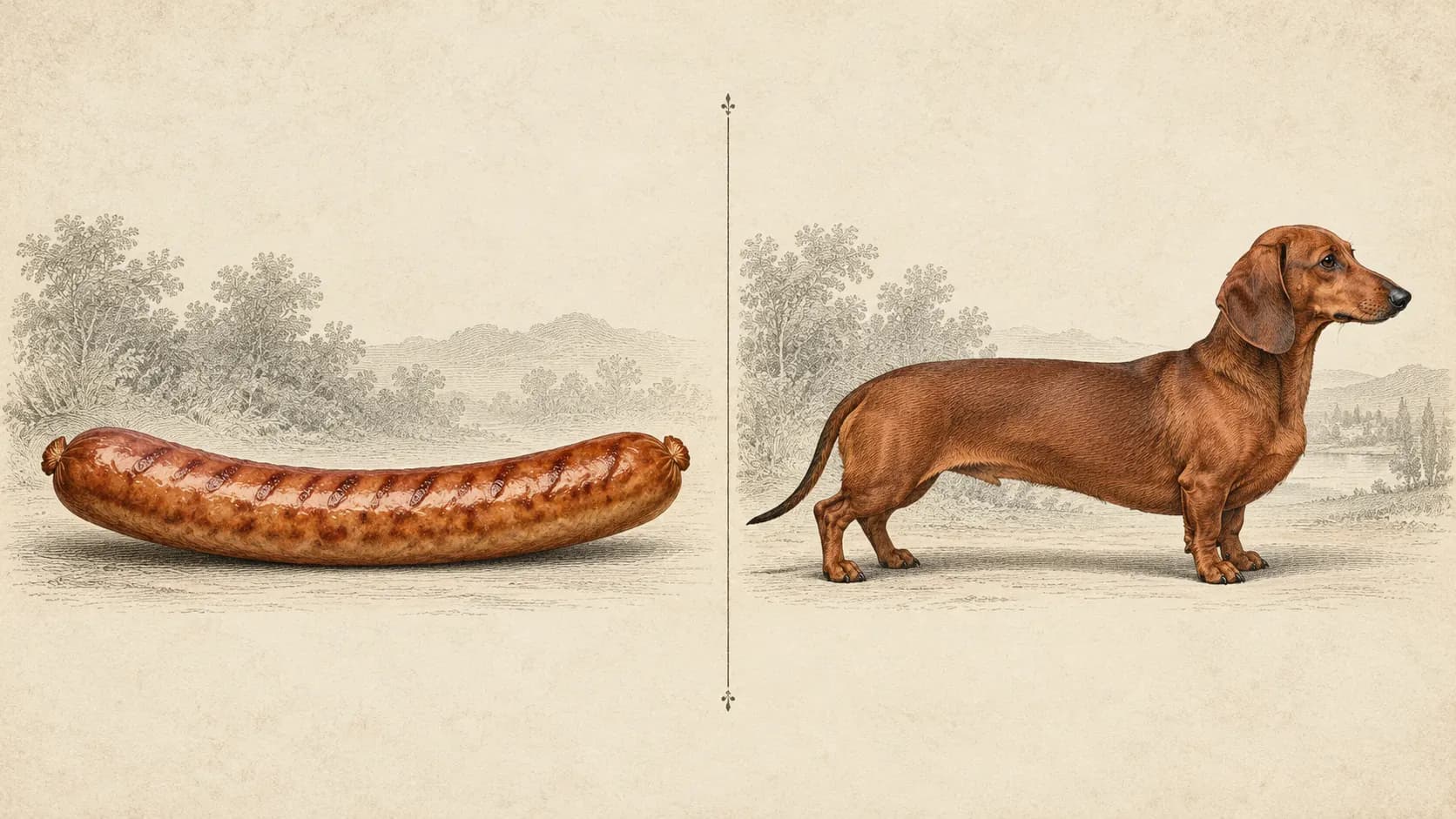
The dachshund connection is one of the strongest clues. Long, thin sausages were compared with the low, long-bodied German dog, and terms such as dachshund sausage or little-dog sausage circulated in popular descriptions.
German immigrants brought both sausage traditions and dachshunds to the United States. That made the comparison easy to understand. A sausage that looked like a little German dog was an obvious target for jokes, and the word dog gradually became attached to the food.
Did Hot Dogs Ever Actually Contain Dog?
The name does not mean that ordinary American hot dogs were made from dogs. Part of the joke appears to have been darker: cheap sausages had a reputation for mysterious ingredients, and people sometimes joked about what might really be inside them.
Historical accounts of hot-dog culture describe suspicion around inexpensive sausage meat and note that the term itself carried a joking suggestion about questionable contents. That kind of humour likely helped the dog comparison stick.
The Famous Cartoon Story Is Probably Not the Answer
One of the best-known stories says a newspaper cartoonist saw vendors selling hot dachshund sausages, drew a dachshund inside a bun and labelled it hot dog because he could not spell dachshund.
It is a perfect origin story. The problem is that historians have never found the supposed cartoon. The National Hot Dog and Sausage Council also notes that no copy has been located despite extensive searches.
There is an even bigger problem for the legend: the expression hot dog was already in circulation before the commonly repeated 1901 cartoon date. That makes it very unlikely that a single cartoon suddenly created the name.
The Term Was Already Around by the Mid-1890s
Smithsonian cites an 1895 Yale Record reference describing students eating hot dogs. The National Hot Dog and Sausage Council also points to Yale usage in the 1890s, including dog wagons selling hot dogs around student dormitories.

Keep reading
Why Is Greenland Called Greenland When It’s Mostly Ice?
That evidence is important because it shows the phrase was already understandable to readers. It was not a strange new invention that needed explanation. By then, hot dog was already functioning as slang for the food.
Who Put the Sausage in a Bun?
That story is uncertain too. Charles Feltman, a German immigrant and Coney Island food vendor, is widely credited with popularising sausages served in split rolls during the 1860s. Smithsonian notes accounts placing his sausage-in-a-bun sales as early as 1867.
Historians disagree over whether Feltman truly invented the idea. Portable sausages and bread were simple enough that more than one vendor could have arrived at the same combination. What is much clearer is that Feltman helped make the format successful at Coney Island.
How Coney Island Helped Make Hot Dogs Famous
Coney Island was almost perfect for the food. Visitors wanted something cheap, portable and easy to eat while walking between beaches, rides and entertainment. Sausages in rolls fit that environment.
By the late 19th and early 20th centuries, hot dogs were spreading through amusement areas, fairs, racetracks and baseball grounds. Nathan Handwerker later opened Nathan’s Famous at Coney Island in 1916, helping strengthen the food’s association with the boardwalk.

Baseball Helped Turn the Hot Dog Into an American Icon
The hot dog fit another growing form of mass entertainment: spectator sports. It was inexpensive, handheld and easy for vendors to sell to crowds. Fairs, racetracks, circuses and especially baseball grounds helped move it far beyond immigrant neighbourhoods.
By the early 20th century, the food had become thoroughly American even though its sausage roots were European. Smithsonian describes the term hot dog as ubiquitous by the time Nathan Handwerker opened his Coney Island stand in 1916.
Frankfurter, Wiener and Hot Dog: Are They the Same Thing?
The words overlap, but their histories are different. Frankfurter points toward Frankfurt. Wiener points toward Wien, or Vienna. Hot dog became the distinctly American slang name that eventually dominated everyday speech.
Recipes and regional usage vary, so the terms are not perfectly interchangeable everywhere. But in ordinary American conversation, hot dog became the broad familiar label for the sausage served in a bun.
So Who Invented the Name Hot Dog?
The responsible answer is that we do not know. There is no reliable evidence pointing to one cartoonist, vendor or customer as the person who definitely coined the term.
The strongest historical picture is gradual: German-style sausages became popular in American cities, their shape invited dachshund jokes, cheap sausage inspired suspicious humour, and the slang expression hot dog spread until it became the ordinary name.
That messier explanation is probably closer to how language usually changes. A funny nickname gets repeated, more people understand it, and eventually everyone forgets that the name once sounded strange.
Reference notes
Sources and further reading
- Smithsonianmag (opens in a new tab)https://www.smithsonianmag.com/arts-culture/hot-dogs-are-us-68009224/
- Smithsonianmag (opens in a new tab)https://www.smithsonianmag.com/arts-culture/red-hot-history-lesson-how-hot-dog-rose-coney-island-carts-platters-presidential-picnics-180988086/
- Smithsonianmag (opens in a new tab)https://www.smithsonianmag.com/history/origins-coney-island-hot-dog-uniquely-american-story-180959659/
Our editorial promise
Prepared with clarity and care.
This guide completed our editorial review before publishing. If something needs attention, report a correction or contact the publisher.
About this article
- Published:
- Last updated:
- Author:
- Ceyora Insights
- Review status:
- Editorially reviewed
- Sources:
- 5
- Corrections:
- Report an issue