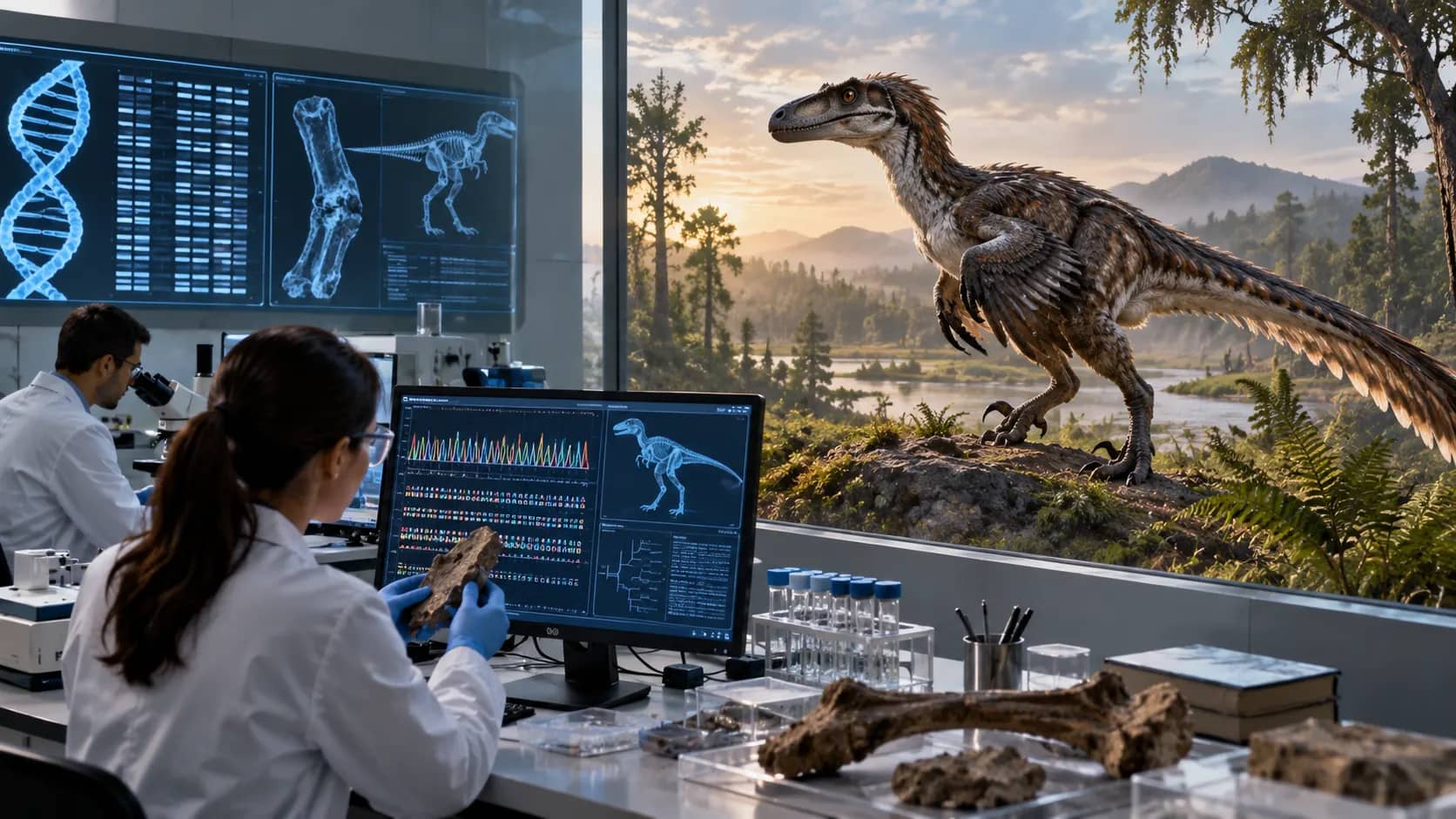
Jurassic World feels slightly more believable today than Jurassic Park did in 1993. Scientists can edit genes. Animals have been cloned. Researchers can recover DNA from ancient remains, and serious projects now discuss whether traits of relatively recent extinct species could be recreated.
That still does not put a living Tyrannosaurus rex within reach.
The biggest obstacle is not building the enclosure or finding a large enough egg. It comes much earlier: scientists do not have a usable dinosaur genome. Non-bird dinosaurs disappeared about 66 million years ago, and DNA is far less durable than fossilized bone.
Jurassic World Rebirth continues the franchise's fascination with dinosaur DNA and genetic material, but that part of the story remains firmly on the science-fiction side of the line.
Could We Really Find Dinosaur DNA in a Mosquito?
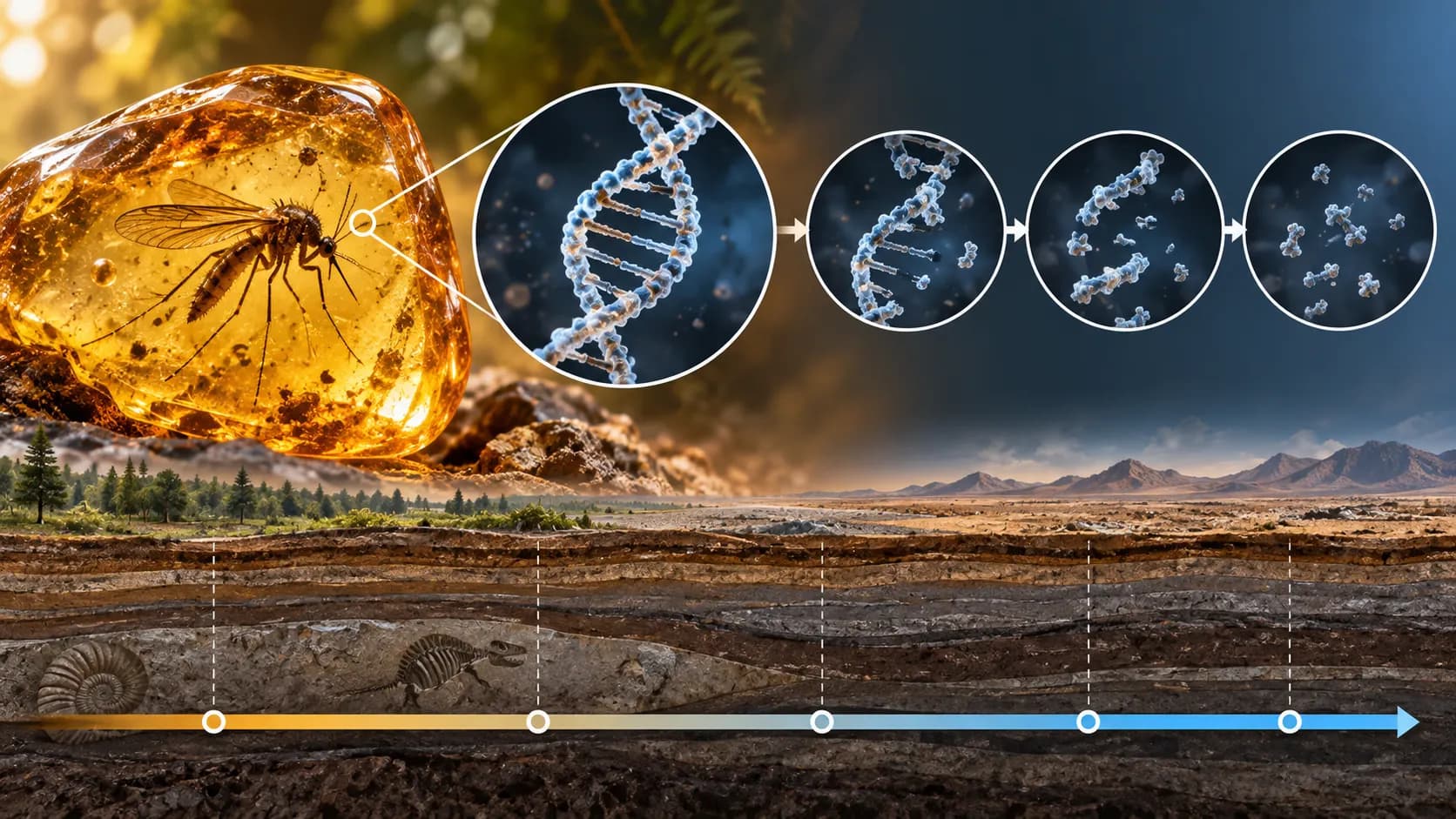
The franchise's famous idea is wonderfully simple: a mosquito drinks dinosaur blood, becomes trapped in tree resin, the resin turns to amber, and scientists recover the dinosaur DNA preserved inside.
Amber can preserve insects with remarkable detail, but that does not mean the blood and DNA inside them remain intact for tens of millions of years. The Natural History Museum notes that amber often preserves the outer structure of an organism rather than perfectly preserving its soft tissues.
DNA is chemically fragile. Water, oxidation, microbial activity and other processes gradually break long DNA molecules into shorter and shorter fragments.
The oldest DNA successfully sequenced so far comes from roughly two-million-year-old sediments in northern Greenland. That is extraordinary, but it is still separated from the last non-bird dinosaurs by more than 60 million years.
Why Is Dinosaur DNA the Biggest Problem?
A dinosaur skeleton can survive because minerals replace or preserve parts of the original structure. A genome is different. It is biological information stored in long chemical molecules that decay.
Scientists have discovered remarkable molecules and microscopic structures in some dinosaur fossils, but that is not the same thing as recovering a complete sequence of dinosaur DNA suitable for cloning.
Without that genetic blueprint, there is no authentic genome to copy into a cell. Fossil bones can tell palaeontologists about anatomy, growth, injuries and evolutionary relationships, but they cannot simply be scanned and converted into the missing genome.
Could Scientists Fill the Missing DNA With Frog DNA?
This is another clever fictional shortcut rather than a realistic reconstruction method.
DNA is not a sentence where any missing word can be replaced with something that fits the empty space. Genes interact with other genes, regulatory sequences and developing cells in extremely complicated ways.
If scientists inserted genetic material from another animal into an incomplete genome, they would be introducing genetic information from that animal. They would not somehow recover the unknown dinosaur sequences that had disappeared.
And because no usable dinosaur genome exists to begin with, there is not even a sufficiently complete template showing where millions of missing pieces should go.
But Aren't Scientists Trying to Bring Extinct Animals Back?
Yes, but the timescale changes the problem completely.
For species that disappeared relatively recently, researchers may have preserved tissue, recoverable ancient DNA and a closely related living species that can help scientists study or reproduce some lost genetic traits.
Dinosaurs are separated from us by tens of millions of years. Even the approximately two-million-year-old DNA recovered from Greenland survived under unusually favourable conditions and was highly fragmented environmental DNA, not an intact animal genome waiting to be cloned.
That makes dinosaur resurrection fundamentally different from efforts involving animals that disappeared thousands or even hundreds of years ago.
Birds Are the Dinosaurs That Never Disappeared
Here the real science becomes stranger than the cloning story.
Birds are dinosaurs.
Modern birds evolved within the theropod dinosaur lineage, the same broad branch that included animals such as Velociraptor and Tyrannosaurus. When the mass extinction 66 million years ago eliminated all other dinosaur lineages, the bird branch survived.
That means pigeons, chickens, ostriches and eagles are not merely distant relatives of dinosaurs in the way humans are relatives of other mammals. In modern evolutionary classification, they are living dinosaurs.
Researchers can study birds to investigate aspects of dinosaur evolution, and experiments can explore how developmental pathways create features such as tails, teeth or limbs. But modifying a chicken to express selected ancestral-looking features would create an engineered bird, not resurrect the exact dinosaur species that once lived.
What Did Jurassic World Get Wrong About Velociraptors?
The franchise's raptors are among cinema's most memorable dinosaurs. The real Velociraptor was quite different.

Keep reading
Most Beautiful Islands in the World You Need to See
They Were Much Smaller
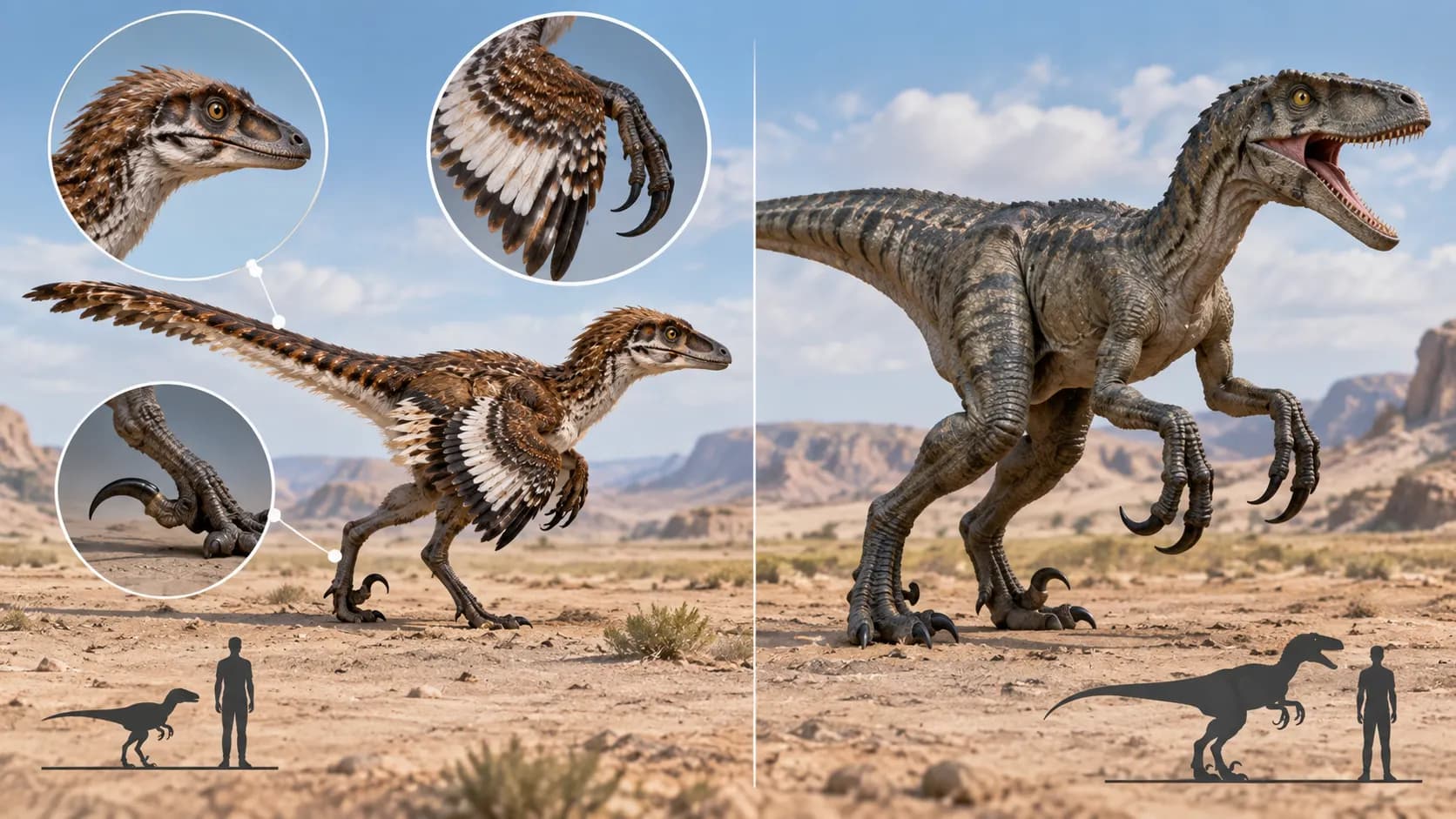
Natural History Museum estimates put Velociraptor at about 1.8 metres long and around 7 kilograms. Much of that length was tail. The movie animals were recreated at roughly twice the size of the real species and were strongly influenced by the larger relative Deinonychus.
They Had Feathers
Fossil evidence makes this especially clear. Quill knobs on a Velociraptor forearm show that long feathers attached to its arms, while evidence from close relatives supports a feathered body covering.
Their Hands Were Different Too
Movie theropods are often shown holding their hands palms-down. Theropod wrist anatomy did not allow that familiar human-like posture. Their palms would have faced more toward each other, almost as if the animal were holding a large ball between its hands.
Did Every Dinosaur Have Feathers?
No. Correcting one movie misconception should not create another.
Feathers are strongly documented in many theropod dinosaurs, particularly groups close to birds. Other dinosaur groups have produced evidence of feather-like structures as well.
But fossil skin impressions also show scales in many duck-billed, horned and armoured dinosaurs, and there is no good evidence that every dinosaur was covered from head to tail in feathers.
The real picture is diverse. Dinosaur skin coverings varied across groups, species and probably different parts of the body.
Mosasaurus Was Not Actually a Dinosaur
The enormous marine predator seen in the Jurassic World films belongs to another common prehistoric misunderstanding.
Mosasaurus was a marine reptile, not a dinosaur. The same basic correction applies to famous flying pterosaurs: they lived alongside dinosaurs but were separate branches of reptiles.
Dinosaurs were primarily terrestrial animals. Ancient oceans contained their own spectacular reptile groups, including mosasaurs, plesiosaurs and ichthyosaurs.
What Did Jurassic Park Get Right?
It would be unfair to treat the franchise as nothing more than a catalogue of scientific errors.
When Jurassic Park appeared in 1993, popular culture still carried many older images of dinosaurs as slow, lumbering reptiles. The film presented them as active, agile animals and drew heavily on the dinosaur renaissance that had transformed palaeontology during the preceding decades.
Our understanding has continued to change since then. Feathered dinosaur discoveries became far more important after the first movie was made, which means some details that now look obviously outdated were not simply ignored by filmmakers in 1993.
That is part of what makes comparing the films with modern palaeontology interesting. Science did not stop when the movie was released.
Could We Ever Build Something Like Jurassic World?
A biological park filled with authentic cloned non-bird dinosaurs is not realistic with present science because the genetic starting material is missing.
A convincing experience is another question entirely.
Modern animatronics, robotics, augmented reality, virtual reality and increasingly detailed palaeoart can reconstruct extinct animals without pretending they have actually been resurrected. Better fossil discoveries can also make those reconstructions increasingly scientifically informed.
In that sense, a future dinosaur park could become visually more believable even while true dinosaur cloning remains out of reach.
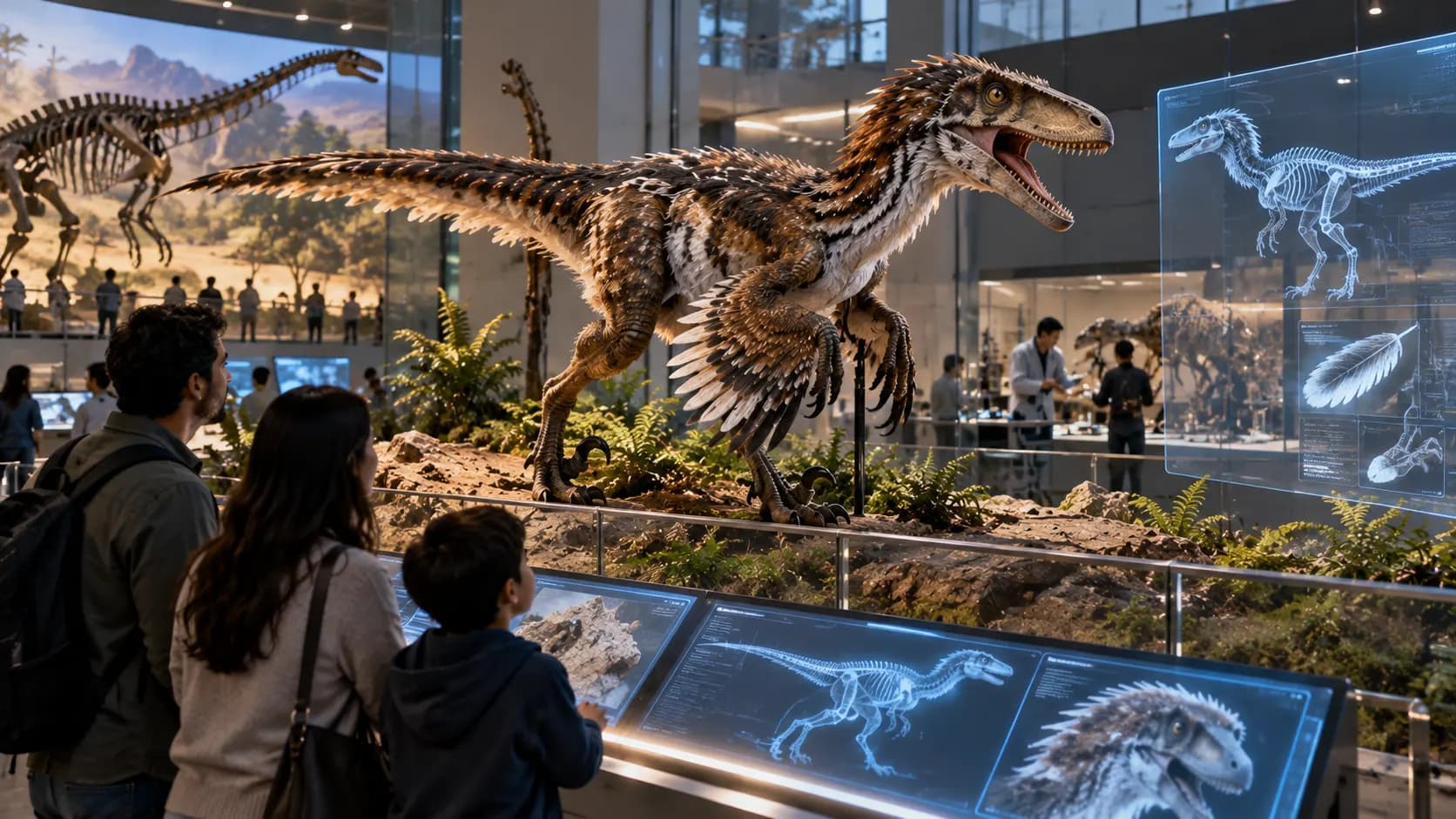
The Real Dinosaur Story Is Stranger Than the Movie
Jurassic World asks us to imagine that extinct dinosaurs could be rebuilt from ancient DNA. The real story goes in almost the opposite direction.
Their DNA appears to be gone. Their bones, tracks and feathers still let scientists reconstruct remarkable parts of their lives. And one branch of the dinosaur family tree never vanished at all.
A pigeon on a pavement is obviously not a miniature Tyrannosaurus. But both belong within the dinosaur evolutionary story.
We may never open a park containing cloned Velociraptors. The surprising part is that if you want to see a living dinosaur, you can already look out of the window and watch one fly past.
Reference notes
Sources and further reading
- Nhm Ac Uk (opens in a new tab)https://www.nhm.ac.uk/discover/could-scientists-bring-dinosaurs-back.html
- Nhm Ac Uk (opens in a new tab)https://www.nhm.ac.uk/discover/what-can-scientists-learn-about-dinosaurs-and-how.html
- Nhm Ac Uk (opens in a new tab)https://www.nhm.ac.uk/discover/why-are-birds-the-only-surviving-dinosaurs.html
Show all 10 sources
- Nhm Ac Uk (opens in a new tab)https://www.nhm.ac.uk/discover/velociraptor-facts.html
- Nhm Ac Uk (opens in a new tab)https://www.nhm.ac.uk/discover/news/2020/march/the-first-dinosaurs-probably-didn-t-have-feathers.html
- Nhm Ac Uk (opens in a new tab)https://www.nhm.ac.uk/discover/what-are-dinosaurs.html
- Nature (opens in a new tab)https://www.nature.com/articles/s41586-022-05453-y
- Amnh (opens in a new tab)https://www.amnh.org/explore/news-blogs/velociraptor-feather-evidence
- Smithsonianmag (opens in a new tab)https://www.smithsonianmag.com/science-nature/bird-wrists-evolved-among-dinosaurs-65035237/
- Universalpictures (opens in a new tab)https://www.universalpictures.com/movies/jurassic-world-rebirth/videos
Our editorial promise
Prepared with clarity and care.
This guide completed our editorial review before publishing. If something needs attention, report a correction or contact the publisher.
About this article
- Published:
- Last updated:
- Author:
- Ceyora Editorial Team
- Review status:
- Editorially reviewed
- Sources:
- 10
- Corrections:
- Report an issue