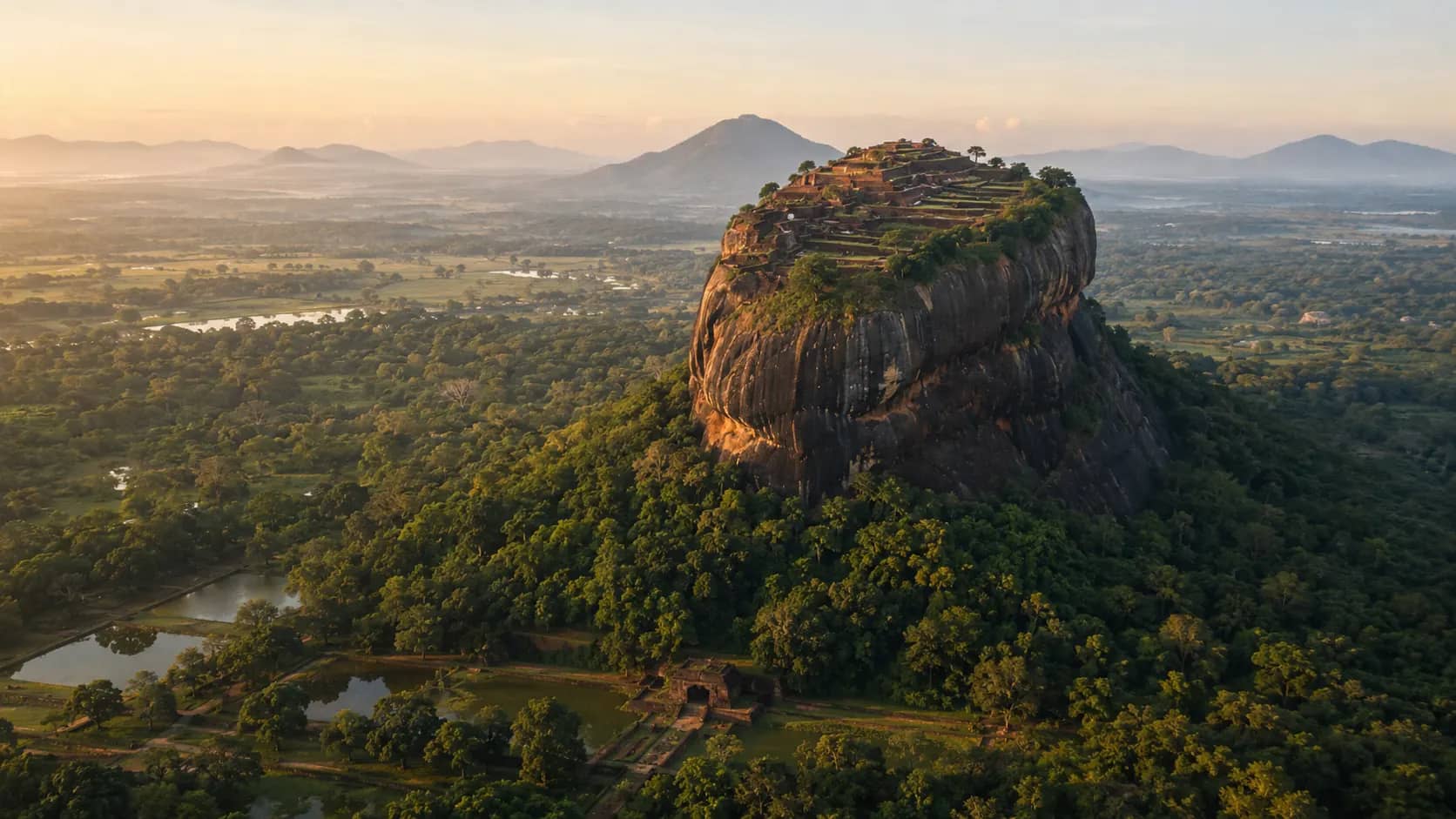
Sigiriya looks almost improbable from a distance. A massive rock rises abruptly above Sri Lanka's central plains, its nearly vertical sides leading to the remains of buildings, pools and terraces on the summit. Far below, geometric gardens, moats, walls and reservoirs spread across the landscape.
It is easy to call it a rock fortress and stop there. But that description misses the most interesting question: why would a fifth-century king create an elaborate capital around such a difficult place?
UNESCO identifies Sigiriya as the remains of the capital established by King Kassapa I, who ruled from 477 to 495 CE. The main rock rises about 180 metres above its surroundings, and the royal complex occupied not only the summit but also the slopes and carefully designed landscape around it.
Why Did King Kassapa Choose Sigiriya?
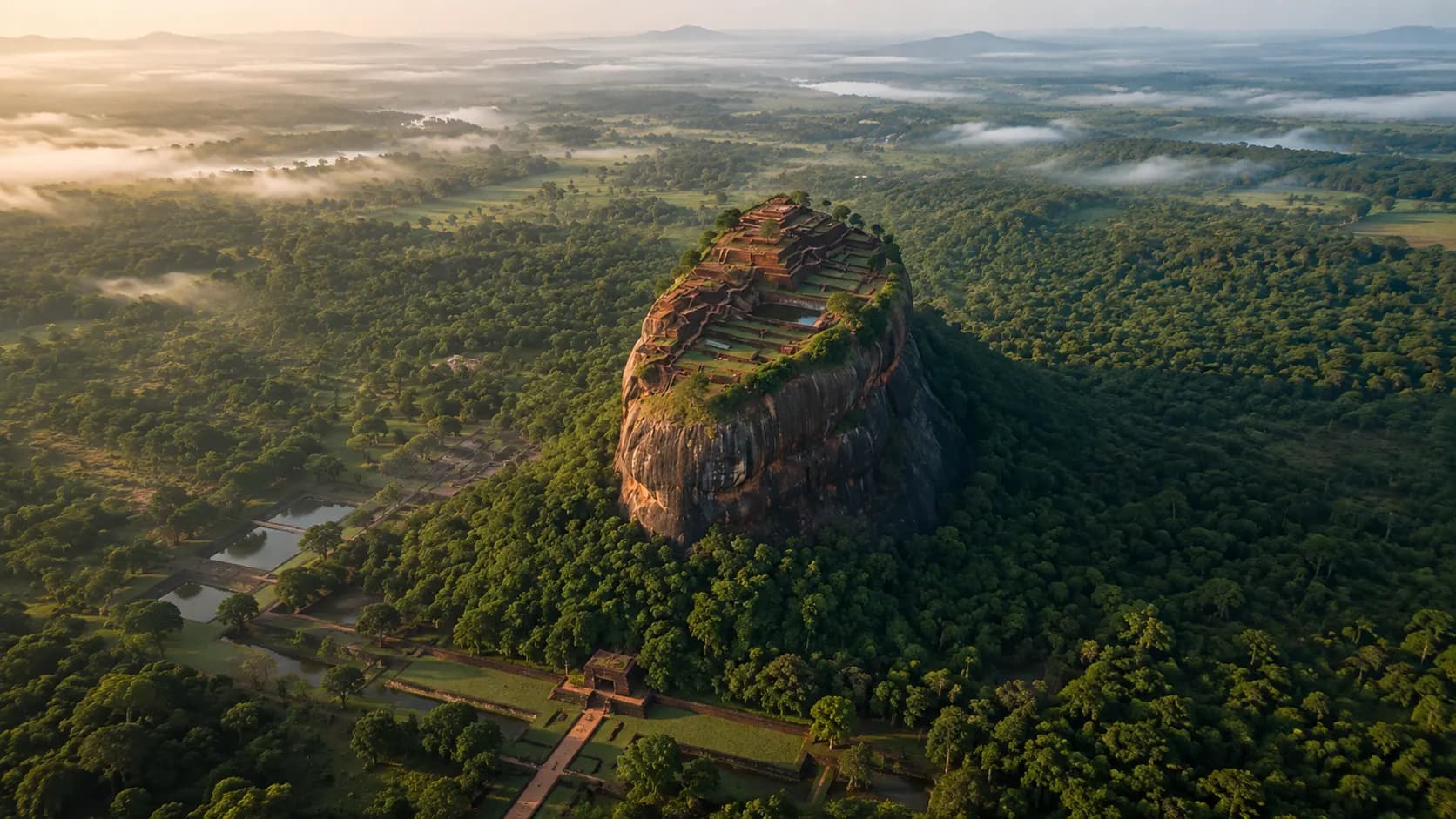
Traditional accounts place Sigiriya's royal phase in the aftermath of a violent struggle for the throne. Kassapa moved his capital to Sigiriya after taking power in 477 CE, while his brother Moggallana remained a potential rival.
The location clearly offered defensive advantages. The sheer rock walls made the summit difficult to approach, while its height provided wide views across the surrounding country.
Defence, however, does not explain everything. A ruler concerned only with protection would not necessarily need symmetrical pleasure gardens, fountains, elaborate paintings, pools and a gigantic lion-shaped entrance. Sigiriya appears to have combined security with royal display, carefully planned architecture and landscape design.
How Did They Build a Royal Complex Up There?
There is no surviving construction manual explaining exactly how every part of Sigiriya was built. What remains nevertheless reveals an enormous organised effort.
Builders used brick masonry, plaster, stone stairways, retaining walls and terraces to adapt the natural slopes. Routes wound upward through different levels of the complex before eventually reaching the summit.
At the top, archaeological remains include foundations of the royal complex, terraces and water-storage features. Building materials, workers, food and water all had to be moved through a site where even today's climb requires a substantial ascent.
Rather than placing one building on a convenient flat surface, the designers made the rock itself part of the architecture. Natural boulders, slopes, terraces and the summit were incorporated into a larger urban plan.
The Water Gardens May Be Sigiriya's Most Impressive Engineering
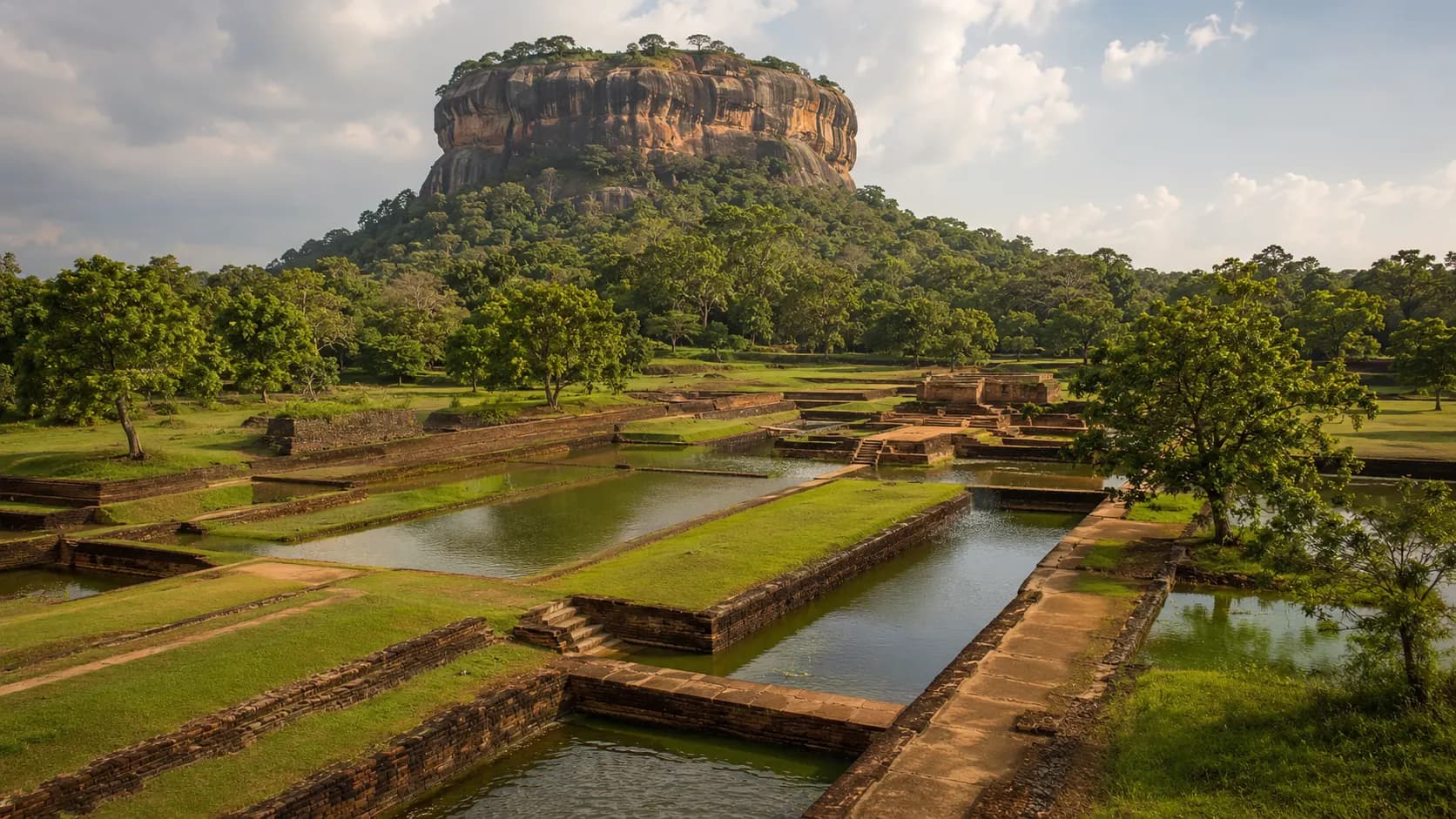
Before climbing the rock, visitors encounter one of Sigiriya's most sophisticated features: its gardens. The western precinct includes deliberately arranged pools, channels, fountains and landscaped spaces organised around a strong geometric plan.
The Central Cultural Fund describes underground and surface hydraulic systems that moved water through the gardens, with some fountains still functioning during suitable rainy conditions. Water was not merely practical infrastructure. It was built into the visual experience of approaching the royal complex.
The wider landscape also includes boulder gardens and terraced gardens, creating a progression from controlled geometry toward the increasingly steep natural rock.
Why Is Sigiriya Called Lion Rock?
The most dramatic entrance came partway up the ascent. UNESCO describes a gigantic lion built from brick and plaster, with galleries and stairways leading through its mouth toward the upper rock.
Most of that monumental structure has disappeared. What remain today are the enormous paws on the Lion's Paws Terrace, positioned on either side of the stairway.
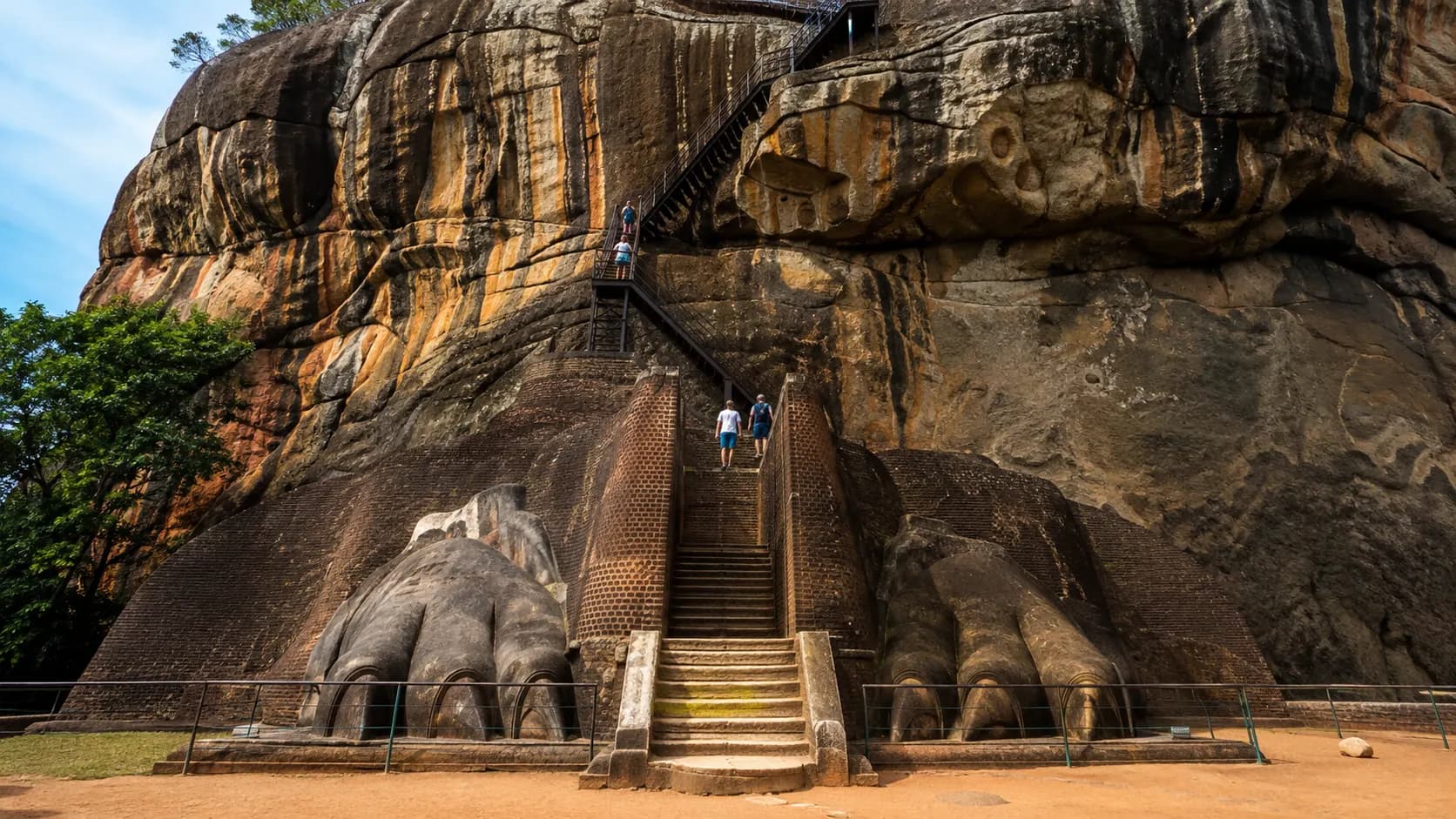
Exactly how every missing part looked cannot be reconstructed with certainty, so modern illustrations should be treated as interpretations rather than photographs of a known original design.
Keep reading
Most Beautiful Islands in the World You Need to See
Who Are the Women in the Sigiriya Frescoes?
Partway up the western rock face is a surviving group of fifth-century paintings showing richly adorned female figures. They are among Sigiriya's most recognisable works of art, but their identities remain unsettled.
Interpretations have included celestial figures, royal women, consorts and figures connected with religious imagery. The Central Cultural Fund notes that several interpretations remain in circulation, which is more responsible than presenting one theory as proven.
Their survival is also a conservation achievement. UNESCO has supported scientific work to understand the deterioration of the paintings and protect them without using treatments that could cause further damage.
What Is the Mirror Wall?
Below the frescoes runs the famous Mirror Wall, originally finished with highly polished plaster. Its later history is arguably even more interesting than its reflective surface.
Visitors scratched poems, reactions and observations onto the wall over many centuries. The Central Cultural Fund says more than 1,800 inscriptions have been documented, providing an unusual record of how medieval visitors responded to Sigiriya and its paintings.
In that sense, Sigiriya was attracting curious visitors long before modern tourism existed.
What Was on Top of Sigiriya?
The summit was not simply a lookout point. Foundations, water tanks, terraces and other archaeological remains show that a substantial royal complex once occupied the top.
Today the missing walls require imagination, but the surviving layout still makes the ambition clear. The builders transformed a difficult natural summit into organised architectural space while preserving commanding views in every direction.
Why Did Sigiriya Stop Being a Royal Capital?
Sigiriya's period as a royal capital was remarkably short. Kassapa's reign ended in 495 CE after conflict with his brother Moggallana, and the centre of royal power shifted away.
The site did not simply vanish. Archaeological and government records show that Sigiriya had monastic associations before Kassapa's royal city and again after his reign. Its long history therefore extends well beyond the famous fifth-century palace phase.
Is Sigiriya Really the Eighth Wonder of the World?
Sigiriya is frequently promoted as an 'Eighth Wonder of the World,' including by Sri Lankan heritage and tourism organisations. It is an understandable description of an extraordinary site, but it is not an official UNESCO title.
UNESCO's official designation is the Ancient City of Sigiriya. It was inscribed on the World Heritage List in 1982.
What Can Visitors Still See Today?
The formal water gardens, pools and channels
Moats, ramparts and landscaped approaches
The surviving Sigiriya frescoes
The Mirror Wall and historic graffiti
The enormous Lion's Paws Terrace
Ancient galleries and stairways
Foundations and water features on the summit
Wide views across Sri Lanka's central plains
Current official visitor information should be checked before travelling. As of August 2026, Sri Lanka's Department of Archaeology lists Sigiriya as open daily from 6:30 a.m. to 5:30 p.m., while the Central Cultural Fund's ticket portal lists 7:00 a.m. to 5:00 p.m. Because the two official pages differ, verify the latest entry time and ticket information on the day of your visit.
Why Sigiriya Still Feels Almost Impossible
The astonishing part of Sigiriya is not simply that people reached the top of a giant rock 1,500 years ago. They transformed the entire setting.
Rock, water, gardens, walls, paintings, gateways and royal architecture were designed to work together. Defence may have helped explain the location, but the final result was something far more ambitious: a landscape engineered to project power, beauty and control.
Reference notes
Sources and further reading
- Whc Unesco (opens in a new tab)https://whc.unesco.org/en/list/202/
- Whc Unesco (opens in a new tab)https://whc.unesco.org/en/intassistance/2284/
- Archaeology (opens in a new tab)https://archaeology.gov.lk/index.php/sigiriya
Show all 7 sources
- Ccf (opens in a new tab)https://ccf.gov.lk/heritage-sites/sigiriya-rock-fortress/
- Ccf (opens in a new tab)https://ccf.gov.lk/vsl/tickets.html
- Srilanka Travel (opens in a new tab)https://srilanka.travel/heritage-discover-the-past?article=28
- Srilanka Travel (opens in a new tab)https://srilanka.travel/sigiriya-a-heavenly-palace-on-earth
Our editorial promise
Prepared with clarity and care.
This guide completed our editorial review before publishing. If something needs attention, report a correction or contact the publisher.
About this article
- Published:
- Last updated:
- Author:
- Ceyora Editorial Team
- Review status:
- Editorially reviewed
- Sources:
- 7
- Corrections:
- Report an issue