
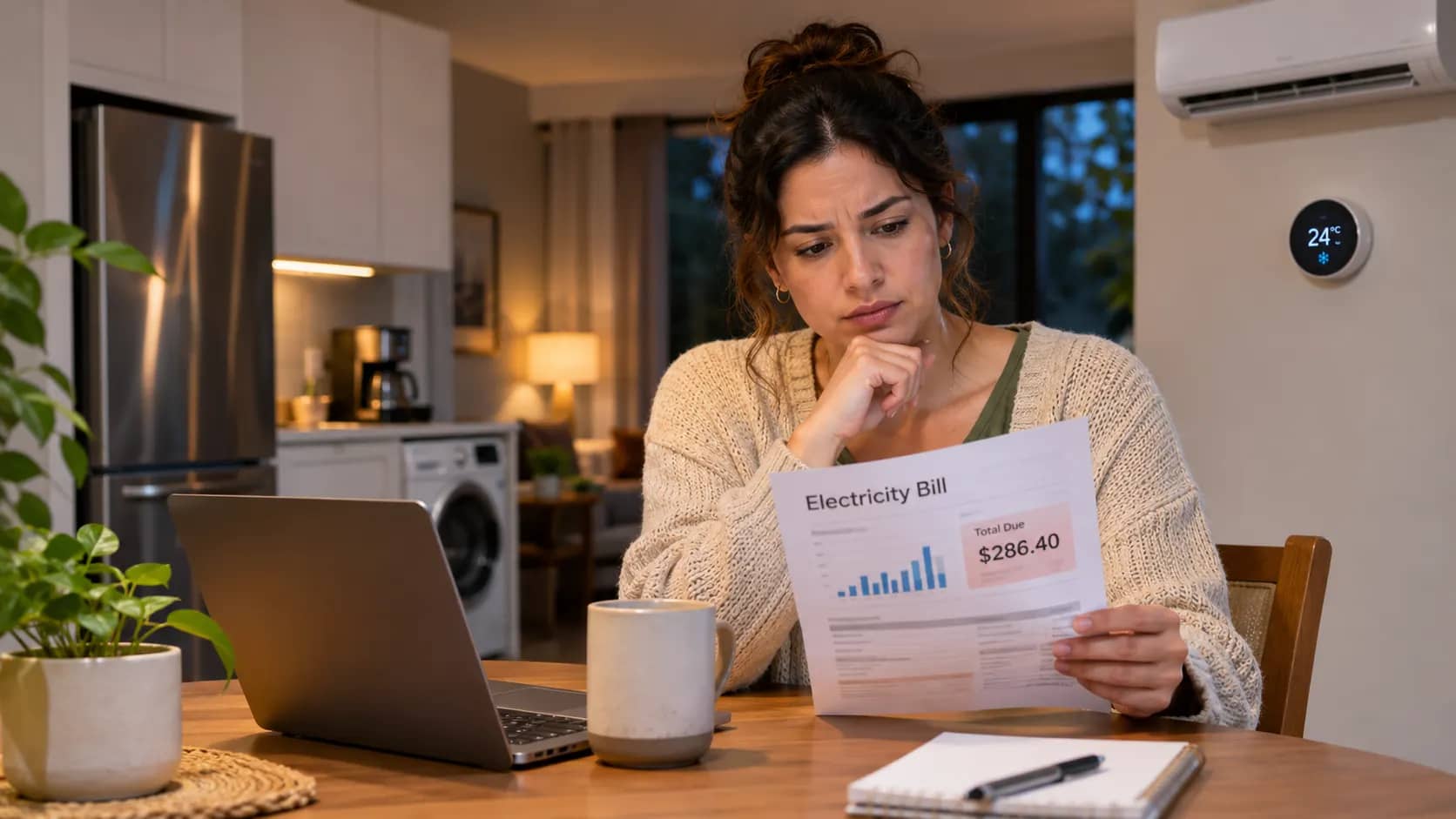
An electricity bill can jump even when your daily routine feels almost unchanged. The reason is that the amount you pay depends on more than how often you switch on the lights. Weather, air conditioning or heating, water heating, appliances that run for long periods, electricity prices and even the number of days covered by the bill can all change the total.
The fastest way to investigate a high bill is not to start unplugging everything. First work out whether you actually used more electricity. Find the kilowatt-hours, or kWh, on your current bill and compare them with the previous month and, where possible, the same month last year. Then compare the price per kWh and any fixed charges.
Start With kWh, Not the Amount You Paid
Electricity use is normally measured in kilowatt-hours. One kilowatt-hour represents using 1,000 watts of power for one hour. Your bill then applies the relevant electricity rate and other charges to that consumption.
Suppose last month's bill showed 700 kWh and this month's shows 950 kWh. Your consumption clearly increased. If both bills show about 700 kWh but the amount due is much higher, the explanation may instead involve the electricity rate, fixed charges, taxes, a tariff change or a billing correction.
Also check how many days each bill covers. Comparing a 33-day bill with a 27-day bill can make an increase look more dramatic even when average daily consumption has changed much less.
Weather Can Change Electricity Use Without Changing Your Routine
Heating and cooling are among the largest electricity uses in many homes. The U.S. Energy Information Administration consistently finds that air conditioning is one of the largest residential electricity uses, and household electricity demand changes significantly with weather.
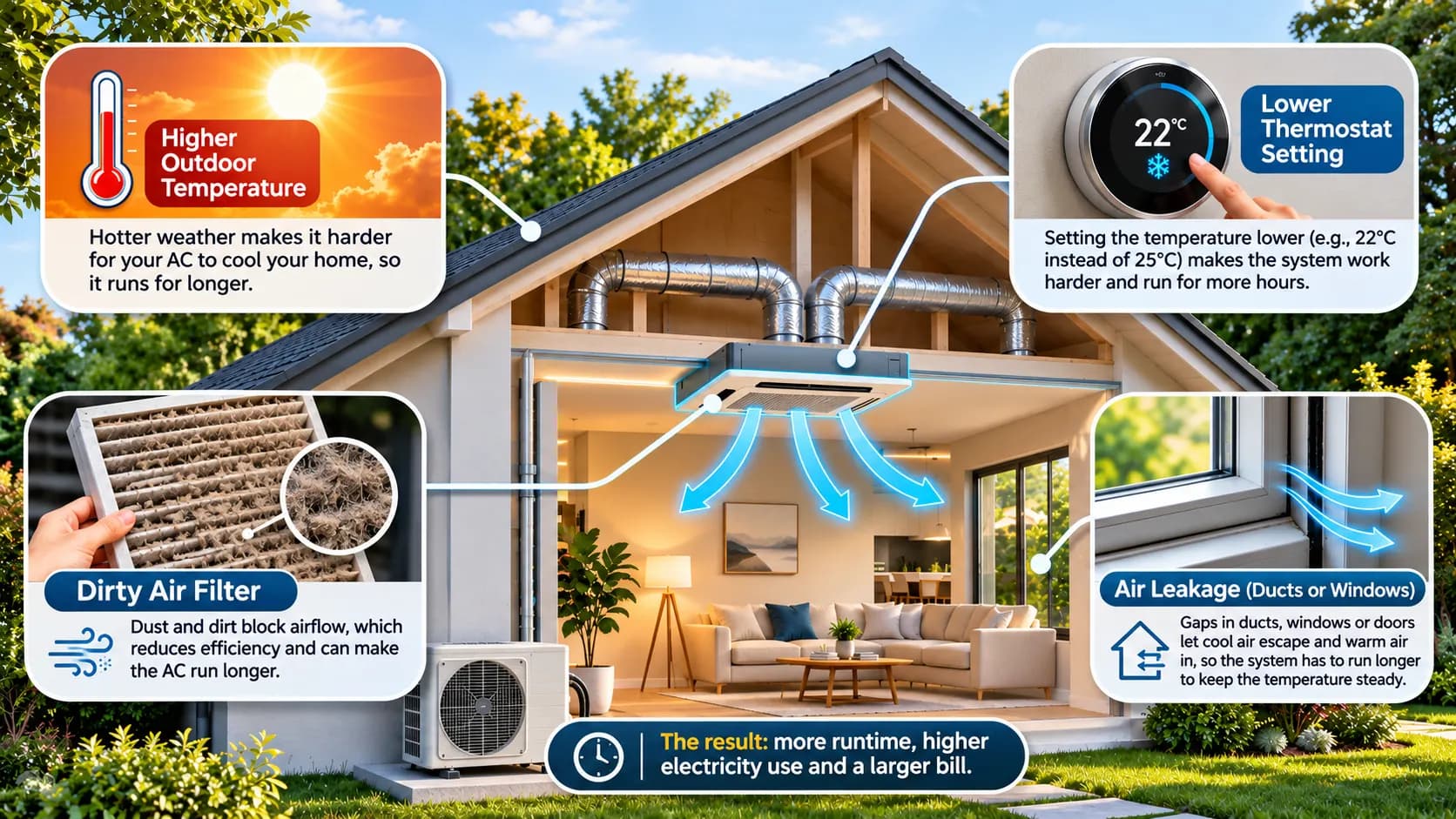
This explains why a bill can rise even when you have not consciously used the air conditioner more often. During hotter weather, the system may need to run much longer simply to maintain the same thermostat setting. The same principle applies to electrically heated homes during cold weather.
Humidity matters as well. An air conditioner may spend more time removing moisture from indoor air during humid conditions, adding to its runtime.
A Small Thermostat Change Can Mean Many More Hours of Cooling or Heating
The thermostat controls one of the home's most energy-intensive systems. A setting that demands a colder indoor temperature during summer or a warmer one during winter can make the heating or cooling equipment operate for longer periods.
The condition of the system matters too. The U.S. Department of Energy notes that dirty filters can restrict airflow and increase energy use. Leaky or poorly insulated ducts can also waste conditioned air before it reaches the rooms you are trying to cool or heat.
If your air conditioner seems to run almost continuously, rooms are taking unusually long to reach the set temperature or airflow has weakened, the answer may not simply be to change the thermostat. Filters, ducts, maintenance or equipment problems may deserve attention.
Water Heating Can Quietly Add a Large Load
Water heating is easy to overlook because you do not see an electric heating element running in the same way you see an air conditioner or oven. Yet electric water heating can be a significant household electricity use.
More people staying in the home, longer showers, additional laundry, frequent dishwasher use or a higher water-heater temperature can all increase demand. A malfunctioning electric water heater can also consume more energy than expected.
If household electricity use increased after guests arrived or family routines changed, hot-water use is worth considering alongside air conditioning.
Look for Appliances That Run for Hours, Not Just Appliances With Big Wattage
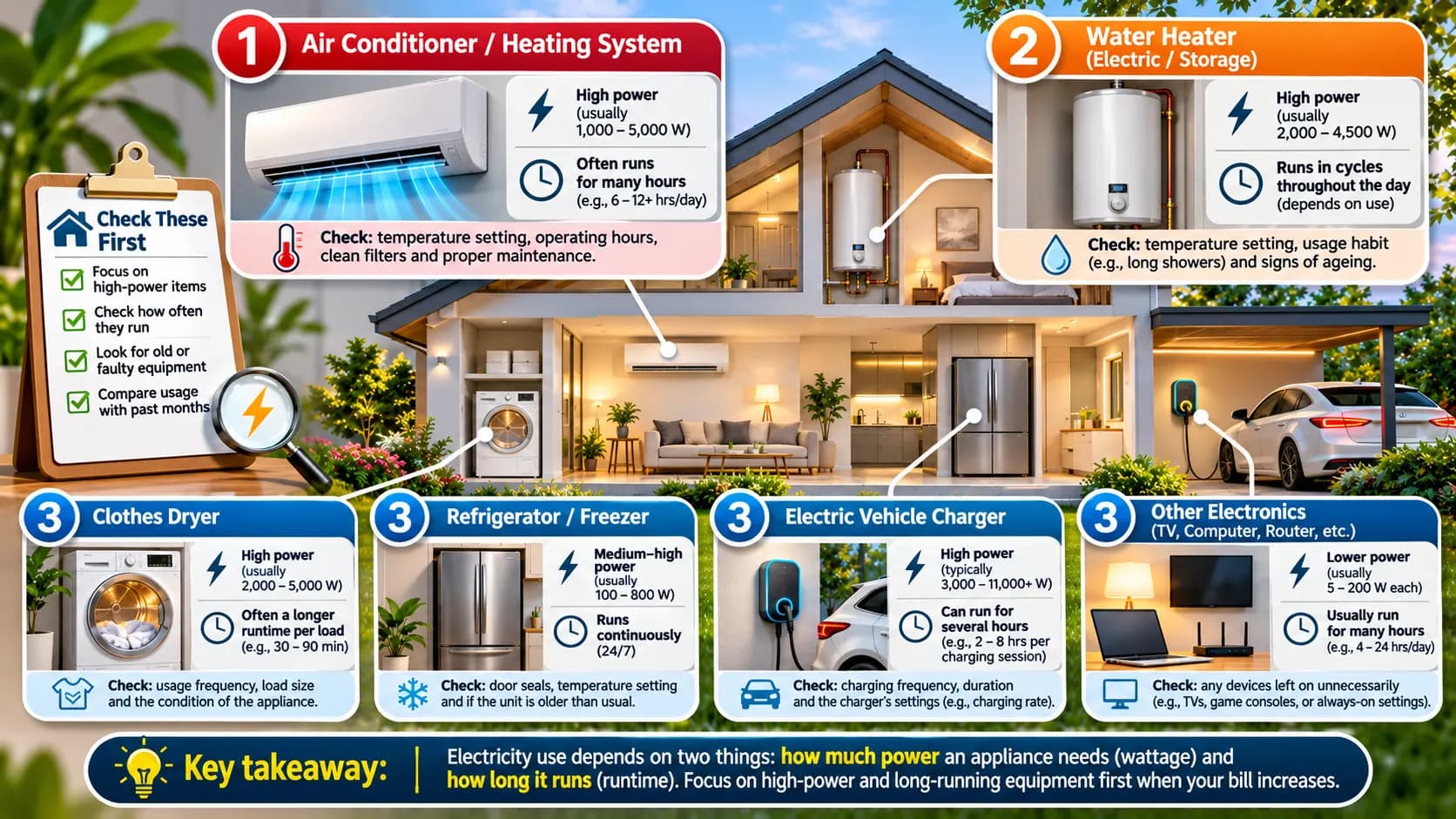
An appliance's electricity use depends on both its power and how long it operates. A simple estimate is: watts multiplied by hours of use, divided by 1,000, gives approximate kilowatt-hours.
For example, imagine a 1,500-watt electric space heater running for 8 hours a day. That would use about 12 kWh per day, or roughly 360 kWh over 30 days. This is only a hypothetical example, but it shows why something used for many hours can change a bill quickly.
Depending on the household, other long-running loads can include air conditioners, electric heaters, water heaters, dehumidifiers, pool pumps, additional refrigerators or freezers and electric-vehicle charging.
Ask What Changed Since the Last Normal Bill
A sudden increase is often easier to explain by looking for a change rather than inspecting every appliance in the house.

Keep reading
Digital Habits That Quietly Waste Your Time
Did unusually hot or cold weather begin?
Did you change the thermostat setting?
Did more people start staying at home?
Did you add a freezer, heater, air conditioner, dryer or other major appliance?
Did you begin charging an electric vehicle at home?
Did working or studying from home increase?
Did an appliance begin running for longer than usual?
Was the previous bill estimated rather than based on an actual meter reading?
One change may explain most of the increase. In other cases several small changes happen together, making the bill feel surprising even though no single appliance is responsible.
A Higher Bill Does Not Always Mean Higher Electricity Use
Electricity prices and billing structures can change. A utility may charge a different price per kWh, fixed daily or monthly charges may rise, or a tariff may charge different rates depending on when electricity is used.
That is why comparing only the total amount due can be misleading. Compare the kWh used, the rate applied to those kWh and the fixed or additional charges shown on both bills.
If your electricity use stayed nearly the same while your bill increased substantially, this part of the statement deserves especially close attention.
An Actual Meter Reading Can Create a Catch-Up Bill
Some electricity suppliers issue estimated bills when they do not have an actual meter reading. If those estimates are lower than your real consumption for several billing periods, a later actual reading can reveal the difference.
The result may be one unusually large bill even though the electricity was actually consumed across several earlier months. UK energy regulator Ofgem identifies this type of reconciliation after estimated readings as one reason consumers can receive unexpectedly high bills.
If a bill suddenly jumps, check whether the meter reading is marked actual or estimated and whether the previous bills were estimated. Terminology varies between suppliers and countries.
Standby Power Exists, but Do Not Blame Every Charger First
Televisions, entertainment systems, computers and other electronics can use electricity while waiting in standby mode. Turning unnecessary devices fully off can reduce this background consumption.
But if your bill has suddenly doubled, it makes sense to investigate major loads such as cooling, heating, water heating and newly added equipment before assuming a few phone chargers caused the entire increase. Large or long-running appliances have much greater potential to move monthly consumption.
Could an Old or Faulty Appliance Be Responsible?
Possibly. An appliance can consume more electricity if it develops a problem that causes it to run for much longer than normal. A refrigerator with damaged door seals, an air conditioner struggling with airflow or maintenance problems, or equipment that repeatedly cycles can increase consumption.
Age alone does not prove that an appliance caused the bill increase. Look for evidence such as unusually long runtime, poor performance, unexpected heat, repeated cycling or a clear change in consumption that coincides with the appliance.
What About a Faulty Electricity Meter?
A meter problem is possible, but it should not automatically be the first explanation for a high bill. Price changes, weather, estimated readings and greater household consumption are often easier explanations to investigate first.
If the recorded consumption remains implausibly high after you have checked those factors, compare the meter reading shown on the bill with the actual meter and contact your electricity supplier about its meter-testing or billing-dispute process. Do not open, alter or attempt to repair the electricity meter yourself.
A 15-Minute Check Can Narrow Down the Cause
You do not need a full home energy audit before doing some basic detective work. Pull out the current bill and one or two earlier bills and compare them in this order.
Compare total kWh used, not just the amount of money charged.
Check the number of days covered by each billing period.
Compare the electricity price per kWh and any fixed charges.
Check whether the meter readings are actual or estimated.
Think about weather and heating or cooling runtime during the period.
List any new appliances, household members or changes in daily routine.
If you have a smart meter or utility app, look for the days or hours when consumption increased.
This usually tells you whether you are dealing with a usage problem, a pricing or billing issue, or something that needs further investigation.
The Bill Is Useful Evidence, Not Just an Amount to Pay
An unexpectedly high electricity bill is easier to solve once you separate consumption from cost. If kWh increased, investigate what changed inside the home and what the weather was doing. If kWh stayed stable, look at rates, charges, billing periods and meter-reading adjustments.
If neither explanation makes sense, contact the electricity supplier and keep copies of your meter readings and bills. A sudden increase can feel mysterious, but the numbers on the statement usually give you a much better starting point than guessing which appliance is responsible.
Reference notes
Sources and further reading
- Eia (opens in a new tab)https://www.eia.gov/energyexplained/use-of-energy/electricity-use-in-homes.php
- Eia (opens in a new tab)https://www.eia.gov/energyexplained/electricity/use-of-electricity.php
- Energy (opens in a new tab)https://www.energy.gov/sites/default/files/2022-08/energy-saver-guide-2022.pdf
Show all 7 sources
- Bsesc Energy (opens in a new tab)https://bsesc.energy.gov/energy-basics/hvac-proper-installation-filters
- Energy (opens in a new tab)https://www.energy.gov/oe/electricity-101
- Energystar (opens in a new tab)https://www.energystar.gov/campaign/home-energy-yardstick
- Ofgem (opens in a new tab)https://www.ofgem.gov.uk/your-energy-supply/your-energy-bill/how-your-electricity-or-gas-bill-calculated
Our editorial promise
Prepared with clarity and care.
This guide completed our editorial review before publishing. If something needs attention, report a correction or contact the publisher.
About this article
- Published:
- Last updated:
- Author:
- Ceyora Insights
- Review status:
- Editorially reviewed
- Sources:
- 7
- Corrections:
- Report an issue