


If money disappears from your payslip every month for 30 or 40 years, it is natural to imagine a large account somewhere with your name on it. When you retire, you might assume the system simply starts giving that same money back.
Sometimes a pension does work roughly like that. Sometimes it does not. In many public pay-as-you-go systems, contributions collected from today's workers and employers help finance pensions being paid to today's retirees. Funded pensions work differently: money is accumulated and invested to help finance future retirement benefits.
What Is a Pension Really?
A pension is a way of providing income after someone stops or reduces paid work because of retirement. The complication is that the word covers very different arrangements. A state pension, an employer pension and an individual retirement plan can all be called pensions even though the money behind them may be collected, invested and paid in different ways.
The Two Very Different Ways Pension Money Can Work
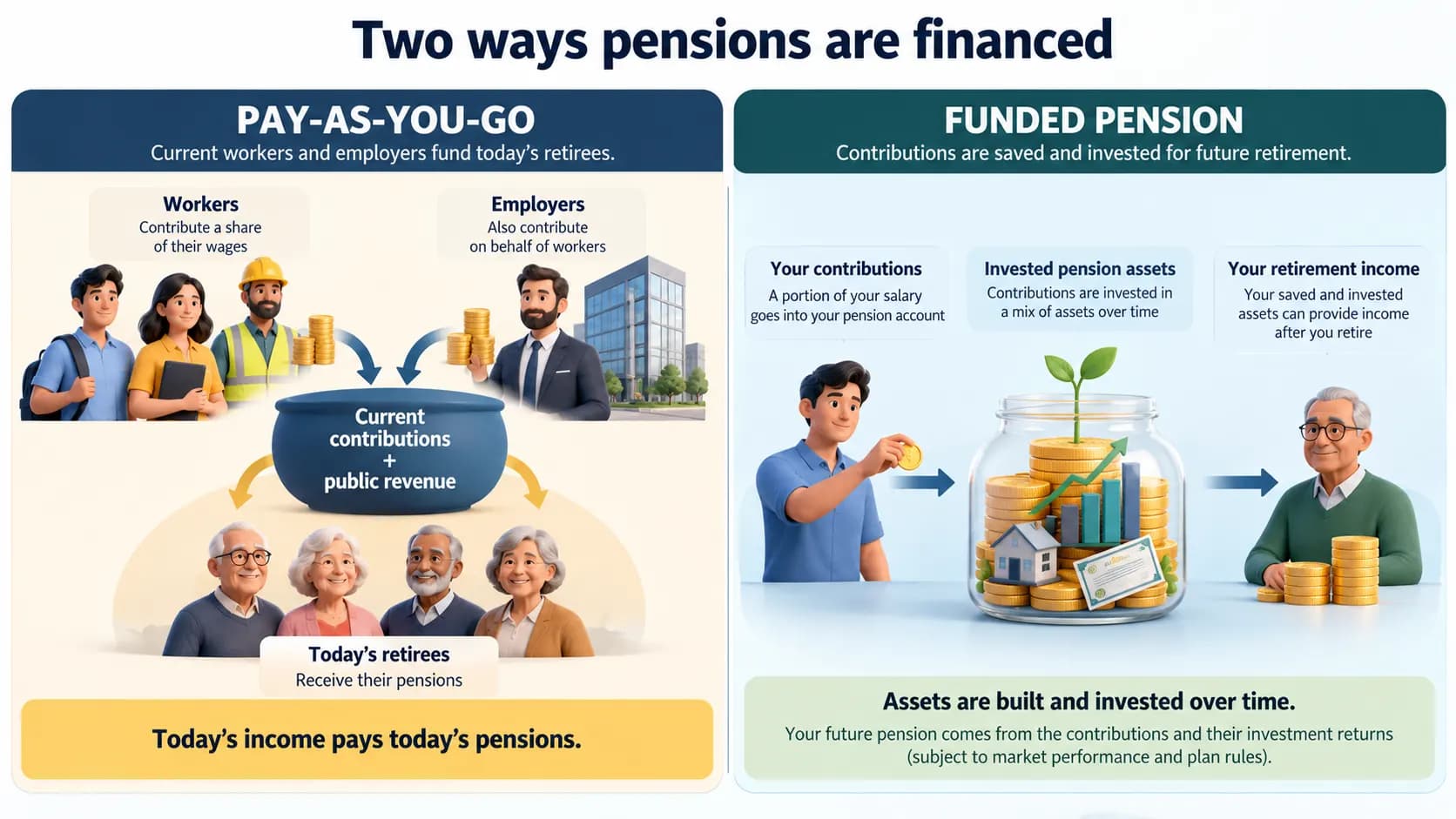
Pensions are generally financed in two very different ways. Some systems use contributions collected today to help pay current retirees, while others build and invest assets that will help pay benefits in the future.
Pay-As-You-Go Pensions
In a pay-as-you-go system, current contributions largely finance current pension payments. Today's workers help support today's retirees. When those workers eventually retire, the system expects future contributions, taxes or other public revenue to help finance their benefits under the rules that apply then.
That does not mean your contributions are meaningless. They may build pension rights or eligibility. It means the exact money deducted from your salary is not necessarily sitting untouched in a personal account waiting for you.
Funded Pensions
A funded pension is closer to the savings-pot picture. Contributions are accumulated in assets and invested. Those assets, plus investment returns and future contributions, help finance retirement benefits.
Funded does not automatically mean private, and pay-as-you-go does not automatically mean a particular benefit formula. OECD pension systems contain combinations of public, occupational and personal arrangements, which is why labels matter less than understanding how a specific scheme is financed.
Is Your State Pension Sitting in an Account With Your Name on It?
In many pay-as-you-go state systems, no. What you accumulate is an entitlement under pension rules rather than a pile of currency reserved only for you. Those rules may consider contribution years, earnings, age, residency or other factors.
Some public systems also hold reserve funds, so the divide is not perfectly binary. OECD data show that many countries maintain public pension reserves alongside pay-as-you-go arrangements. The important point is that a public pension contribution should not automatically be imagined as a personal investment account.
What About Workplace and Private Pensions?
Many workplace and personal pensions are asset-backed. Contributions can be invested in assets such as shares, bonds and other investments, although the exact mix and legal structure vary enormously.
The OECD reported that pension plans managed by pension providers held about USD 63.1 trillion in assets across the OECD at the end of 2024. Those assets help finance future retirement benefits, but the amount an individual ultimately receives depends on the rules of the particular plan.
Defined Benefit and Defined Contribution Are Not the Same Thing
These terms describe how pension benefits are calculated and who carries more of the financial risk. They are different from the question of whether a pension is public, private, funded or pay-as-you-go.
Defined Benefit
A defined-benefit pension promises a benefit calculated using a formula, often linked to earnings and years of service. The scheme carries much of the responsibility for financing that promised benefit. A defined-benefit plan can be funded, pay-as-you-go or combine elements of both.
Defined Contribution
In a defined-contribution plan, contributions build up in an account and the retirement outcome depends more directly on how much goes in, investment performance, fees and what happens to the accumulated assets at retirement. This is a different distinction from public versus private.
Why Are Ageing Populations Putting Pensions Under Pressure?
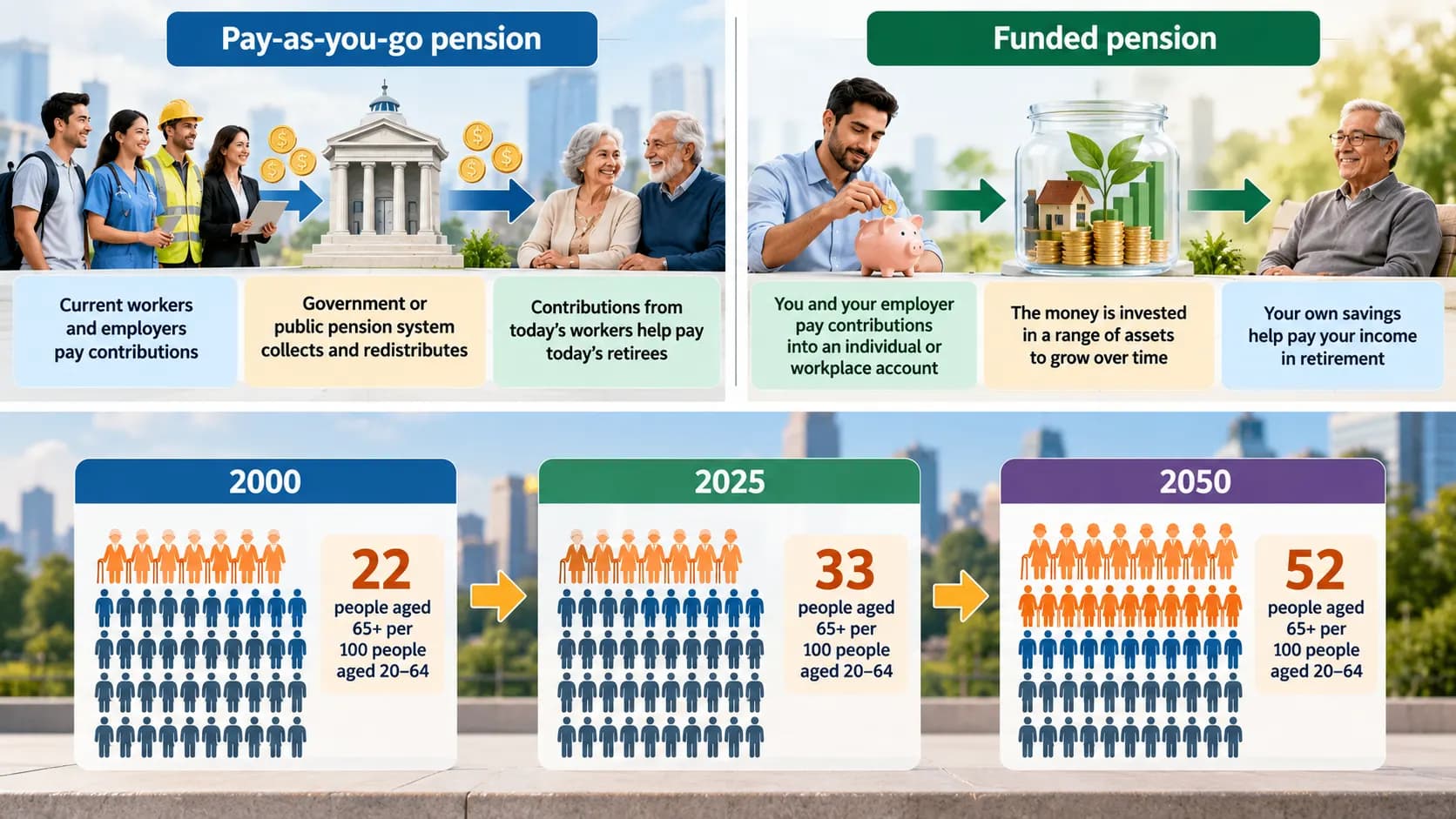
The basic demographic challenge is easy to see. Across OECD countries, there were about 22 people aged 65 or older for every 100 people aged 20 to 64 in 2000. By 2025, that figure had risen to 33, and the OECD projects around 52 by 2050.
That ratio is not literally the number of pensioners divided by the number of workers. Some people over 65 work, and some people aged 20 to 64 do not. But it shows the direction of pressure: more older people relative to the population most likely to be contributing through work.

Keep reading
Why Does Money Have Value If It’s Just Paper and Numbers?
Why Does Living Longer Change the Pension Maths?
Living longer is good news, but it changes retirement financing. If someone retires at 65 and receives a pension for 10 years, the cost is very different from paying that income for 20 or 25 years.
Longer retirements affect both pay-as-you-go and funded pensions. Public systems may need to finance benefits for more years, while individuals using accumulated assets face the challenge of making retirement income last through an uncertain lifespan.
Why Are Retirement Ages Going Up?
Across OECD countries, the average normal retirement age for a full-career worker retiring in 2024 was 64.7 for men and 63.9 for women. Under legislation already in place, the OECD projects averages of about 66.4 for men and 65.9 for women for workers beginning their careers in 2024. More than half of OECD countries are set to increase normal retirement ages.
Working longer can increase contribution years and reduce the period over which retirement benefits must be paid. But raising retirement ages also creates fairness questions, particularly for people in physically demanding work, people with poor health and groups with shorter healthy life expectancy.
What Happens If There Are Fewer Workers Supporting More Retirees?
There is no painless single solution. Governments and pension systems can respond in several ways, often using a combination.
Increase pension contributions or taxes.
Change future benefit levels or benefit formulas.
Raise retirement ages or encourage people to work longer.
Use more revenue from the wider government budget.
Increase employment, productivity and the number of contributors.
Build or expand funded retirement savings alongside public pensions.
The OECD identifies higher contribution rates, lower benefits and later retirement among the major ways pension systems can respond to ageing pressure. Every option involves economic and political trade-offs.
Can a Government Pension Run Out?
For a state-backed pay-as-you-go scheme, the problem is usually not a personal investment account reaching a balance of zero. The bigger question is whether future contributions and public revenue are sufficient to finance promised benefits under existing rules.
Governments can change contribution rates, eligibility, retirement ages, benefit formulas or budget support. Those changes can be difficult and controversial, but they are different from a private savings account simply being emptied.
Can a Funded Pension Run Out?
It depends on how retirement income is structured. Someone drawing money directly from an investment account can potentially exhaust those assets. A lifetime annuity or a defined-benefit promise works differently because it is designed to continue payments according to the contract or scheme rules.
That is why two people who both say they have a pension may face very different risks.
Why Career Breaks Can Affect Retirement Income
Pensions linked to earnings or contributions can be affected by years spent outside paid work, lower earnings or part-time employment, although many systems provide credits or protections for some career breaks.
The OECD reported an average gender pension gap of 23% in 2024 across countries with available data, driven mainly by differences in lifetime earnings, employment and hours worked. That illustrates how inequalities during working life can continue into retirement.
Does Starting Earlier Matter for a Funded Pension?
Generally, yes. In an asset-backed pension, money contributed earlier has more time to experience investment gains or losses and to compound. But there is no universal return, contribution rate or retirement target that fits everyone.
The useful lesson is not to assume that time guarantees a particular outcome. Check the actual fees, contribution rules, investment choices and benefit projections of your own scheme.
What Should You Actually Check About Your Pension?
Start by finding out what type of pension you have. Check your official retirement or pension age, whether you qualify for a state pension, and whether any workplace plan is defined benefit or defined contribution.
Then check how much you and any employer contribute, what pension rights or assets you have already built, what happens if you change jobs, whether career breaks affect entitlement, and how early or late retirement changes the benefit. These rules vary substantially by country and scheme, so your official pension provider or government pension service is the right place for the exact answer.
Will Pensions Still Exist When Today's Young Workers Retire?
Ageing does not mean pensions automatically disappear. What it does mean is that governments, employers and workers may face harder choices about contributions, retirement ages, benefit formulas and the balance between public pensions and funded retirement saving.
Recent OECD reforms already show countries adjusting those rules. No one can promise that a pension system will look exactly the same decades from now, but change is not the same as disappearance.
Reference notes
Sources and further reading
- Oecd (opens in a new tab)https://www.oecd.org/en/publications/pension-markets-in-focus-2024_b11473d3-en/full-report/component-8.html
- Oecd (opens in a new tab)https://www.oecd.org/en/publications/pensions-at-a-glance-2025_e40274c1-en/full-report/mandatory-earnings-related-pensions_fdd73e40.html
- Oecd (opens in a new tab)https://www.oecd.org/en/publications/pensions-at-a-glance-2025_e40274c1-en/full-report/assets-earmarked-for-retirement_089c3f13.html
Show all 8 sources
- Oecd (opens in a new tab)https://www.oecd.org/en/publications/pensions-at-a-glance-2025_e40274c1-en/full-report/recent-pension-reforms_146d2687.html
- Oecd (opens in a new tab)https://www.oecd.org/en/publications/pensions-at-a-glance-2025_e40274c1-en/full-report/current-retirement-ages_0f63b747.html
- Oecd (opens in a new tab)https://www.oecd.org/en/publications/pensions-at-a-glance-2025_e40274c1-en/full-report/future-retirement-ages_23752280.html
- Oecd (opens in a new tab)https://www.oecd.org/en/publications/pensions-at-a-glance-2025_e40274c1-en/full-report/gender-pension-gap_90ed13b5.html
- Oecd (opens in a new tab)https://www.oecd.org/en/topics/public-pensions.html
Our editorial promise
Prepared with clarity and care.
This guide completed our editorial review before publishing. If something needs attention, report a correction or contact the publisher.
About this article
- Published:
- Last updated:
- Author:
- Ceyora Insights
- Review status:
- Editorially reviewed
- Sources:
- 8
- Corrections:
- Report an issue