

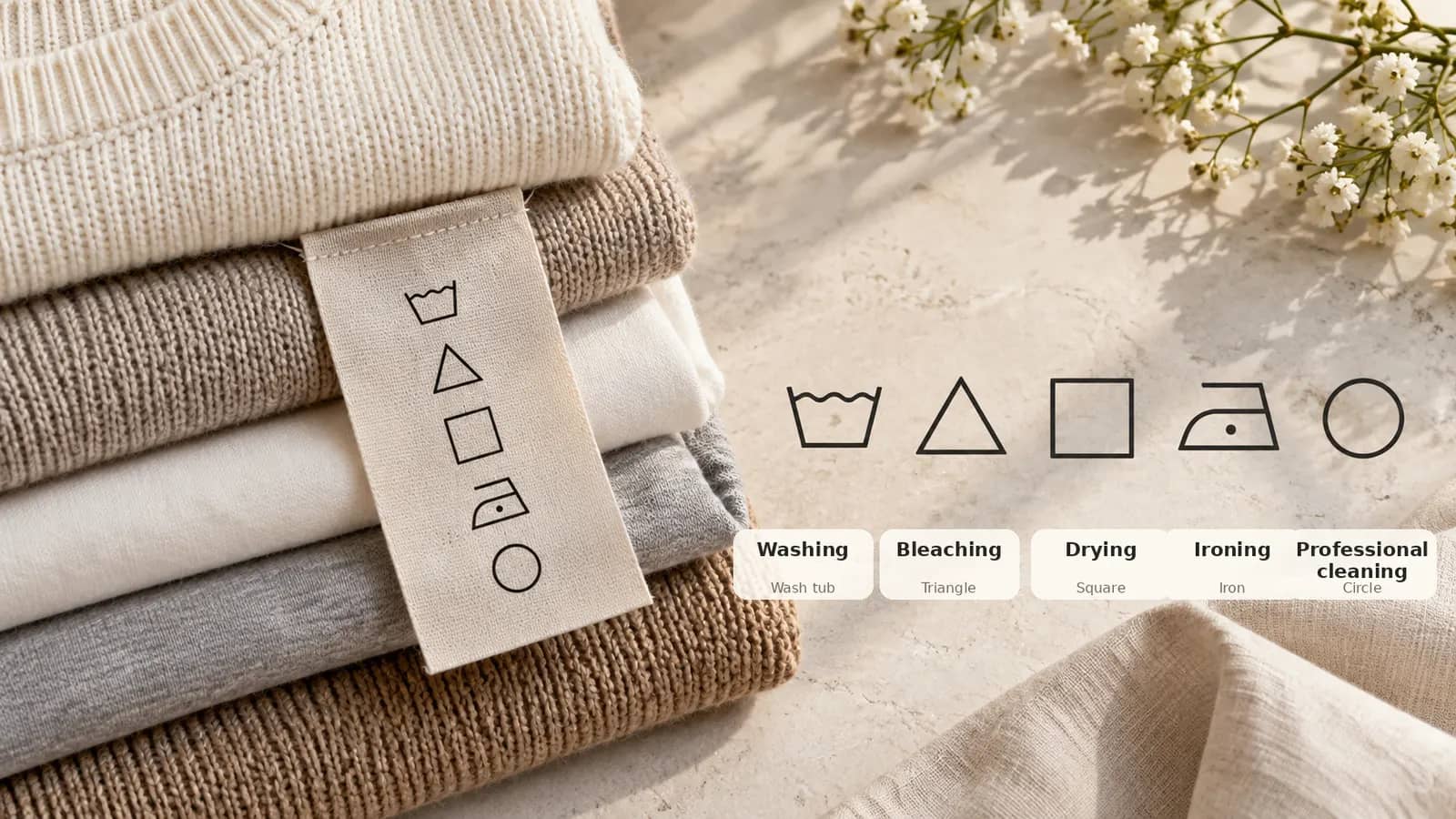
Laundry labels can look like a row of tiny puzzles, but the system is more organised than it first appears. In the international care-label system, the basic shapes represent five types of treatment: a wash tub for washing, a triangle for bleaching, a square for drying, an iron for ironing and a circle for professional textile care.
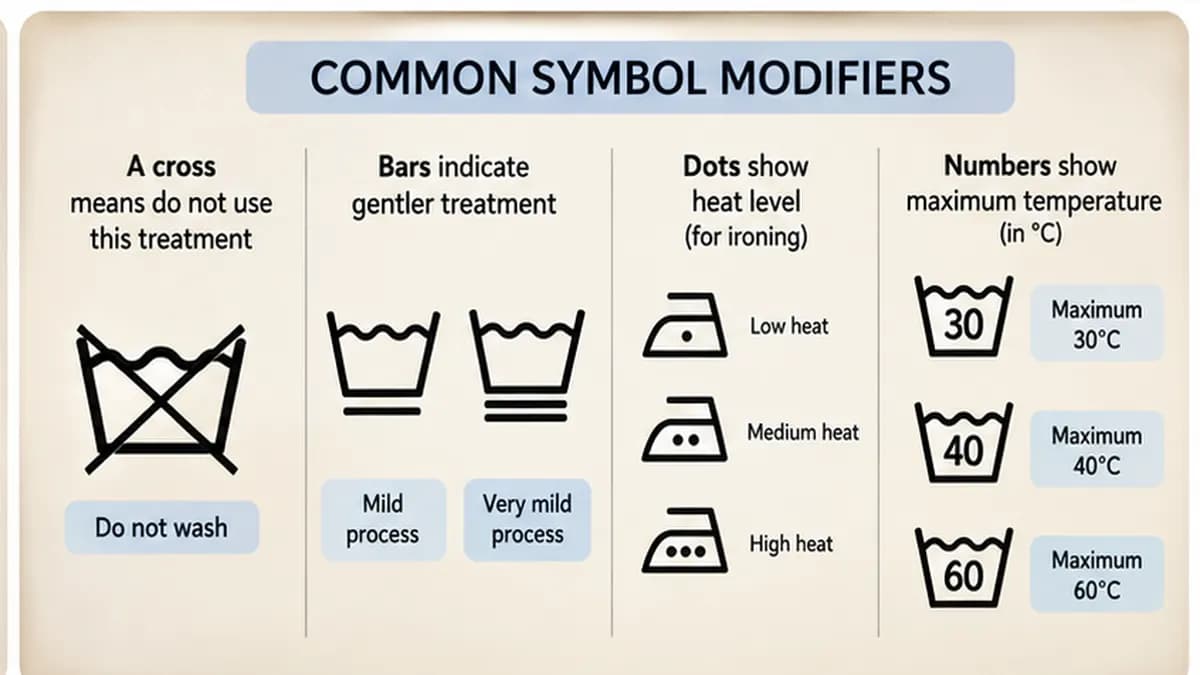
Once you recognise those five shapes, the smaller details become much easier to understand. Numbers usually tell you the maximum washing temperature, dots indicate heat levels, bars underneath a symbol call for gentler treatment, and a large cross means that treatment should not be used.
The Symbols Show the Maximum Safe Treatment
One useful detail makes the whole system easier to understand: a care label generally tells you the strongest treatment the manufacturer says the item can safely tolerate, not the treatment you must use every single time.
GINETEX explains that milder treatments and lower temperatures than those shown on a care label are generally permitted. A garment labelled for a 40°C wash, for example, does not necessarily have to be washed at exactly 40°C. The label is telling you not to exceed the permitted treatment.
The care instruction also applies to the garment as a whole, including features such as colouring, finishes, buttons, zips and other attached components. That is one reason relying only on the fibre name can lead to mistakes.
The Wash Tub Tells You How the Item Can Be Washed
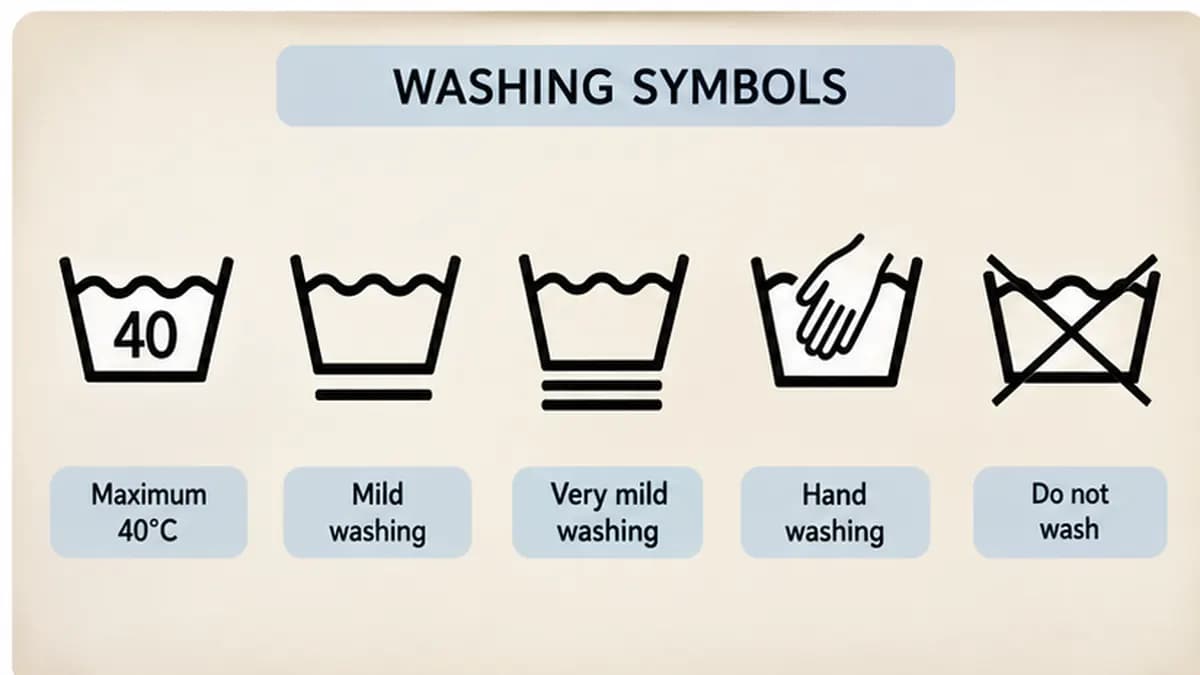
A wash-tub symbol refers to domestic washing, whether by machine or by hand. Under the ISO 3758 system, a number inside the tub indicates the maximum washing temperature in degrees Celsius.
If you see 30, 40 or 60 inside the tub, do not read that as a recommendation to make the water as hot as possible. It is the maximum temperature specified for that care process.
What Do the Lines Under the Wash Tub Mean?
A single bar underneath the wash symbol means a milder process with reduced mechanical action. Two bars mean a very mild process, commonly relevant to more sensitive textiles such as some wool garments.
The important idea is that the bars change more than temperature. They also tell you to reduce the physical intensity of the washing process.
What Does a Hand in the Wash Tub Mean?
A hand-wash symbol tells you the item should be washed manually rather than through an ordinary machine cycle. Hand-washing still requires care: avoid aggressive rubbing, twisting or wringing unless the garment instructions specifically allow it.
What Does a Crossed-Out Wash Tub Mean?
A crossed-out wash tub means do not wash. Putting the item through a normal water-washing process could cause irreversible damage, so check the rest of the label for the appropriate professional-care instructions.
The Triangle Is About Bleach
The triangle tells you what kind of bleaching treatment the fabric can tolerate.
Under the GINETEX and ISO system, an empty triangle means chlorine or oxygen-based bleach can be used. A triangle containing two diagonal lines means only oxygen or non-chlorine bleach is permitted. A crossed-out triangle means do not bleach.
This matters beyond pouring household bleach into the washing machine. Some stain removers and laundry products contain bleaching agents, so check the product ingredients when the garment specifically says not to bleach.
The Square Tells You How to Dry the Garment
A square represents drying. The symbol becomes more specific depending on what appears inside it.
A circle inside the square refers to tumble drying. Dots inside that tumble-dry symbol indicate how much heat the garment can tolerate. Under current GINETEX guidance, two dots indicate a normal drying process, while one dot calls for a milder process with reduced heat.

Keep reading
Kitchen Organization Ideas That Actually Work in Real Life
A crossed-out tumble-dry symbol means the item should not go into a tumble dryer.
Lines Inside the Square Describe Natural Drying
Drying labels can also show vertical or horizontal lines inside the square. These indicate natural drying methods such as line drying, drip drying or drying the garment flat.
An additional diagonal mark can indicate that the natural drying process should take place in the shade. This can matter for garments that may fade, distort or otherwise be affected by stronger drying conditions.
Dots Inside the Iron Tell You How Much Heat to Use
The iron symbol is one of the easier categories once you recognise the dot system. More dots mean a higher permitted sole-plate temperature.
Under ISO 3758:2023 guidance reflected by GINETEX, one dot corresponds to a low maximum sole-plate temperature of 120°C, two dots to a moderate maximum of 160°C and three dots to a high maximum of 210°C.
A crossed-out iron means do not iron. Ignoring it can cause irreversible changes to heat-sensitive fabric, finishes, prints or decorative elements.
The care label should take priority over guessing from the fibre content. A garment made from a familiar material may contain finishes, linings or decorations that require gentler treatment than you expect.
The Circle Is Mainly a Message for Professional Cleaners
A plain circle belongs to the professional textile-care category. Letters and bars used with the circle tell professional cleaners which cleaning processes and solvents are appropriate.
Letters such as P and F are not washing-machine programmes for you to select at home. They communicate technical dry-cleaning information to the professional cleaner. Professional wet-cleaning also has its own circle-based markings.
A crossed-out circle means the garment should not be dry-cleaned using the professional process represented by that symbol.
Three Small Marks Make Most Symbols Easier to Decode
If you cannot remember every individual care symbol, remember what the common modifiers are trying to communicate.
A cross usually means the treatment shown by that symbol is not permitted.
A bar underneath a symbol means a milder process, while two bars mean an even gentler process.
Dots usually communicate heat intensity in drying and ironing symbols.
Numbers inside a wash tub indicate the maximum washing temperature in degrees Celsius.
Lines inside a drying square describe how the item should be naturally dried.
This approach is easier than trying to memorise dozens of unrelated pictures because most variations build on the same basic visual language.
Why Laundry Symbols Can Look Slightly Different Between Countries
The overall visual language is widely recognised, but care-labelling rules are not perfectly identical worldwide. ISO 3758:2023 defines an international system used in many countries, while the United States has its own Care Labeling Rule and recognises an ASTM-based symbol system.
The U.S. Federal Trade Commission notes that ASTM care symbols are similar to, but not identical with, the international ISO symbols used in many other countries. American labels may also provide care instructions in words rather than relying entirely on symbols.
For that reason, an unfamiliar or unusual symbol should be checked against the care-labelling system used where the garment was sold rather than interpreted from memory.
The Label Matters More Than What the Fabric Usually Does
It can be tempting to ignore the label because you already know how you normally wash cotton, wool or polyester. The problem is that two garments made from similar fibres can have different dyes, trims, prints, coatings, linings or construction.
GINETEX says care symbols refer to the most critical aspect of the whole textile article, including colouring, finishing, accessories and applications. The safest approach is therefore to follow the garment's actual label rather than choosing a treatment based only on fibre type.
You do not need to memorise every possible symbol before doing laundry. Start with the five shapes: wash tub, triangle, square, iron and circle. Then read the numbers, dots, bars or crosses attached to them. That small system is enough to decode most everyday care labels without guessing.
Reference notes
Sources and further reading
- Iso (opens in a new tab)https://www.iso.org/standard/74401.html
- Ginetex (opens in a new tab)https://www.ginetex.net/article/FR/care-symbols
- Ginetex (opens in a new tab)https://www.ginetex.net/gb/labelling/care-labelling.asp
Show all 6 sources
- Ginetex (opens in a new tab)https://www.ginetex.net/userfiles/files/gin_bro_gb_rz_brochure_web.pdf
- FTC (opens in a new tab)https://www.ftc.gov/legal-library/browse/rules/care-labeling-textile-wearing-apparel-certain-piece-goods-text
- FTC (opens in a new tab)https://www.ftc.gov/business-guidance/resources/clothes-captioning-complying-care-labeling-rule
Our editorial promise
Prepared with clarity and care.
This guide completed our editorial review before publishing. If something needs attention, report a correction or contact the publisher.
About this article
- Published:
- Last updated:
- Author:
- Ceyora Insights
- Review status:
- Editorially reviewed
- Sources:
- 6
- Corrections:
- Report an issue