
If you drink tea or coffee every day, a headline saying hot drinks can triple cancer risk sounds frightening. The latest research deserves attention, but the useful message is much less dramatic than giving up your morning cup.
A large 2026 UK study found that people who said they usually drank beverages "hot" or "very hot" had a higher risk of oesophageal squamous cell carcinoma, a cancer that develops in cells lining the oesophagus. The study did not find that tea or coffee themselves caused the association.
Temperature appears to be the important part.
What Did the New Hot Drink Study Find?
Researchers analysed 977,282 adults from two large UK studies, the UK Biobank and the Million Women Study. Participants reported whether they usually preferred hot drinks warm, hot or very hot, and researchers followed their health records for more than a decade.
Compared with people who preferred their drinks warm, those choosing very hot drinks had about three times the risk of oesophageal squamous cell carcinoma. The reported relative risk was 3.17. People preferring hot drinks also had an elevated risk.
The study recorded 2,348 oesophageal cancers, including 1,045 squamous cell carcinomas and 1,303 adenocarcinomas. The strong temperature association appeared for squamous cell carcinoma, not for adenocarcinoma.
One limitation is crucial: researchers did not measure the temperature of every drink. Participants described their own preference as warm, hot or very hot.

Does This Mean Tea and Coffee Cause Cancer?
No. That would misrepresent the evidence.
The new analysis found that the association followed drinking temperature rather than whether someone consumed tea or coffee. Earlier evidence reviewed by the International Agency for Research on Cancer reached a similar conclusion: the concern is drinking beverages when they are very hot, regardless of the particular drink.
This distinction matters because a person seeing the headline may unnecessarily stop drinking coffee while continuing to drink another beverage at a scalding temperature. That would miss the practical point.
How Hot Is 'Very Hot'?
The International Agency for Research on Cancer uses above 65°C, or 149°F, when describing beverages consumed at "very hot" temperatures. In 2016, IARC classified drinking very hot beverages as probably carcinogenic to humans, Group 2A.
But the new UK study did not take a thermometer to nearly one million cups. Its categories were based on how participants described their usual drinking preference.
That means it would be inaccurate to combine the two findings and claim that drinking something at exactly 65°C triples your risk.
Why Could Heat Matter to the Oesophagus?
The leading explanation involves repeated thermal injury.
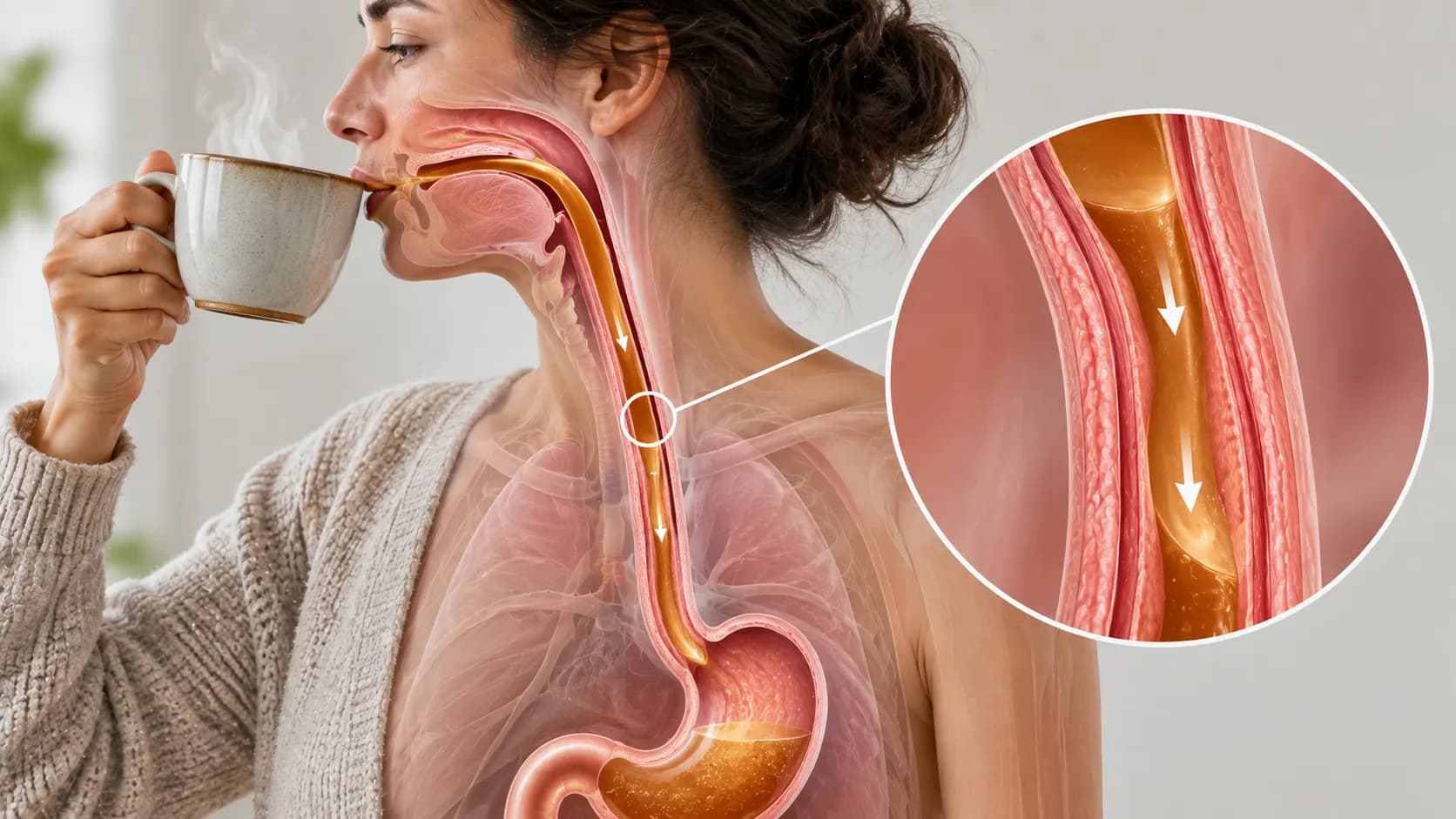
The oesophagus is the tube carrying food and drink from the mouth to the stomach. Very hot liquid travels directly across its lining. Repeated exposure could damage those cells, creating cycles of injury and repair that may contribute to cancer development over many years.
That mechanism is biologically plausible and supported by earlier experimental and observational evidence, but scientists still do not understand every step. The 2026 study itself shows an association; it cannot prove the biological mechanism in an individual person.
What Does 'Three Times the Risk' Actually Mean?
This is where a scary headline can become misleading.

Keep reading
Does Living by the Sea Really Improve Your Health?
Three times the risk is a relative comparison between groups. It does not mean three out of every ten people who drink very hot tea will develop this cancer.
Cancer Research UK notes that the lifetime risk of oesophageal squamous cell carcinoma in the UK is around 1%, which means it remains relatively uncommon. That 1% figure should not simply be multiplied by three to predict an individual's lifetime risk, because the study's relative risks and a population lifetime-risk estimate are not interchangeable in that way.
The sensible interpretation is that the relative difference observed was substantial, while the absolute chance for any one UK individual remains comparatively low.
Does the Number of Hot Drinks Matter Too?
The study found another interesting pattern. After accounting for reported temperature preference, people drinking six or more hot beverages per day had a 71% higher risk of squamous cell carcinoma than those drinking fewer than six.
This does not create a simple rule that five cups are safe and six are dangerous. Frequency and temperature are both imperfectly measured lifestyle exposures, and this remains observational research.
What it does suggest is that repeated exposure may matter, which fits with the proposed thermal-injury explanation.
Should You Stop Drinking Tea or Coffee?
For most people, that is not the lesson.
You can keep the drink and change the temperature. Cancer Research UK suggests allowing tea or coffee to cool a little before drinking it, particularly if it initially feels uncomfortably hot.
You do not need to carry a kitchen thermometer to the coffee shop. A practical habit is simply to avoid repeatedly drinking beverages while they still feel scalding or difficult to sip comfortably.

Hot Drinks Are Not the Biggest Risk Factor
Temperature deserves attention, but it should remain in proportion.
Cancer Research UK emphasizes that not smoking and reducing alcohol consumption are more important established ways to lower the risk of oesophageal squamous cell carcinoma.
An independent expert assessment of the new study made a similar point: the results provide strong evidence of an association, but normal hot drinks should not suddenly be portrayed as one of the dominant causes of oesophageal cancer.
When Symptoms Should Not Be Blamed on Your Tea
Difficulty swallowing, pain when swallowing or unexplained weight loss should not be dismissed as irritation from drinking something hot.
The NHS lists persistent swallowing problems, unexplained weight loss and worsening digestive symptoms among reasons to seek medical assessment. These symptoms have many possible causes and do not automatically mean cancer, but persistent or worsening symptoms deserve proper evaluation.
The Simplest Change Is Probably Enough
The new research does not turn tea and coffee into forbidden drinks. It strengthens a much narrower message that scientists have been investigating for years: repeatedly drinking beverages at very high temperatures may increase the risk of one form of oesophageal cancer.
The evidence still has limits. The UK study was observational, drink temperatures were self-reported, and researchers cannot yet give everyone a precise personal risk based on a thermometer reading.
Fortunately, the practical response does not require that level of precision. If a drink feels scalding, let it cool.
Your morning tea can remain your morning tea. It just does not need to burn on the way down.
Reference notes
Sources and further reading
- Visualize Jove (opens in a new tab)https://visualize.jove.com/42710538-hot-drinks-and-oesophageal-cancer-prospective-analyses-in-around-1-million-uk-adults
- News Cancerresearchuk (opens in a new tab)https://news.cancerresearchuk.org/2026/09/09/link-between-hot-drinks-and-type-of-oesophageal-cancer-in-the-uk/
- Sciencemediacentre (opens in a new tab)https://www.sciencemediacentre.org/expert-reaction-to-a-prospective-analysis-of-hot-drinks-and-oesophageal-cancer/
Show all 7 sources
- WHO (opens in a new tab)https://www.iarc.who.int/media-centre-iarc-news-drinking-very-hot-beverages/
- WHO (opens in a new tab)https://www.iarc.who.int/news-events/iarc-monographs-volume-116-evaluation-of-drinking-coffee-mate-and-very-hot-beverages/
- Biobank Ndph Ox Ac Uk (opens in a new tab)https://biobank.ndph.ox.ac.uk/ukb/pub.cgi?id=15261
- NHS (opens in a new tab)https://www.nhs.uk/conditions/oesophageal-cancer/symptoms/
Our editorial promise
Prepared with clarity and care.
This guide completed our editorial review before publishing. If something needs attention, report a correction or contact the publisher.
About this article
- Published:
- Last updated:
- Author:
- Ceyora Editorial Team
- Review status:
- Editorially reviewed
- Sources:
- 7
- Corrections:
- Report an issue