
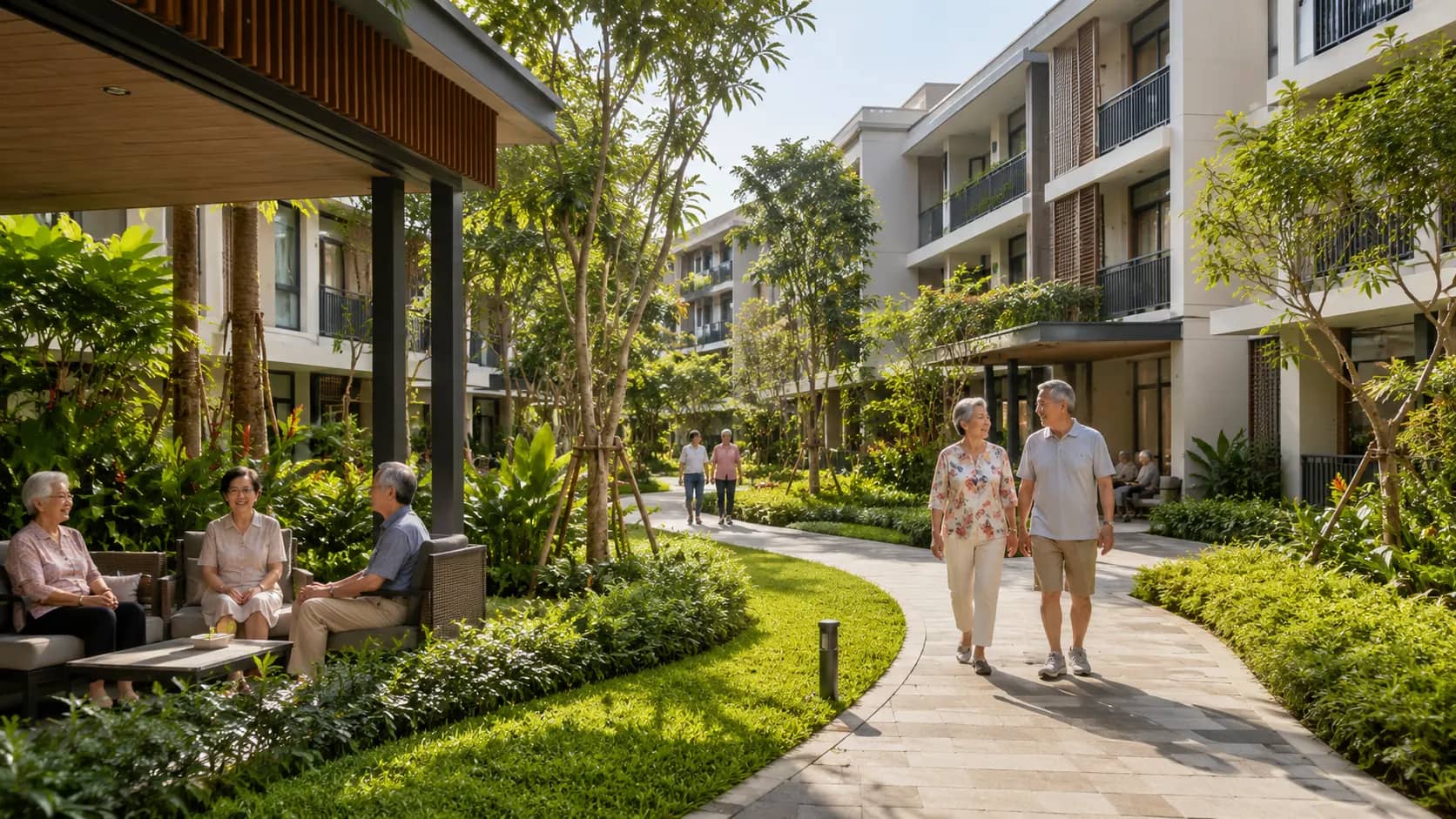
That is the idea behind Perennial Living at 28 Parry Avenue, which is being presented as Singapore's first private assisted-living development.
The concept sits between two familiar options: continuing to live independently at home and moving into a nursing home. Residents have their own apartments and lifestyle amenities, but support can be added as needs change.
The model is ambitious. It is also expensive. Perennial Living's current website advertises launch rates of approximately S$8,000 to S$13,600 a month for the first 40 assisted-living suites, subject to availability.
What Exactly Is Assisted Living?
Assisted living is easy to confuse with nursing-home care, but the two are not the same.
A nursing home is generally designed for people who need substantial ongoing help with daily activities, nursing support or closer medical supervision. Assisted living is intended to preserve more independence while making help easier to access.
That might mean living in your own apartment but having meals, housekeeping, social activities, emergency support and care services available without organising every provider separately.
Singapore's Ministry of Health and Urban Redevelopment Authority described the original Parry Avenue project as a housing-cum-care model intended to support seniors with different needs and allow them to continue living within the community as those needs change.
What Does S$8,000 a Month Actually Buy?
The S$8,000 figure needs context. It is a launch-special starting point rather than a universal price for every apartment.
Perennial Living currently advertises approximately S$8,000 to S$13,600 per month for the first 40 assisted-living suites. Earlier published pricing put standard basic packages higher, depending on apartment layout, floor and facing.
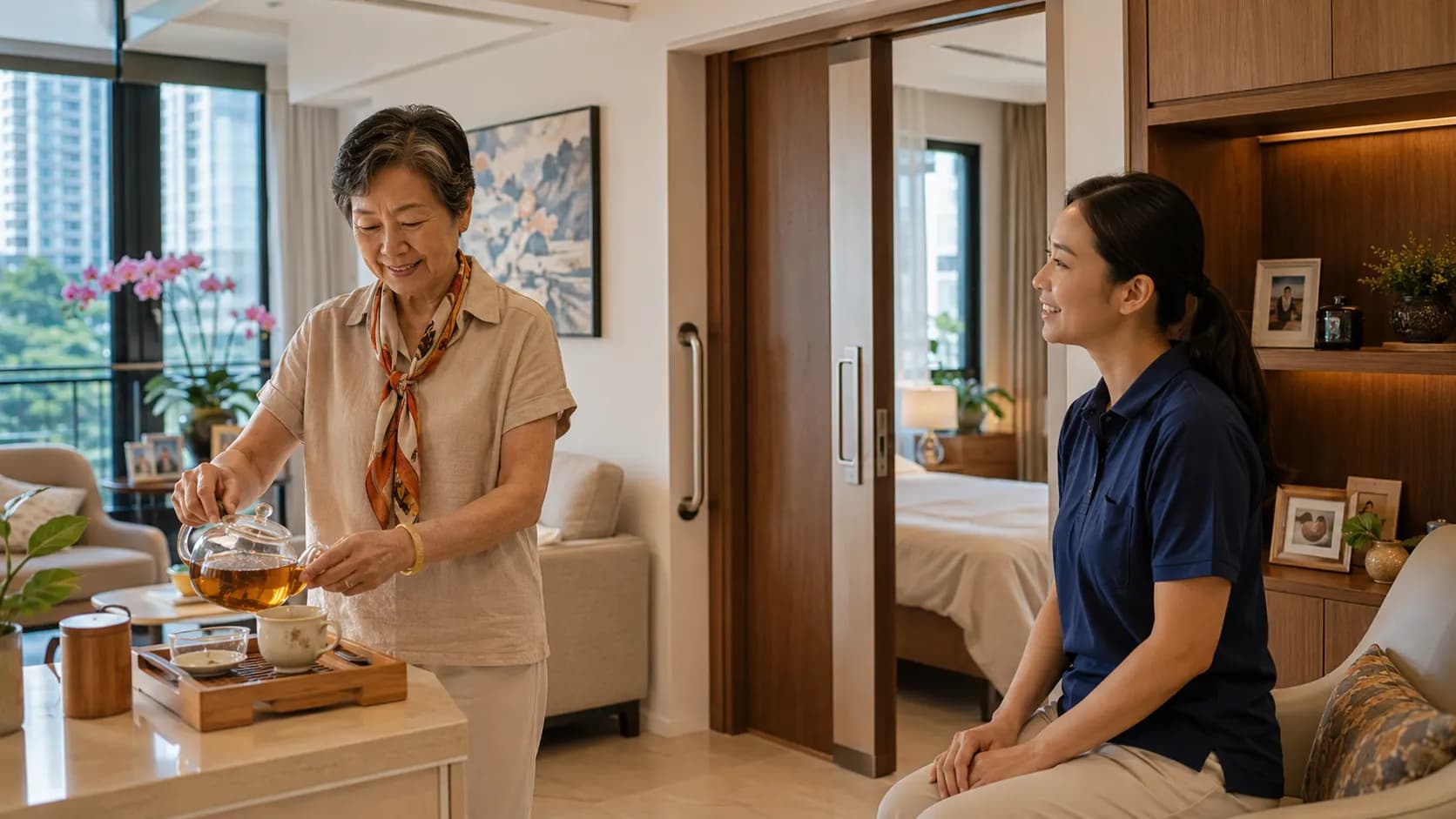
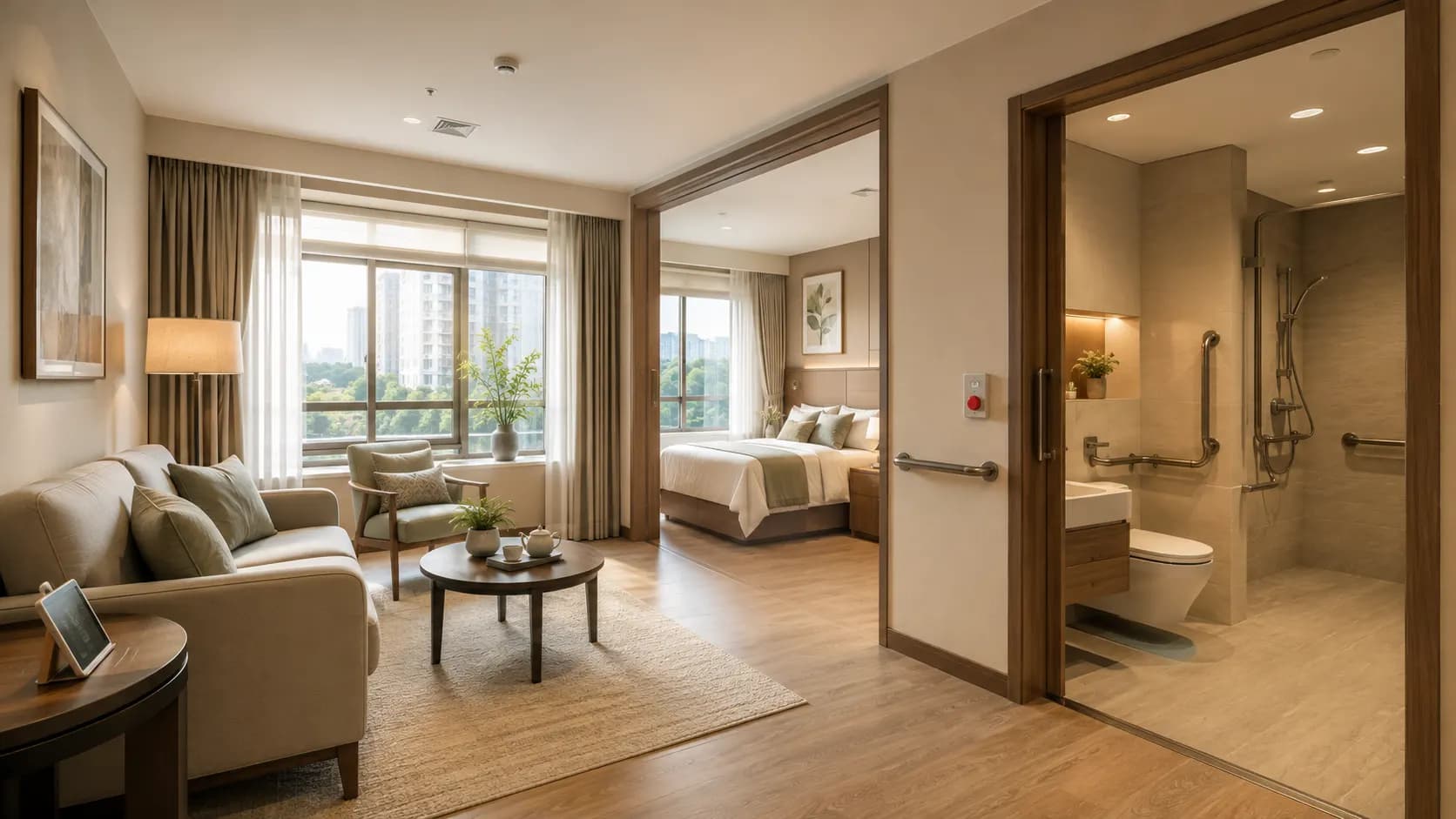
The apartments range from about 302 to 593 sq ft and include studios, one-bedroom and two-bedroom layouts. The operator also promotes private lift access, in-apartment dining, concierge services and senior-oriented safety technology.
A previously reported basic package included accommodation, regular cleaning, housekeeping and linen service, core meals, use of amenities and fitness equipment, and access to social and wellness activities. Families should still confirm exactly what today's quoted fee includes because care services and optional treatments may be charged separately.
The Technology Is Designed to Stay in the Background
The development lists features including a 24-hour emergency-response system, fall-detection technology, motion-sensitive ambient lighting and health-monitoring devices.
The useful idea is not technology for its own sake. It is that some monitoring and emergency support can be built into an ordinary-looking home rather than added only after a crisis.
Healthcare Is Built Into the Development
This is one of the biggest differences between Perennial Living and simply renting a luxury apartment designed for older adults.
Its on-site Perennial Wellness centre combines medical services, diagnostic care, rehabilitation, fitness and Traditional Chinese Medicine. The operator lists access to specialists across fields including geriatrics, cardiology, neurology, orthopaedics, endocrinology and respiratory medicine.
Rehabilitation services include conventional and robotics-assisted equipment, strength training and hydrotherapy. The development also promotes health monitoring and medical-concierge support.
Those offerings should be understood as services available within the development, not as evidence that every therapy offered has the same level of clinical evidence or will benefit every resident. Individual medical decisions still belong with appropriately qualified healthcare professionals.
Can Residents Stay as Their Health Needs Change?
The idea of ageing in place is central to the project.

Keep reading
Does Living by the Sea Really Improve Your Health?
The development combines 200 assisted-living apartments with 100 nursing-home beds. Perennial says residents whose care needs increase can transition from assisted living to nursing-home care within the same broader community.
That continuity may matter to families. A move into more intensive care can be disruptive, particularly when it also means leaving familiar surroundings, routines and relationships.
It is still important to ask how that transition works in practice: whether a nursing place is guaranteed, how fees change, what medical criteria apply and whether the resident can remain close to a spouse who needs a different level of care.
What If Someone Develops Dementia?
Perennial Living says some blocks are dedicated to residents living with mild to moderate dementia, with secure self-contained areas and personalised support.
The operator also describes cognitive-stimulation activities and non-drug interventions. These kinds of environments can be designed to reduce confusion, support routine and make daily life easier, but they should not be presented as treatments that reverse dementia.
For families considering dementia support, the practical questions are more important than the marketing language: staffing ratios, staff training, overnight supervision, wandering prevention, behaviour support, emergency procedures and what happens if dementia progresses beyond the level the assisted-living area can safely support.
Why Build It Inside an Ordinary Residential Neighbourhood?
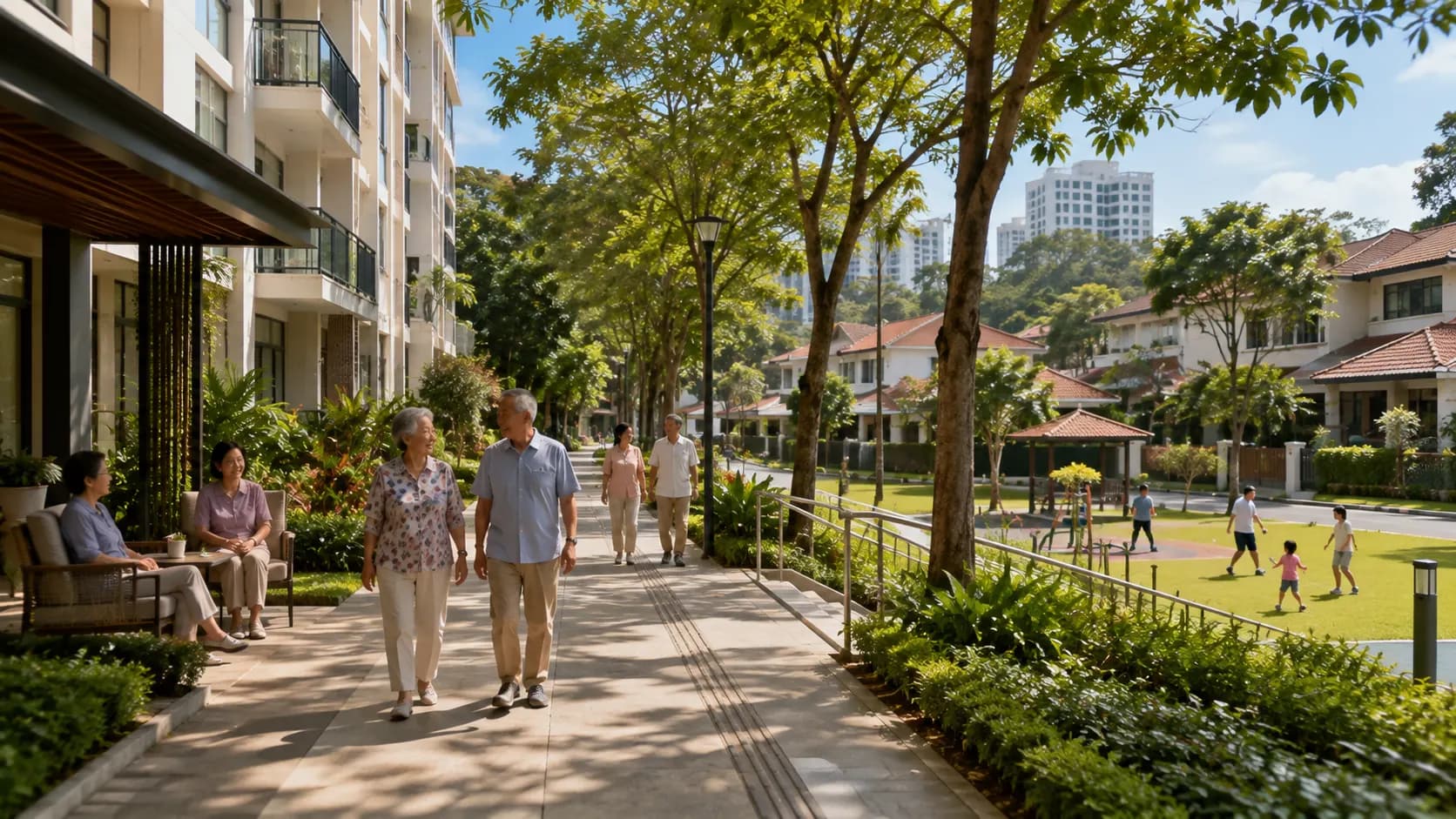
Parry Avenue sits within Rosyth Estate rather than on an isolated institutional campus.
That was deliberate. When the Government released the site, MOH and URA said the location was intended to help seniors remain independent within an established neighbourhood, close to shops, food and other amenities.
The site also adjoins a new neighbourhood park. Perennial's current materials describe a 1.5-hectare park integrated with the development.
The Bigger Question Is Who Can Afford It
The model may be interesting, but its pricing clearly places this particular development at the premium end of senior living.
A starting rate of around S$8,000 a month can exceed the housing costs of many households before optional care and medical services are added.
That means Perennial Living should not be presented as the solution to Singapore's wider eldercare affordability challenge. It is a private pilot serving a particular part of the market.
Its wider importance may come from what Singapore learns from it: which services residents actually value, whether people prefer a housing-plus-care model to staying at home, how well different care levels can coexist, and whether future developments can borrow useful ideas at lower price points.
What Should Families Compare Before Choosing Assisted Living?
The monthly headline price is only one part of the decision. Families comparing assisted-living options should ask what happens after a resident actually moves in.
Ask exactly what the monthly package includes and which medical, nursing, rehabilitation or personal-care services cost extra.
Check how much assistance is available overnight and how quickly staff responds to falls or emergencies.
Understand what happens if the resident develops dementia, loses mobility or begins needing help with more daily activities.
Ask whether transition to nursing care is guaranteed or dependent on assessment and bed availability.
Compare apartment size and amenities with the resident's actual needs rather than assuming more luxury automatically means better care.
Check contract length, notice periods, fee increases, deposits and what happens during a hospital stay.
Consider whether the location makes it easy for family and friends to continue visiting regularly.
Is This the Future of Ageing in Singapore?
Probably not in this exact form for everyone.
Singapore already has other approaches, including public Community Care Apartments and services that help seniors remain in their existing homes. Private assisted living adds another option rather than replacing those models.
What makes Parry Avenue worth watching is the combination: a private home, hospitality, social life, medical services, rehabilitation and a route into nursing care within one development.
If that arrangement proves attractive to residents and families, the most important legacy may not be the marble finishes, private lifts or concierge service. It may be the idea that ageing does not have to involve an abrupt jump from complete independence to institutional care.
Reference notes
Sources and further reading
- Perennialliving (opens in a new tab)https://www.perennialliving.com.sg/
- Perennialholdings (opens in a new tab)https://www.perennialholdings.com/parry_assisted_living_care.html
- Moh (opens in a new tab)https://www.moh.gov.sg/newsroom/tender-launch-of-site-at-parry-avenue-for-private-assisted-living-development/
Show all 7 sources
- Moh (opens in a new tab)https://www.moh.gov.sg/newsroom/award-of-tender-for-site-at-parry-avenue-for-private-assisted-living-development/
- Moh (opens in a new tab)https://www.moh.gov.sg/newsroom/assisted-living-developments-will-support-seniors-with-different-care-needs/
- Straitstimes (opens in a new tab)https://www.straitstimes.com/singapore/housing/singapores-first-260-million-private-assisted-living-project-to-open-by-q1-2026
- Straitstimes (opens in a new tab)https://www.straitstimes.com/singapore/housing/if-singapores-first-private-luxury-senior-housing-takes-off-will-more-developers-get-in-this-space
Our editorial promise
Prepared with clarity and care.
This guide completed our editorial review before publishing. If something needs attention, report a correction or contact the publisher.
About this article
- Published:
- Last updated:
- Author:
- Ceyora Editorial Team
- Review status:
- Editorially reviewed
- Sources:
- 7
- Corrections:
- Report an issue